
Free NCERT Solutions for Class 12 Maths Chapter 8 Application of Integrals solved by Expert Teachers as per NCERT (CBSE) Book guidelines and brought to you by CBSE Learning. These Application of Integrals Exercise Questions with Solutions for Class 12 Maths covers all questions of Chapter Application of Integrals Class 12 and help you to revise complete Syllabus and Score More marks as per CBSE Board guidelines from the latest NCERT book for class 12 maths. You can read and download NCERT Book Solution to get a better understanding of all topics and concepts
8.1 Introduction
8.2 Area under Simple Curves
8.2.1 The area of the region bounded by a curve and a line
8.3 Area between Two Curves.
Application of Integrals NCERT Solutions – Class 12 Maths
Exercise 8.1 : Solutions of Questions on Page Number : 365
Q1 : Find the area of the region bounded by the curve y2 = x and the lines x = 1, x = 4 and the x-axis.
Answer :
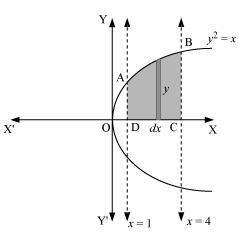
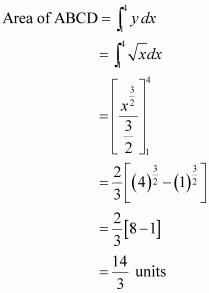
The area of the region bounded by the curve, y2 = x, the lines,x = 1 and x = 4, and the x-axis is the area ABCD.
Q2 : Find the area of the region bounded by y2 = 9x, x = 2, x = 4 and the x-axis in the first quadrant.
Answer :
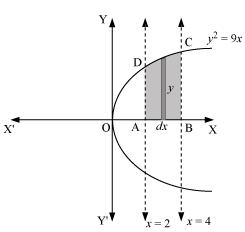
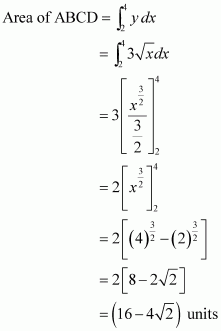
The area of the region bounded by the curve, y2 = 9x, x = 2, and x = 4, and the x-axis is the area ABCD.
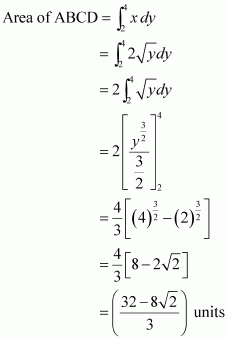
Q3 : Find the area of the region bounded by x2 = 4y, y = 2, y = 4 and the y-axis in the first quadrant.
Answer :
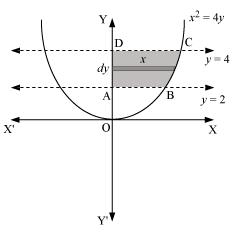
The area of the region bounded by the curve, x2 = 4y, y = 2, and y = 4, and the y-axis is the area ABCD.
Q4 : Find the area of the region bounded by the ellipse
Answer :
The given equation of the ellipse, , can be represented as
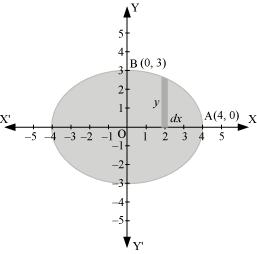
It can be observed that the ellipse is symmetrical about x-axis and y-axis.
∴ Area bounded by ellipse = 4 × Area of OAB
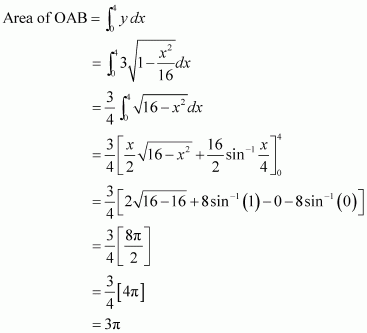
Therefore, area bounded by the ellipse = 4 × 3π = 12π units
Q5 : Find the area of the region bounded by the ellipse
Answer :
The given equation of the ellipse can be represented as
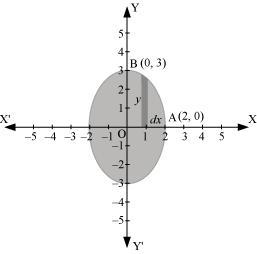
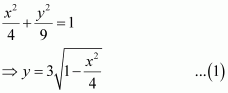
It can be observed that the ellipse is symmetrical about x-axis and y-axis.
∴ Area bounded by ellipse = 4 × Area OAB
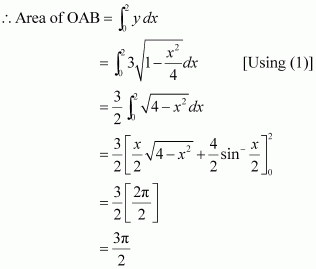
Therefore, area bounded by the ellipse =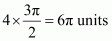
Q6 : Find the area of the region in the first quadrant enclosed by x-axis, line and the circle
Answer:
The area of the region bounded by the circle, ,  and the x-axis is the area OAB.
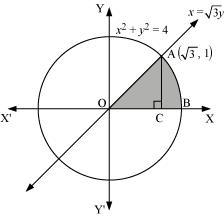
The point of intersection of the line and the circle in the first quadrant is  .
.
Area OAB = Area ΔOCA + Area ACB
Area of OAC
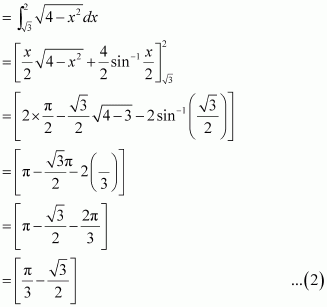
Area of ABC

Q7 : Find the area of the smaller part of the circle x2 + y2 = a2 cut off by the line
Answer :
The area of the smaller part of the circle, x2 + y2 = a2, cut off by the line, , is the area ABCDA.
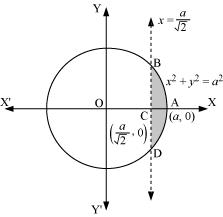
It can be observed that the area ABCD is symmetrical about x-axis.
∴ Area ABCD = 2 × Area ABC
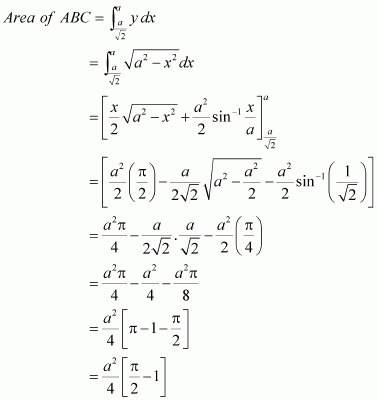

Therefore, the area of smaller part of the circle, x2 + y2 = a2, cut off by the line, is  units.
Q8 : The area between x = y2 and x = 4 is divided into two equal parts by the line x = a, find the value of a.
Answer :
The line, x = a, divides the area bounded by parabola and x = 4 into two equal parts.
∴ Area OAD = Area ABCD
∴ Area OAD = Area ABCD
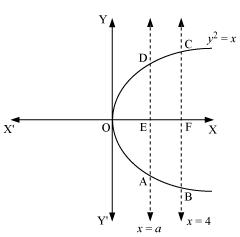
It can be observed that the given area is symmetrical about x-axis.
⇒ Area OED = Area EFCD
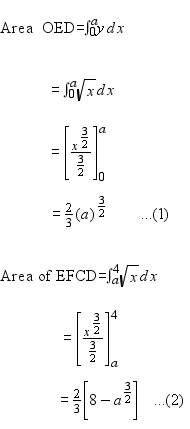
From (1) and (2), We obtain,
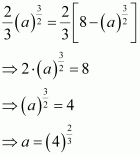
Therefore,the value of a is 
Q9 : Find the area of the region bounded by the parabola y = x2 and
Answer :
The area bounded by the parabola, x2 = y, and the line,, can be represented as
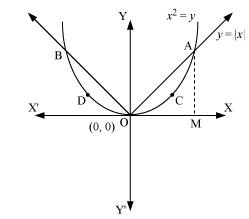
The given area is symmetrical about y-axis.
∴ Area OACO = Area ODBO
The point of intersection of parabola, x2 = y, and line, y = x, is A (1, 1).
Area of OACO = Area ΔOAM – Area OMACO
Area of ΔOAM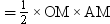
Area of OMACO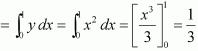
⇒ Area of OACO = Area of ΔOAM – Area of OMACO

Therefore, required area =  units
units
Q10 : Find the area bounded by the curve x2 = 4y and the line x = 4y – 2
Answer :
The area bounded by the curve, x2 = 4y, and line, x = 4y – 2, is represented by the shaded area OBAO.
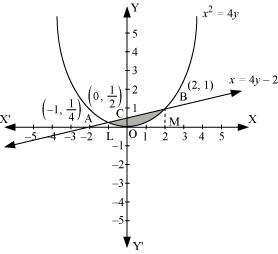
Let A and B be the points of intersection of the line and parabola.
Coordinates of point .
.
Coordinates of point B are (2, 1).
We draw AL and BM perpendicular to x-axis.
It can be observed that,
Area OBAO = Area OBCO + Area OACO … (1)
Then, Area OBCO = Area OMBC – Area OMBO
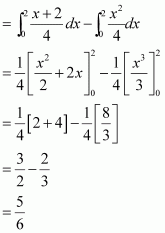
Similarly, Area OACO = Area OLAC – Area OLAO
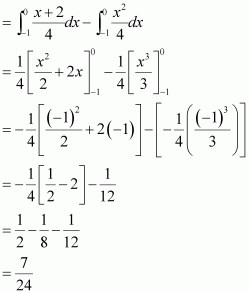
Therefore, required area =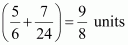
Q11 : Find the area of the region bounded by the curve y2 = 4x and the line x = 3
Answer :
The region bounded by the parabola, y2 = 4x, and the line, x = 3, is the area OACO.
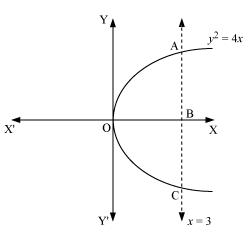
The area OACO is symmetrical about x-axis.
∴ Area of OACO = 2 (Area of OAB)
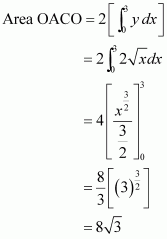
Therefore, the required area is units.
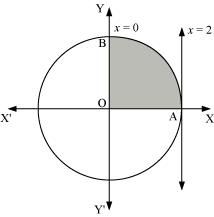
Q12 : Area lying in the first quadrant and bounded by the circle x2 + y2 = 4 and the lines x = 0 and x = 2 is
A. π
B.
C.
D.
Answer :
The area bounded by the circle and the lines, x = 0 and x = 2, in the first quadrant is represented as
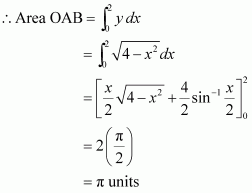
Thus, the correct answer is A.
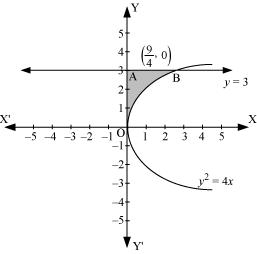
Q13 : Area of the region bounded by the curve y2 = 4x, y-axis and the line y = 3 is
A. 2
B.
C.
D.
Answer :
The area bounded by the curve, y2 = 4x, y-axis, and y = 3 is represented as
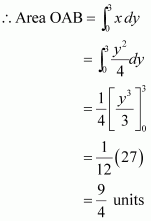
Thus, the correct answer is B.
Exercise 8.2 : Solutions of Questions on Page Number : 371
Q1 : Find the area of the circle 4x2 + 4y2 = 9 which is interior to the parabola x2 = 4y
Answer :
The required area is represented by the shaded area OBCDO.
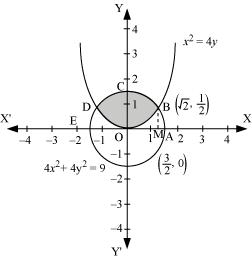
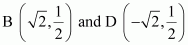
Solving the given equation of circle, 4x2 + 4y2 = 9, and parabola, x2 = 4y, we obtain the point of intersection as.
It can be observed that the required area is symmetrical about y-axis.
∴ Area OBCDO = 2 × Area OBCO
We draw BM perpendicular to OA.
Therefore, the coordinates of M are .
.
Therefore, Area OBCO = Area OMBCO – Area OMBO
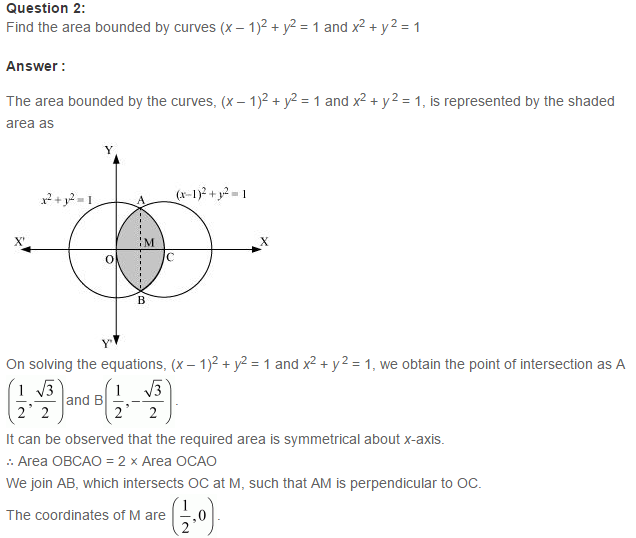
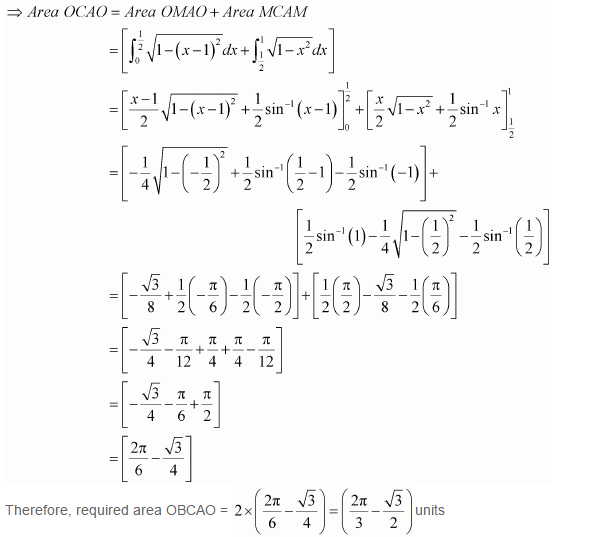
Q3 : Find the area of the region bounded by the curves y = x2 + 2, y = x, x = 0 and x = 3
Answer :
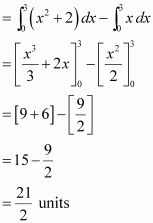
The area bounded by the curves, y = x2 + 2, y = x, x = 0, and x = 3, is represented by the shaded area OCBAO as
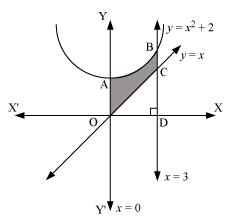
Then, Area OCBAO = Area ODBAO – Area ODCO
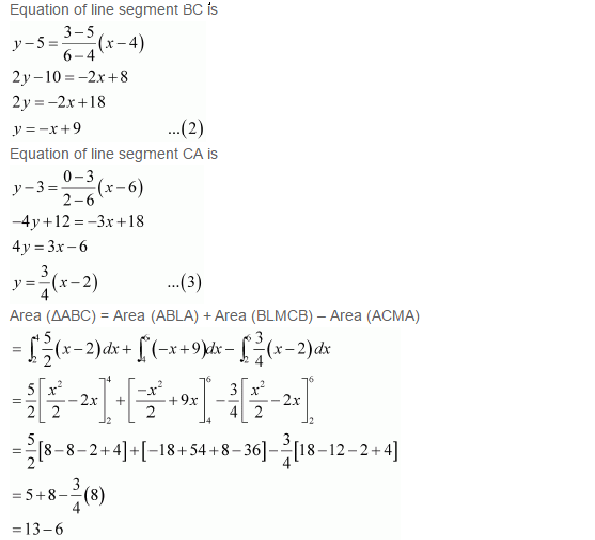
Q4 : Using integration finds the area of the region bounded by the triangle whose vertices are (-1, 0), (1, 3) and (3, 2).
Answer :
BL and CM are drawn perpendicular to x-axis.
It can be observed in the following figure that,
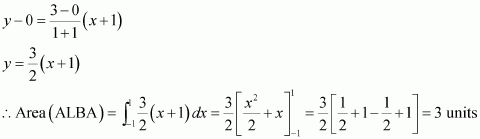
Area (ΔACB) = Area (ALBA) + Area (BLMCB) – Area (AMCA) … (1)
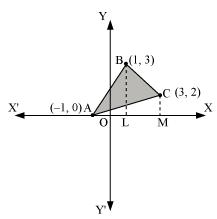
Equation of line segment AB is
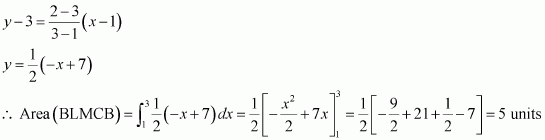
Equation of line segment BC is
Equation of line segment AC is
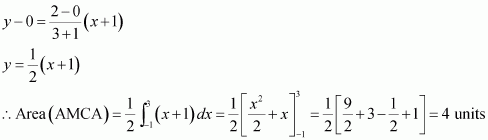
Therefore, from equation (1), we obtain
Area (ΔABC) = (3 + 5 – 4) = 4 units
Q5 : Using integration find the area of the triangular region whose sides have the equations y = 2x +1, y = 3x + 1 and x = 4.
Answer :
The equations of sides of the triangle are y = 2x +1, y = 3x + 1, and x = 4.
On solving these equations, we obtain the vertices of triangle as A(0, 1), B(4, 13), and C (4, 9).
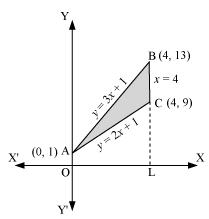
It can be observed that,
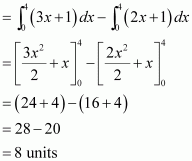
Area (ΔACB) = Area (OLBAO) – Area (OLCAO)
Q6 : Smaller area enclosed by the circle x2 + y2 = 4 and the line x + y = 2 is
A. 2 (π – 2)
B. π – 2
C. 2π – 1
D. 2 (π + 2)
Answer :
The smaller area enclosed by the circle, x2 + y2 = 4, and the line, x + y = 2, is represented by the shaded area ACBA as
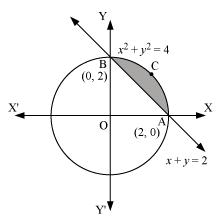
It can be observed that,
Area ACBA = Area OACBO – Area (ΔOAB)
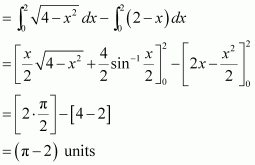
Thus, the correct answer is B.
Q7 : Area lying between the curve y2 = 4x and y = 2x is
A.
B.
C.
D.
Answer :
The area lying between the curve, y2 = 4x and y = 2x, is represented by the shaded area OBAO as
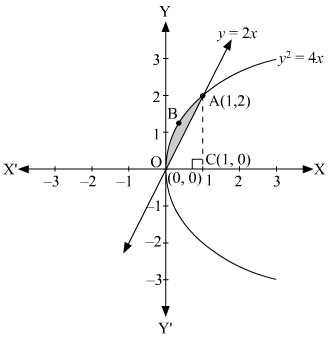
The points of intersection of these curves are O (0, 0) and A (1, 2).
We draw AC perpendicular to x-axis such that the coordinates of C are (1, 0).
∴ Area OBAO = Area (OCABO) – Area (ΔOCA)
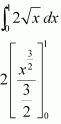

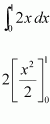

 square units
Thus, the correct answer is B.
Exercise Miscellaneous : Solutions of Questions on Page Number : 375
Q1 : Find the area under the given curves and given lines:
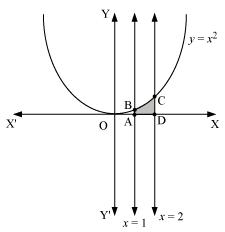
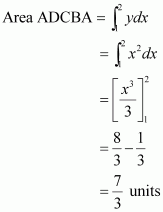
(i) y = x2, x = 1, x = 2 and x-axis
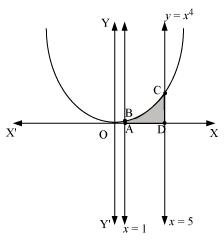
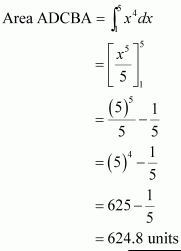
(ii) y = x4, x = 1, x = 5 and x -axis
Answer :
The required area is represented by the shaded area ADCBA as
The required area is represented by the shaded area ADCBA as
Q2 : Find the area between the curves y = x and y = x2
Answer :
The required area is represented by the shaded area OBAO as
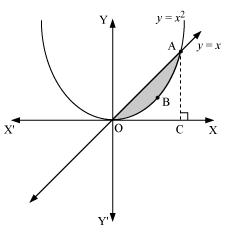
The points of intersection of the curves, y = x and y = x2, is A (1, 1).
We draw AC perpendicular to x-axis.
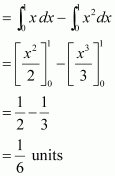
∴ Area (OBAO) = Area (ΔOCA) – Area (OCABO) … (1)
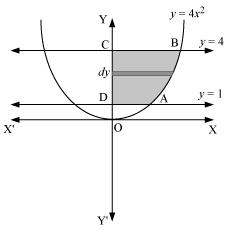
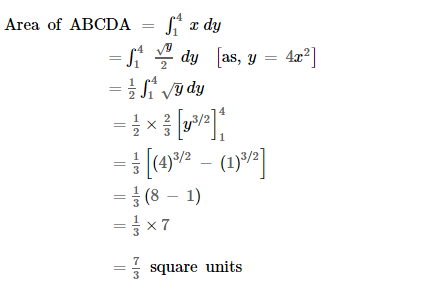
Q3 : Find the area of the region lying in the first quadrant and bounded by y = 4x2, x = 0, y = 1 and y = 4
Answer :
The area in the first quadrant bounded by y = 4x2, x = 0, y = 1, and y = 4 is represented by the shaded area ABCDA as
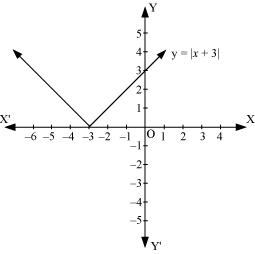
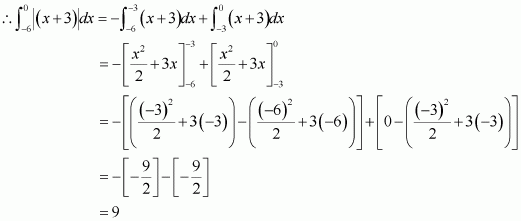
Q4 : Sketch the graph of and evaluate
Answer :
The given equation is The corresponding values of x and y are given in the following table.
| x | -6 | -5 | – 4 | -3 | -2 | – 1 | 0 |
| y | 3 | 2 | 1 | 0 | 1 | 2 | 3 |
On plotting these points, we obtain the graph of
 as follows.
It is known that,
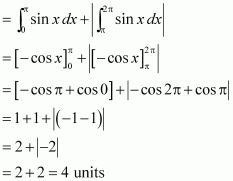
Q5 : Find the area bounded by the curve y = sin x between x = 0 and x = 2π
Answer :
The graph of y = sin x can be drawn as
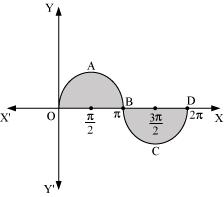
∴ Required area = Area OABO + Area BCDB
Q6 : Find the area enclosed between the parabola y2 = 4ax and the line y = mx
Answer :
The area enclosed between the parabola, y2 = 4ax, and the line, y = mx, is represented by the shaded area OABO as
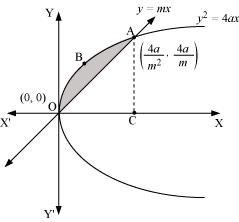
The points of intersection of both the curves are (0, 0) and .
.
We draw AC perpendicular to x-axis.
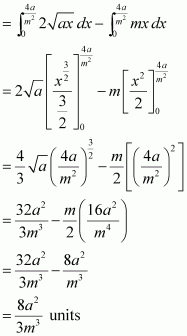
∴ Area OABO = Area OCABO – Area (ΔOCA)
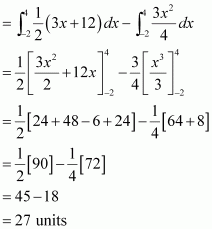
Q7 : Find the area enclosed by the parabola 4y = 3x2 and the line 2y = 3x + 12
Answer :
The area enclosed between the parabola, 4y = 3x2, and the line, 2y = 3x + 12, is represented by the shaded area OBAO as
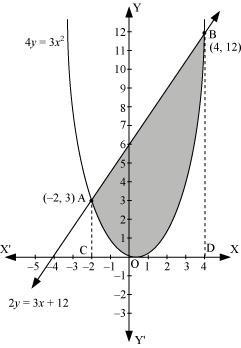
The points of intersection of the given curves are A (-2, 3) and (4, 12).
We draw AC and BD perpendicular to x-axis.
∴ Area OBAO = Area CDBA – (Area ODBO + Area OACO)
Q8 : Find the area of the smaller region bounded by the ellipse and the line
Answer :
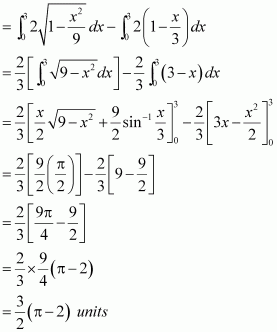
The area of the smaller region bounded by the ellipse, , and the line, , is represented by the shaded region BCAB as
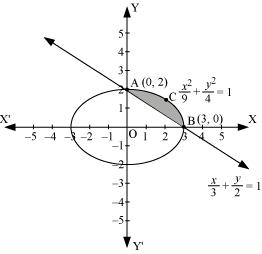
∴ Area BCAB = Area (OBCAO) – Area (OBAO)
Q9 : Find the area of the smaller region bounded by the ellipse and the line
Answer :
The area of the smaller region bounded by the ellipse, , and the line, , is represented by the shaded region BCAB as
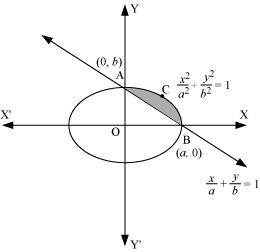
∴ Area BCAB = Area (OBCAO) – Area (OBAO)
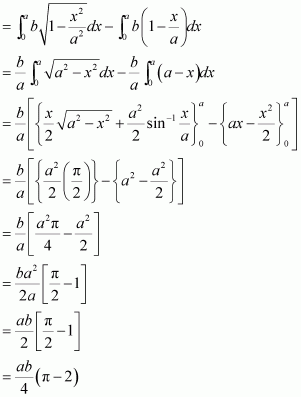
Q10 : Find the area of the region enclosed by the parabola x2 = y, the line y = x + 2 and x-axis
Answer :
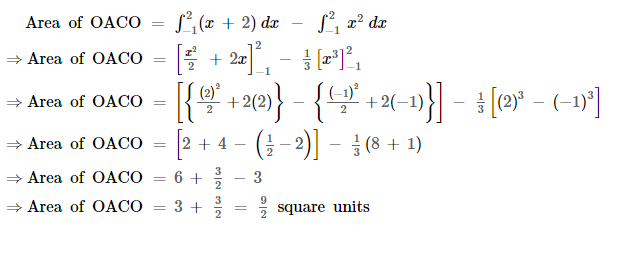
The area of the region enclosed by the parabola, x2 = y, the line, y = x + 2, and x-axis is represented by the shaded region OACO as
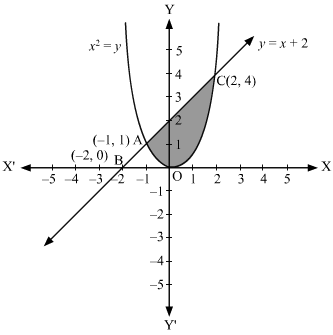
The point of intersection of the parabola, x2 = y, and the line, y = x + 2, is A (-1, 1) and C(2, 4).
Q11 : Using the method of integration find the area bounded by the curve
[Hint: the required region is bounded by lines x + y = 1, x – y = 1, – x + y = 1 and – x – y = 11]
Answer :
The area bounded by the curve, , is represented by the shaded region ADCB as
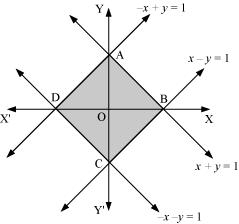
The curve intersects the axes at points A (0, 1), B (1, 0), C (0, -1), and D (-1, 0).
It can be observed that the given curve is symmetrical about x-axis and y-axis.
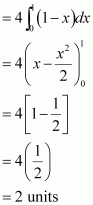
∴ Area ADCB = 4 × Area OBAO
Q12 : Find the area bounded by curves
Answer :
The area bounded by the curves, , is represented by the shaded region as
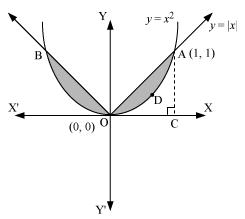
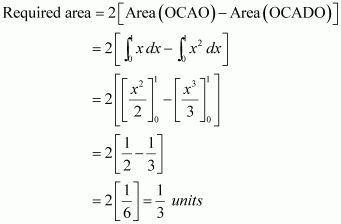
It can be observed that the required area is symmetrical about y-axis.
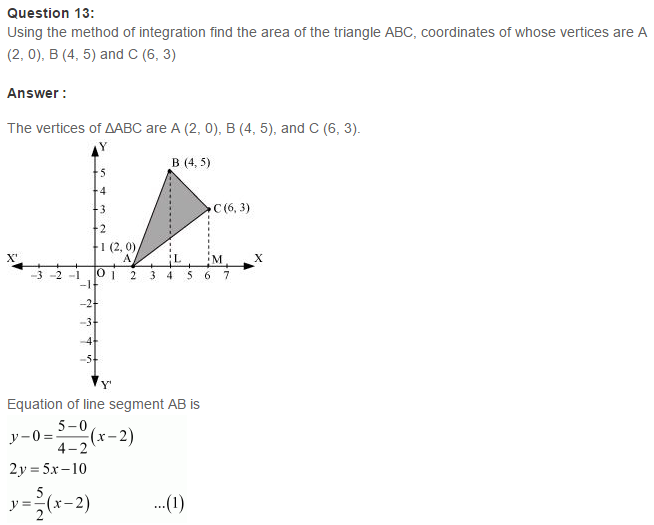
= 7 units
Q14 : Using the method of integration find the area of the region bounded by lines:
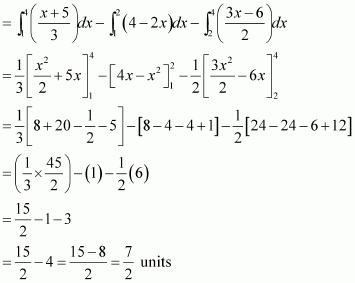
2x + y = 4, 3x – 2y = 6 and x – 3y + 5 = 0
Answer :
The given equations of lines are
2x + y = 4 … (1)
3x – 2y = 6 … (2)
And, x – 3y + 5 = 0 … (3)
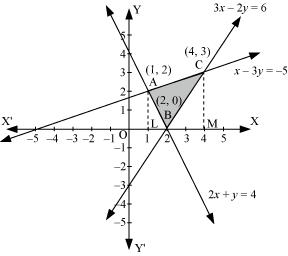
The area of the region bounded by the lines is the area of ΔABC. AL and CM are the perpendiculars on x-axis.
Area (ΔABC) = Area (ALMCA) – Area (ALB) – Area (CMB)
Q15 : Find the area of the region Answer :
The area bounded by the curves, , is represented as
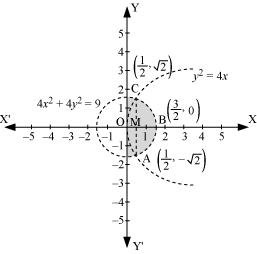
The points of intersection of both the curves are.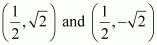
The required area is given by OABCO.
It can be observed that area OABCO is symmetrical about x-axis.
∴ Area OABCO = 2 × Area OBC
Area OBCO = Area OMC + Area MBC
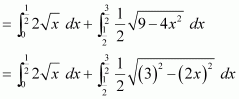
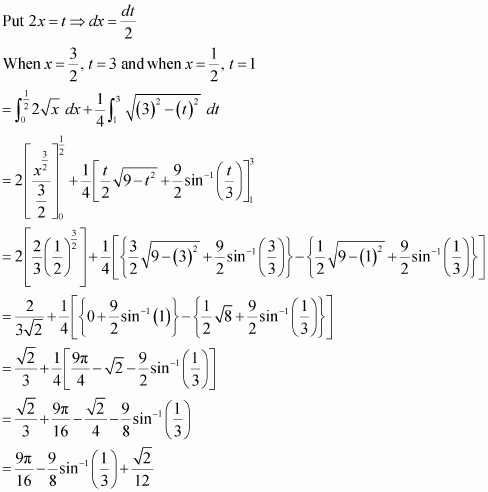
Therefore, the required area is units
Q16 : Area bounded by the curve y = x3, the x-axis and the ordinates x = -2 and x = 1 is
A. – 9
B.
C.
D.
Answer :
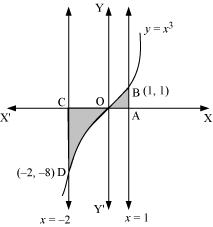
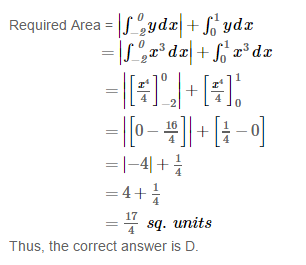
Q17 : The area bounded by the curve , x-axis and the ordinates x = -1 and x = 1 is given by
[Hint: y = x2 if x > 0 and y = -x2 if x < 0]
A. 0
B.
C.
D.
Answer :
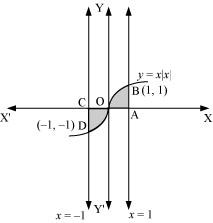
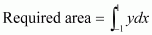
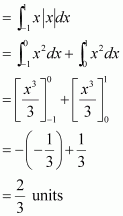
Thus, the correct answer is C.
Q18 : The area of the circle x2 + y2 = 16 exterior to the parabola y2 = 6x is
A.
B.
C.
D.
Answer :
The given equations are
x2 + y2 = 16 … (1)
y2 = 6x … (2)
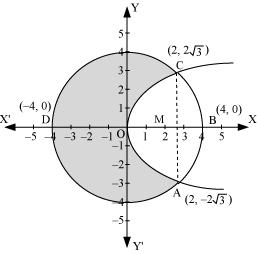
Area bounded by the circle and parabola
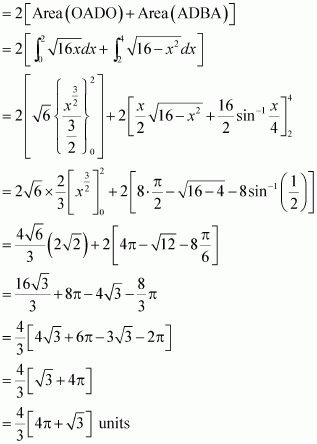
Area of circle = π (r)2
= π (4)2
= 16π units
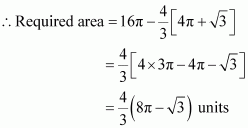
Thus, the correct answer is C.
Q19 : The area bounded by the y-axis, y = cos x and y = sin x when
A.
B.
C.
D.
Answer :
The given equations are
y = cos x … (1)
And, y = sin x … (2)
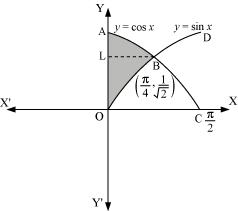
Required area = Area (ABLA) + area (OBLO)
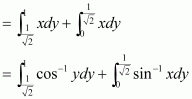
Integrating by parts, we obtain
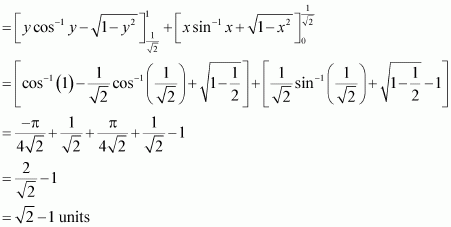
Thus, the correct answer is B.