
Exercise 11.1 : Solutions of Questions on Page Number : 467
Q1 : If a line makes angles 90°, 135°, 45° with x, y and z-axes respectively, find its direction cosines.
Answer :
Let direction cosines of the line be l, m, and n.
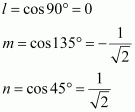
Therefore, the direction cosines of the line are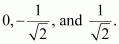
Q2 : Find the direction cosines of a line which makes equal angles with the coordinate axes.
Answer :
Let the direction cosines of the line make an angle α with each of the coordinate axes.
∴ l= cos α, m = cos α, n = cos α
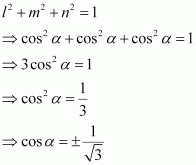
Thus, the direction cosines of the line, which is equally inclined to the coordinate axes, are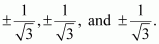
Q3 : If a line has the direction ratios -18, 12, -4, then what are its direction cosines?
Answer :
If a line has direction ratios of – 18, 12, and – 4, then its direction cosines are
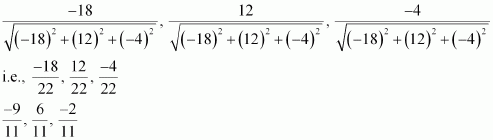
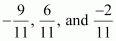
Thus, the direction cosines are.
Q4 : Show that the points (2, 3, 4), (-1, -2, 1), (5, 8, 7) are collinear.
Answer :
The given points are A (2, 3, 4), B (- 1, – 2, 1), and C (5, 8, 7).
It is known that the direction ratios of line joining the points, (x1, y1, z1) and (x2, y2, z2), are given by, x2 – x1, y2 – y1, and z2 – z1.
The direction ratios of AB are (-1 – 2), (-2 – 3), and (1 – 4) i.e., -3, -5, and -3.
The direction ratios of BC are (5 – (- 1)), (8 – (- 2)), and (7 – 1) i.e., 6, 10, and 6.
It can be seen that the direction ratios of BC are -2 times that of AB i.e., they are proportional.
Therefore, AB is parallel to BC. Since point B is common to both AB and BC, points A, B, and C are collinear.
Q5 : Find the direction cosines of the sides of the triangle whose vertices are (3, 5, – 4), (- 1, 1, 2) and (- 5, – 5, – 2)
Answer :
The vertices of ΔABC are A (3, 5, – 4), B ( – 1, 1, 2), and C ( – 5, – 5, – 2).
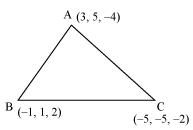
The direction ratios of side AB are ( – 1 – 3), (1 – 5), and (2 – ( – 4)) i.e., – 4, – 4, and 6.
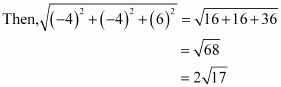
Therefore, the direction cosines of AB are
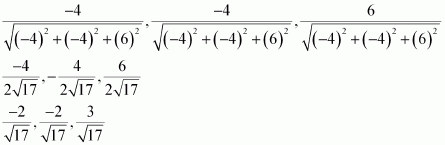
The direction ratios of BC are ( – 5 – ( – 1)), ( – 5 – 1), and ( – 2 – 2) i.e., – 4, – 6, and – 4.
Therefore, the direction cosines of BC are
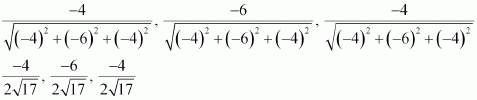
Exercise 11.2 : Solutions of Questions on Page Number : 477
Q1 : Show that the three lines with direction cosines are mutually perpendicular.
Answer :
Two lines with direction cosines, l1, m1, n1 and l2, m2, n2, are perpendicular to each other, if l1l2 + m1m2 + n1n2 = 0
(i) For the lines with direction cosines, and
and , we obtain
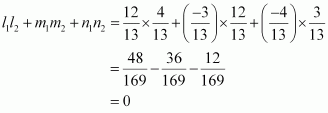
Therefore, the lines are perpendicular.
(ii) For the lines with direction cosines, and , we obtain
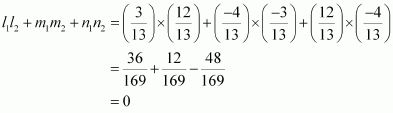
Therefore, the lines are perpendicular.
(iii) For the lines with direction cosines, and , we obtain
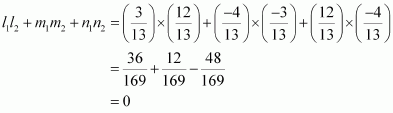
Therefore, the lines are perpendicular.
Thus, all the lines are mutually perpendicular.
Q2 : Show that the line through the points (1, -1, 2) (3, 4, -2) is perpendicular to the line through the points (0, 3, 2) and (3, 5, 6).
Answer :
Let AB be the line joining the points, (1, -1, 2) and (3, 4, – 2), and CD be the line joining the points, (0, 3, 2) and (3, 5, 6).
The direction ratios, a1, b1, c1, of AB are (3 – 1), (4 – (-1)), and (-2 – 2) i.e., 2, 5, and -4.
The direction ratios, a2, b2, c2, of CD are (3 – 0), (5 – 3), and (6 -2) i.e., 3, 2, and 4.
AB and CD will be perpendicular to each other, if a1a2 + b1b2+ c1c2 = 0
a1a2 + b1b2+ c1c2 = 2 x 3 + 5 x 2 + (- 4) x 4
= 6 + 10 – 16
= 0
Therefore, AB and CD are perpendicular to each other.
Q3 : Show that the line through the points (4, 7, 8) (2, 3, 4) is parallel to the line through the points (-1, -2, 1), (1, 2, 5).
Answer :
Let AB be the line through the points, (4, 7, 8) and (2, 3, 4), and CD be the line through the points, ( – 1, – 2, 1) and (1, 2, 5).
The directions ratios, a1, b1, c1, of AB are (2 – 4), (3 – 7), and (4 – 8) i.e., – 2, – 4, and – 4.
The direction ratios, a2, b2, c2, of CD are (1 – ( – 1)), (2 – ( – 2)), and (5 – 1) i.e., 2, 4, and 4.
AB will be parallel to CD, if


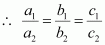 Thus, AB is parallel to CD.
Q4 : Find the equation of the line which passes through the point (1, 2, 3) and is parallel to the vector .
.
Answer :
It is given that the line passes through the point A (1, 2, 3). Therefore, the position vector through A is
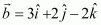
It is known that the line which passes through point A and parallel to is given by
 is a constant.

This is the required equation of the line.
Q5 : Find the equation of the line in vector and in Cartesian form that passes through the point with position vector and is in the direction
  .
.
Answer :
It is given that the line passes through the point with position vector


It is known that a line through a point with position vector and parallel to is given by the equation,

This is the required equation of the line in vector form.
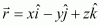

Eliminating λ, we obtain the Cartesian form equation as
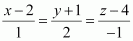
This is the required equation of the given line in Cartesian form.
Q6 : Find the Cartesian equation of the line which passes through the point( – 2, 4, – 5) and parallel to the line given by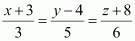
Answer :
It is given that the line passes through the point ( – 2, 4, – 5) and is parallel to
The direction ratios of the line, , are 3, 5, and 6.
The required line is parallel to
Therefore, its direction ratios are 3k, 5k, and 6k, where k ≠ 0
It is known that the equation of the line through the point (x1, y1, z1) and with direction ratios, a, b, c, is given by
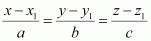
Therefore the equation of the required line is
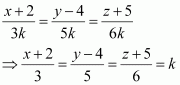
Q7 : The Cartesian equation of a line is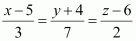 . Write its vector form.
Answer :
The Cartesian equation of the line is

The given line passes through the point (5, – 4, 6). The position vector of this point is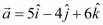
Also, the direction ratios of the given line are 3, 7, and 2.
This means that the line is in the direction of vector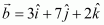 ,
,
It is known that the line through position vector and in the direction of the vector is given by the equation,
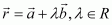

This is the required equation of the given line in vector form.
Q8 : Find the vector and the Cartesian equations of the lines that pass through the origin and (5, -2, 3).
Answer :
The required line passes through the origin. Therefore, its position vector is given by,

The direction ratios of the line through origin and (5, – 2, 3) are
(5 – 0) = 5, ( – 2 – 0) = – 2, (3 – 0) = 3
The line is parallel to the vector given by the equation,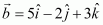
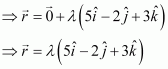
The equation of the line in vector form through a point with position vector and parallel to is,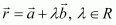
The equation of the line through the point (x1, y1, z1) and direction ratios a, b, c is given by,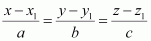
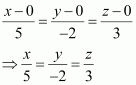
Therefore, the equation of the required line in the Cartesian form is
Q9 : Find the vector and the Cartesian equations of the line that passes through the points (3, -2, -5), (3, -2, 6).
Answer :
Let the line passing through the points, P (3, – 2, – 5) and Q (3, – 2, 6), be PQ.
Since PQ passes through P (3, – 2, – 5), its position vector is given by,
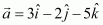
The direction ratios of PQ are given by,
(3 – 3) = 0, ( – 2 + 2) = 0, (6 + 5) = 11
The equation of the vector in the direction of PQ is

The equation of PQ in vector form is given by,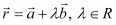
 The equation of PQ in Cartesian form is
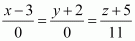
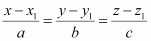 i.e.,
i.e.,
Q10 : Find the angle between the following pairs of lines:
(i)

(ii) and
and

Answer :
(i) Let Q be the angle between the given lines.
The angle between the given pairs of lines is given by,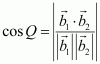
The given lines are parallel to the vectors,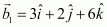
and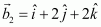
, respectively.
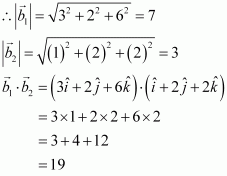
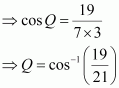
(ii) The given lines are parallel to the vectors, and
and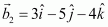 , respectively.
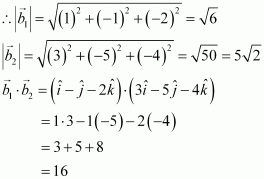
Q11 : Find the angle between the following pairs of lines:
(i)
(ii)
Answer :
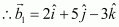
Let  and
and be the vectors parallel to the pair of lines,
 , respectively.
 and
and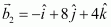
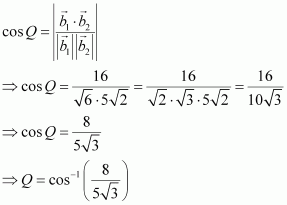
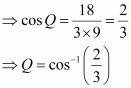
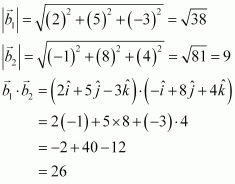 The angle, Q, between the given pair of lines is given by the relation,
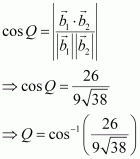
(ii) Let be the vectors parallel to the given pair of lines,
 and
and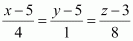 , respectively.
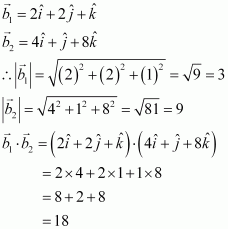
If Q is the angle between the given pair of lines, then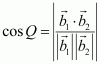
Q12 : Find the values of p so the line 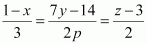 and
and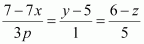
are at right angles.
Answer :
The given equations can be written in the standard form as
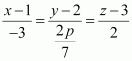 and
and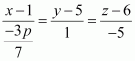
The direction ratios of the lines are – 3, , 2 and
 respectively.
Two lines with direction ratios, a1, b1, c1 and a2, b2, c2, are perpendicular to each other, if a1a2 + b1 b2 + c1c2 = 0
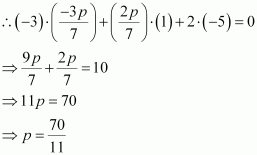
Thus, the value of p is .
.
Q13 : Show that the lines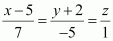 and
and are perpendicular to each other.
Answer :
The equations of the given lines areand
The direction ratios of the given lines are 7, – 5, 1 and 1, 2, 3 respectively.
Two lines with direction ratios, a1, b1, c1 and a2, b2, c2, are perpendicular to each other, if a1a2 + b1 b2 + c1c2 = 0
∴ 7 × 1 + ( – 5) × 2 + 1 × 3
= 7 – 10 + 3
= 0
Therefore, the given lines are perpendicular to each other.
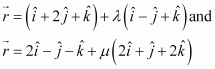
Q14 : Find the shortest distance between the lines
Answer :
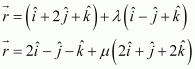
The equations of the given lines are
It is known that the shortest distance between the lines, and
and , is given by,

Comparing the given equations, we obtain
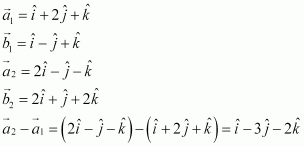
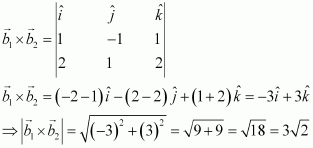
Substituting all the values in equation (1), we obtain
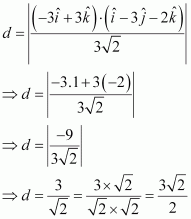
Therefore, the shortest distance between the two lines is units.
Q15 : Find the shortest distance between the lines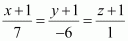 and
and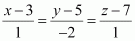
Answer :
The given lines are and
It is known that the shortest distance between the two lines, , is given by,
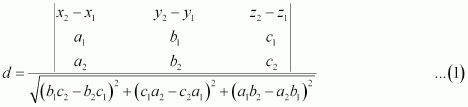
Comparing the given equations, we obtain
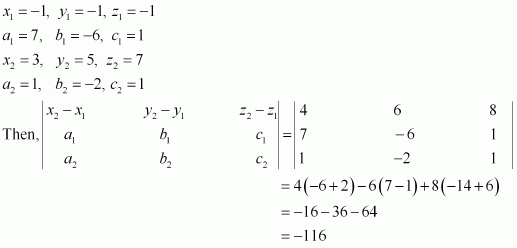
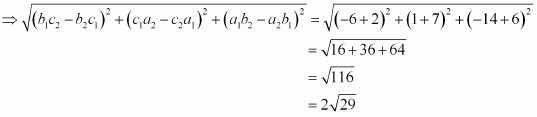
Substituting all the values in equation (1), we obtain

Since distance is always non-negative, the distance between the given lines is  units.
Q16 : Find the shortest distance between the lines whose vector equations are

Answer :
The given lines are and
and
It is known that the shortest distance between the lines, and
and  , is given by,

Comparing the given equations with and, we obtain
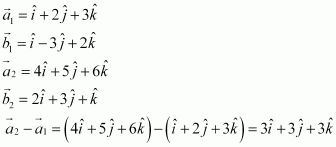
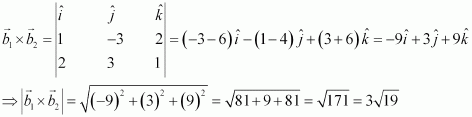
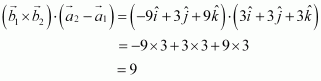
Substituting all the values in equation (1), we obtain
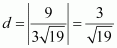
Therefore, the shortest distance between the two given lines is
 units.
Q17 : Find the shortest distance between the lines whose vector equations are
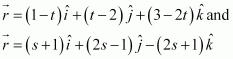
Answer :
The given lines are

Exercise 11.3 : Solutions of Questions on Page Number : 493
Q1 : In each of the following cases, determine the direction cosines of the normal to the plane and the distance from the origin.
(a)z = 2
(b)
 (c)
(c) (d)5y + 8 = 0
Answer :
(a) The equation of the plane is z = 2 or 0x + 0y + z = 2 … (1)
The direction ratios of normal are 0, 0, and 1.
∴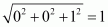
Dividing both sides of equation (1) by 1, we obtain

This is of the form lx + my + nz = d, where l, m, n are the direction cosines of normal to the plane and d is the distance of the perpendicular drawn from the origin.
Therefore, the direction cosines are 0, 0, and 1 and the distance of the plane from the origin is 2 units.
(b) x + y + z = 1 … (1)
The direction ratios of normal are 1, 1, and 1.
∴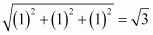
Dividing both sides of equation (1) by , we obtain

This equation is of the form lx + my + nz = d, where l, m, n are the direction cosines of normal to the plane and d is the distance of normal from the origin.
Therefore, the direction cosines of the normal are 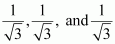 and the distance of normal from the origin is
 units.
(c) 2x + 3y – z = 5 … (1)
The direction ratios of normal are 2, 3, and – 1.

Dividing both sides of equation (1) by  , we obtain
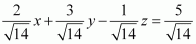
This equation is of the form lx + my + nz = d, where l, m, n are the direction cosines of normal to the plane and d is the distance of normal from the origin.
Therefore, the direction cosines of the normal to the plane are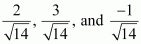 and the distance of normal from the origin is
 units.
(d) 5y + 8 = 0
⇒ 0x – 5y + 0z = 8 … (1)
The direction ratios of normal are 0, – 5, and 0.
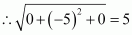
Dividing both sides of equation (1) by 5, we obtain

This equation is of the form lx + my + nz = d, where l, m, n are the direction cosines of normal to the plane and d is the distance of normal from the origin.
Therefore, the direction cosines of the normal to the plane are 0, – 1, and 0 and the distance
of normal from the origin is
Q2 : Find the vector equation of a plane which is at a distance of 7 units from the origin and normal to the vector .
.
Answer :
The normal vector is,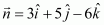
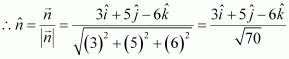
It is known that the equation of the plane with position vector is given by,
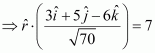
This is the vector equation of the required plane.
Q3 : Find the Cartesian equation of the following planes:
(a)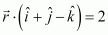 (b)
(b)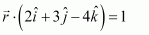
(c)
Answer :
(a) It is given that equation of the plane is

For any arbitrary point P (x, y, z) on the plane, position vector  is given by,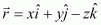
Substituting the value of in equation (1), we obtain
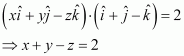
This is the Cartesian equation of the plane.
(b)
For any arbitrary point P (x, y, z) on the plane, position vector is given by,Substituting the value of in equation (1), we obtain
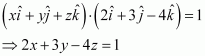
This is the Cartesian equation of the plane.
(c)
For any arbitrary point P (x, y, z) on the plane, position vector is given by,
Substituting the value of in equation (1), we obtain

This is the Cartesian equation of the given plane.
Q4 : In the following cases, find the coordinates of the foot of the perpendicular drawn from the origin.
(a) (b)
(b)
(c) (d)
(d)
Answer :
(a) Let the coordinates of the foot of perpendicular P from the origin to the plane be (x1, y1, z1).
2x + 3y + 4z – 12 = 0
⇒ 2x + 3y + 4z = 12 … (1)
The direction ratios of normal are 2, 3, and 4.

Dividing both sides of equation (1) by , we obtain
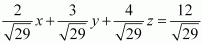
This equation is of the form lx + my + nz = d, where l, m, n are the direction cosines of normal to the plane and d is the distance of normal from the origin.
The coordinates of the foot of the perpendicular are given by
(ld, md, nd).
Therefore, the coordinates of the foot of the perpendicular are
(b) Let the coordinates of the foot of perpendicular P from the origin to the plane be (x1, y1, z1).

⇒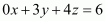 … (1)
… (1)
The direction ratios of the normal are 0, 3, and 4.
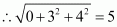
Dividing both sides of equation (1) by 5, we obtain
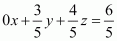
This equation is of the form lx + my + nz = d, where l, m, n are the direction cosines of normal to the plane and d is the distance of normal from the origin.
The coordinates of the foot of the perpendicular are given by
(ld, md, nd).
Therefore, the coordinates of the foot of the perpendicular are
(c) Let the coordinates of the foot of perpendicular P from the origin to the plane be (x1, y1, z1).
 … (1)
… (1)
The direction ratios of the normal are 1, 1, and 1.
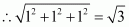
Dividing both sides of equation (1) by , we obtain
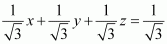
This equation is of the form lx + my + nz = d, where l, m, n are the direction cosines of normal to the plane and d is the distance of normal from the origin.
The coordinates of the foot of the perpendicular are given by
(ld, md, nd).
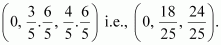
Therefore, the coordinates of the foot of the perpendicular are

(d) Let the coordinates of the foot of perpendicular P from the origin t
Q5 : Find the vector and Cartesian equation of the planes
(a) that passes through the point (1, 0, – 2) and the normal to the plane is .
.
(b) that passes through the point (1, 4, 6) and the normal vector to the plane is  .
.
Answer :
(a) The position vector of point (1, 0, – 2) is
The normal vector perpendicular to the plane is
The vector equation of the plane is given by,

is the position vector of any point P (x, y, z) in the plane.
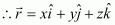
Therefore, equation (1) becomes
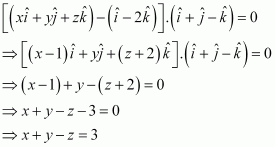
This is the Cartesian equation of the required plane.
(b) The position vector of the point (1, 4, 6) is
The normal vector perpendicular to the plane is
The vector equation of the plane is given by,

is the position vector of any point P (x, y, z) in the plane.
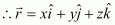
Therefore, equation (1) becomes
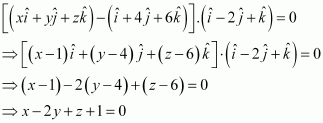
This is the Cartesian equation of the required plane.
Q6 : Find the equations of the planes that passes through three points.
(a) (1, 1, -1), (6, 4, -5), (-4, -2, 3)
(b) (1, 1, 0), (1, 2, 1), (-2, 2, -1)
Answer :
(a) The given points are A (1, 1, – 1), B (6, 4, – 5), and C ( – 4, – 2, 3).
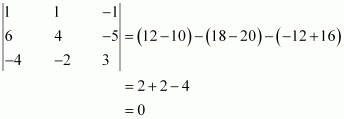
Since A, B, C are collinear points, there will be infinite number of planes passing through the given points.
(b) The given points are A (1, 1, 0), B (1, 2, 1), and C ( – 2, 2, – 1).
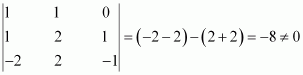
Therefore, a plane will pass through the points A, B, and C.
It is known that the equation of the plane through the points,
 , and
, and , is
, is
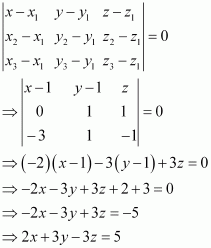
This is the Cartesian equation of the required plane.
Q7 : Find the intercepts cut off by the plane
Answer :

Dividing both sides of equation (1) by 5, we obtain
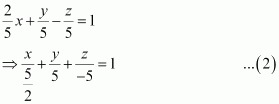
It is known that the equation of a plane in intercept form is , where a, b, c are the intercepts cut off by the plane at x, y, and z axes respectively.
Therefore, for the given equation,
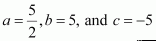
Thus, the intercepts cut off by the plane are.
Q8 : Find the equation of the plane with intercept 3 on the y-axis and parallel to ZOX plane.
Answer :
The equation of the plane ZOX is
y = 0
Any plane parallel to it is of the form, y = a
Since the y-intercept of the plane is 3,
∴ a = 3
Thus, the equation of the required plane is y = 3
Q9 : Find the equation of the plane through the intersection of the planes and
and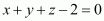 and the point (2, 2, 1)
Answer :
The equation of any plane through the intersection of the planes,
3x – y + 2z – 4 = 0 and x + y + z – 2 = 0, is

The plane passes through the point (2, 2, 1). Therefore, this point will satisfy equation (1).
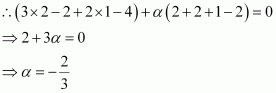
Substituting in equation (1), we obtain
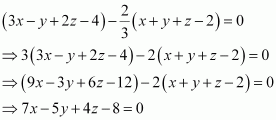
This is the required equation of the plane.
Q10 : Find the vector equation of the plane passing through the intersection of the planes and through the point (2, 1, 3)
Answer :
The equations of the planes are
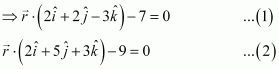
The equation of any plane through the intersection of the planes given in equations (1) and (2) is given by,

, where

The plane passes through the point (2, 1, 3). Therefore, its position vector is given by,
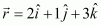
Substituting in equation (3), we obtain
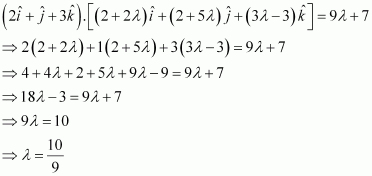
Substituting in equation (3), we obtain
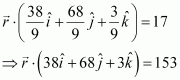
This is the vector equation of the required plane.
Q11 : Find the equation of the plane through the line of intersection of the planes and
and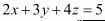 which is perpendicular to the plane
Answer :
The equation of the plane through the intersection of the planes, and , is

The direction ratios, a1, b1, c1, of this plane are (2λ + 1), (3λ + 1), and (4λ + 1).
The plane in equation (1) is perpendicular to
Its direction ratios, a2, b2, c2, are 1, – 1, and 1.
Since the planes are perpendicular,
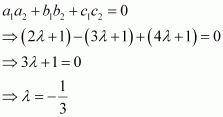
Substituting in equation (1), we obtain
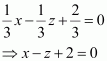
This is the required equation of the plane.
Q12 : Find the angle between the planes whose vector equations are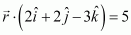
and 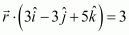 .
.
Answer :
The equations of the given planes are and
It is known that if and
and are normal to the planes,
 and
and , then the angle between them, Q, is given by,

Here,
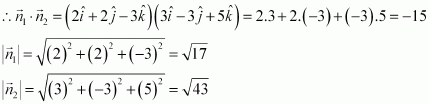
Substituting the value of ,
, in equation (1), we obtain
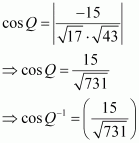
Q13 : In the following cases, determine whether the given planes are parallel or perpendicular, and in case they are neither, find the angles between them.
(a)
(b)
(c)
(d)
(e)
Answer :
The direction ratios of normal to the plane, , are a1, b1, c1 and
 .
.
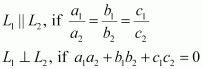
The angle between L1 and L2 is given by,
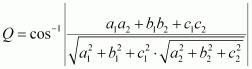
(a) The equations of the planes are 7x + 5y + 6z + 30 = 0 and
3x – y – 10z + 4 = 0
Here, a1 = 7, b1 =5, c1 = 6


Therefore, the given planes are not perpendicular.

It can be seen that,
Therefore, the given planes are not parallel.
The angle between them is given by,
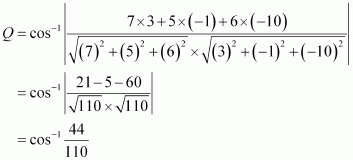

(b) The equations of the planes are and
and
Here, and
and

Thus, the given planes are perpendicular to each other.
(c) The equations of the given planes are
and
Here, and
and

Thus, the given planes are not perpendicular to each other.

∴
Q14 : In the following cases, find the distance of each of the given points from the corresponding given plane.
Point Plane
(a) (0, 0, 0)
(b) (3, – 2, 1)
(c) (2, 3, – 5)
(d) ( – 6, 0, 0)
Answer :
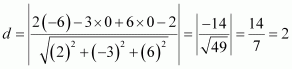
It is known that the distance between a point, p(x1, y1, z1), and a plane, Ax + By + Cz = D, is given by,

(a) The given point is (0, 0, 0) and the plane is
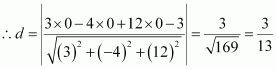
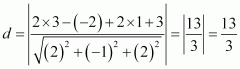
(b) The given point is (3, – 2, 1) and the plane is
∴
(c) The given point is (2, 3, – 5) and the plane is
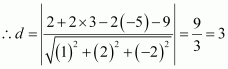
(d) The given point is ( – 6, 0, 0) and the plane is
Exercise Miscellaneous : Solutions of Questions on Page Number : 497
Q1 : Show that the line joining the origin to the point (2, 1, 1) is perpendicular to the line determined by the points (3, 5, -1), (4, 3, -1).
Answer :
Let OA be the line joining the origin, O (0, 0, 0), and the point, A (2, 1, 1).
Also, let BC be the line joining the points, B (3, 5, -1) and C (4, 3, -1).
The direction ratios of OA are 2, 1, and 1 and of BC are (4 – 3) = 1, (3 – 5) = -2, and (-1 + 1) = 0
OA is perpendicular to BC, if a1a2 + b1b2 + c1c2 = 0
∴ a1a2 + b1b2 + c1c2 = 2 x 1 + 1 (-2) + 1 x 0 = 2 – 2 = 0
Thus, OA is perpendicular to BC.
Q2 : If l1, m1, n1 and l2, m2, n2 are the direction cosines of two mutually perpendicular lines, show that the direction cosines of the line perpendicular to both of these are m1n2 – m2n1, n1l2 – n2l1, l1m2 - l2m1.
Answer :
It is given that l1, m1, n1 and l2, m2, n2 are the direction cosines of two mutually perpendicular lines. Therefore,


Let l, m, n be the direction cosines of the line which is perpendicular to the line with direction cosines l1, m1, n1 and l2, m2, n2.
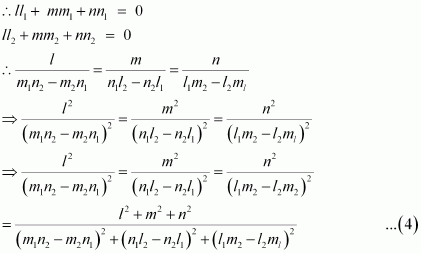
l, m, n are the direction cosines of the line.
∴l2 + m2 + n2 = 1 … (5)
It is known that,
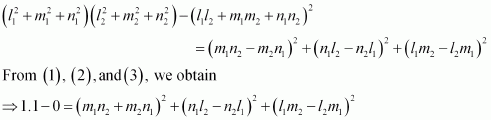 ∴
∴ Substituting the values from equations (5) and (6) in equation (4), we obtain
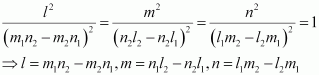
Thus, the direction cosines of the required line are
Q3 : Find the angle between the lines whose direction ratios are a, b, c and b – c,
c – a, a – b.
Answer :
The angle Q between the lines with direction cosines, a, b, c and b – c, c – a,
a – b, is given by,
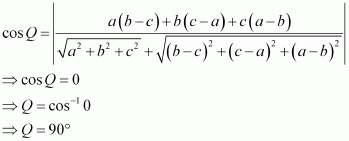 Thus, the angle between the lines is 90°.
Q4 : Find the equation of a line parallel to x-axis and passing through the origin.
Answer :
The line parallel to x- axis and passing through the origin is x-axis itself.
Let A be a point on x-axis. Therefore, the coordinates of A are given by (a, 0, 0), where a ∈ R.
Direction ratios of OA are (a – 0) = a, 0, 0
The equation of OA is given by,
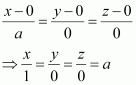 Thus, the equation of line parallel to x-axis and passing through origin is
Q5 : If the coordinates of the points A, B, C, D be (1, 2, 3), (4, 5, 7), (-4, 3, -6) and (2, 9, 2) respectively, then find the angle between the lines AB and CD.
Answer :
The coordinates of A, B, C, and D are (1, 2, 3), (4, 5, 7), ( – 4, 3, – 6), and
(2, 9, 2) respectively.
The direction ratios of AB are (4 – 1) = 3, (5 – 2) = 3, and (7 – 3) = 4
The direction ratios of CD are (2 – ( – 4)) = 6, (9 – 3) = 6, and (2 – ( – 6)) = 8
It can be seen that,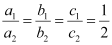 Therefore, AB is parallel to CD.
Thus, the angle between AB and CD is either 0° or 180°.
Q6 : If the lines 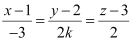 and
and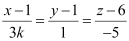 are perpendicular, find the value of k.
Answer :
The direction of ratios of the lines, and , are – 3, 2k, 2 and 3k, 1, – 5 respectively.
It is known that two lines with direction ratios, a1, b1, c1 and a2, b2, c2, are perpendicular, if a1a2 + b1b2 + c1c2 = 0
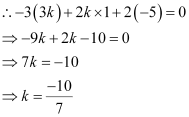 Therefore, for
 , the given lines are perpendicular to each other.
Q7 : Find the vector equation of the plane passing through (1, 2, 3) and perpendicular to the plane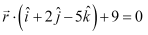 Answer :
The position vector of the point (1, 2, 3) is The direction ratios of the normal to the plane,, are 1, 2, and – 5 and the normal vector is
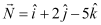 The equation of a line passing through a point and perpendicular to the given plane is given by,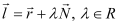

Q8 : Find the equation of the plane passing through (a, b, c) and parallel to the plane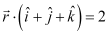
Answer :
Any plane parallel to the plane,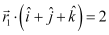 , is of the form
The plane passes through the point (a, b, c). Therefore, the position vector of this point is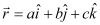 Therefore, equation (1) becomes
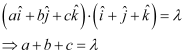 Substituting
 in equation (1), we obtain
 This is the vector equation of the required plane.
Substituting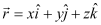 in equation (2), we obtain
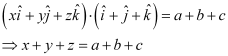
Q9 : Find the shortest distance between lines
and.
Answer :
The given lines are
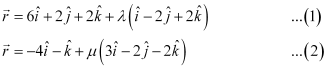 It is known that the shortest distance between two lines,
 , is given by
 Comparingto equations (1) and (2), we obtain
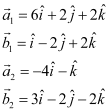

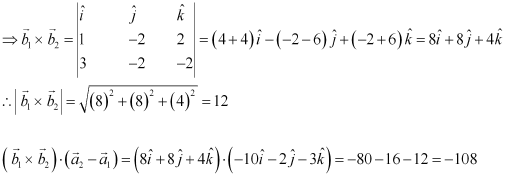 Substituting all the values in equation (1), we obtain
 Therefore, the shortest distance between the two given lines is 9 units.
Q10 : Find the coordinates of the point where the line through (5, 1, 6) and
(3, 4, 1) crosses the YZ-plane
Answer :
It is known that the equation of the line passing through the points, (x1, y1, z1) and (x2, y2, z2), is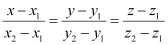 The line passing through the points, (5, 1, 6) and (3, 4, 1), is given by,
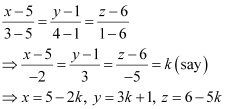 Any point on the line is of the form (5 – 2k, 3k + 1, 6 – 5k).
The equation of YZ-plane is x = 0
Since the line passes through YZ-plane,
5 – 2k = 0

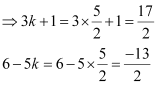 Therefore, the required point is
  .
.
Q11 : Find the coordinates of the point where the line through (5, 1, 6) and
(3, 4, 1) crosses the ZX – plane.
Answer :
It is known that the equation of the line passing through the points, (x1, y1, z1) and (x2, y2, z2), is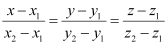 The line passing through the points, (5, 1, 6) and (3, 4, 1), is given by,
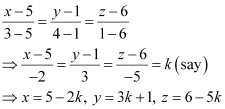 Any point on the line is of the form (5 – 2k, 3k + 1, 6 – 5k).
Since the line passes through ZX-plane,

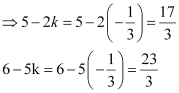 Therefore, the required point is
 .
.
Q12 : Find the coordinates of the point where the line through (3, -4, -5) and (2, – 3, 1) crosses the plane 2x + y + z = 7).
Answer :
It is known that the equation of the line through the points, (x1, y1, z1) and (x2, y2, z2), is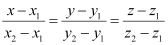 Since the line passes through the points, (3, – 4, – 5) and (2, – 3, 1), its equation is given by,
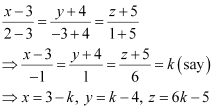 Therefore, any point on the line is of the form (3 – k, k – 4, 6k – 5).
This point lies on the plane, 2x + y + z = 7
∴ 2 (3 – k) + (k – 4) + (6k – 5) = 7
 Hence, the coordinates of the required point are (3 – 2, 2 – 4, 6 × 2 – 5) i.e.,
(1, – 2, 7).
Q13 : Find the equation of the plane passing through the point (-1, 3, 2) and perpendicular to each of the planes x + 2y + 3z = 5 and 3x + 3y + z = 0.
Answer :
The equation of the plane passing through the point ( – 1, 3, 2) is
a (x + 1) + b (y – 3) + c (z – 2) = 0 … (1)
where, a, b, c are the direction ratios of normal to the plane.
It is known that two planes,  and
and , are perpendicular, if
 Plane (1) is perpendicular to the plane, x + 2y + 3z = 5
 Also, plane (1) is perpendicular to the plane, 3x + 3y + z = 0
 From equations (2) and (3), we obtain
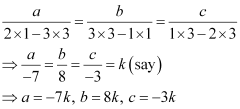 Substituting the values of a, b, and c in equation (1), we obtain
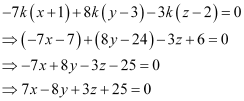 This is the required equation of the plane.
Q14 : If the points (1, 1, p) and ( – 3, 0, 1) be equidistant from the plane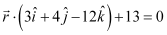 , then find the value of p.
Answer :
The position vector through the point (1, 1, p) is Similarly, the position vector through the point ( – 3, 0, 1) is
 The equation of the given plane is
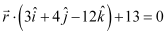 It is known that the perpendicular distance between a point whose position vector is
 and the plane,
 is given by,

Here,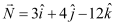 and d
and d Therefore, the distance between the point (1, 1, p) and the given plane is
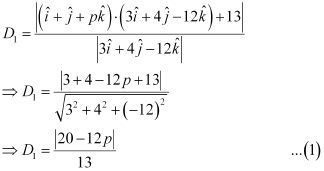 Similarly, the distance between the point ( – 3, 0, 1) and the given plane is
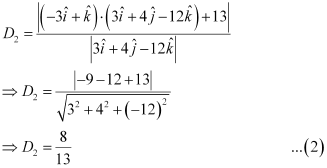
It is given that the distance between the required plane and the points, (1, 1, p) and ( – 3, 0, 1), is equal.
∴ D1 = D2
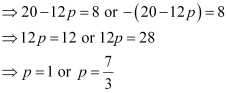
Q15 : Find the equation of the plane passing through the line of intersection of the planes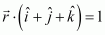 and
and 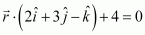 and parallel to x-axis.
Answer :
The given planes are
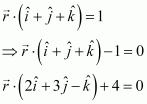 The equation of any plane passing through the line of intersection of these planes is
Q16 : If O be the origin and the coordinates of P be (1, 2, -3), then find the equation of the plane passing through P and perpendicular to OP.
Answer :
The coordinates of the points, O and P, are (0, 0, 0) and (1, 2, – 3) respectively.
Therefore, the direction ratios of OP are (1 – 0) = 1, (2 – 0) = 2, and ( – 3 – 0) = – 3
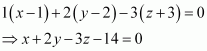
It is known that the equation of the plane passing through the point (x1, y1 z1) is
 where, a, b, and c are the direction ratios of normal.
Here, the direction ratios of normal are 1, 2, and – 3 and the point P is (1, 2, – 3).
Thus, the equation of the required plane is
Q17 : Find the equation of the plane which contains the line of intersection of the planes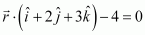
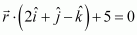 , and which is perpendicular to the plane
 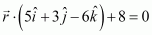 .
.
Answer :
The equations of the given planes are
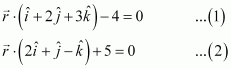
The equation of the plane passing through the line intersection of the plane given in equation (1) and equation (2) is

The plane in equation (3) is perpendicular to the plane,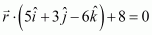
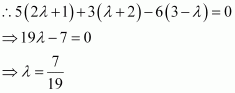
Substituting in equation (3), we obtain

This is the vector equation of the required plane.
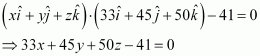
The Cartesian equation of this plane can be obtained by substituting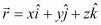 in equation (3).
Q18 : Find the distance of the point ( – 1, – 5, – 10) from the point of intersection of the line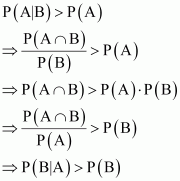 and the plane
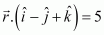 .
.
Answer :
The equation of the given line is

The equation of the given plane is

Substituting the value of from equation (1) in equation (2), we obtain
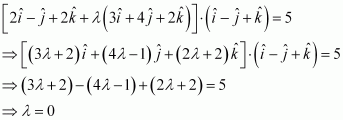
Substituting this value in equation (1), we obtain the equation of the line as

This means that the position vector of the point of intersection of the line and the plane is
This shows that the point of intersection of the given line and plane is given by the coordinates, (2, – 1, 2). The point is ( – 1, – 5, – 10).
The distance d between the points, (2, – 1, 2) and ( – 1, – 5, – 10), is

Q19 : Find the vector equation of the line passing through (1, 2, 3) and parallel to the planes and
and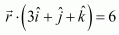 .
.
Answer :
Let the required line be parallel to vector given by,
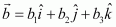
The position vector of the point (1, 2, 3) is
The equation of line passing through (1, 2, 3) and parallel to is given by,

The equations of the given planes are

The line in equation (1) and plane in equation (2) are parallel. Therefore, the normal to the plane of equation (2) and the given line are perpendicular.
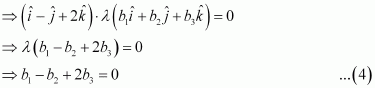
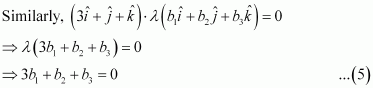
From equations (4) and (5), we obtain
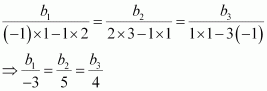
Therefore, the direction ratios of are – 3, 5, and 4.

Substituting the value of in equation (1), we obtain

This is the equation of the required line.
Q20 : Find the vector equation of the line passing through the point (1, 2, – 4) and perpendicular to the two lines: 
Answer :
Let the required line be parallel to the vector given by,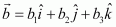
The position vector of the point (1, 2, – 4) is
The equation of the line passing through (1, 2, – 4) and parallel to vector is

The equations of the lines are
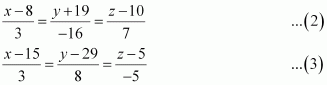
Line (1) and line (2) are perpendicular to each other.

Also, line (1) and line (3) are perpendicular to each other.

From equations (4) and (5), we obtain
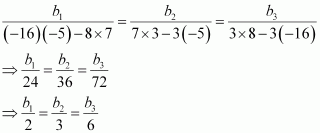
∴Direction ratios of are 2, 3, and 6.
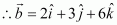
Substituting in equation (1), we obtain

This is the equation of the required line.
Q21 : Prove that if a plane has the intercepts a, b, c and is at a distance of P units from the origin, then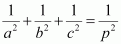
Answer :
The equation of a plane having intercepts a, b, c with x, y, and z axes respectively is given by,

The distance (p) of the plane from the origin is given by,
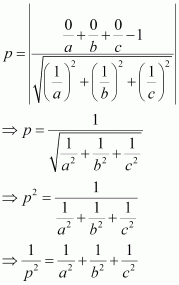
Q22 : Distance between the two planes: and
and is
is
(A)2 units (B)4 units (C)8 units
(D)
Answer :
The equations of the planes are


 It can be seen that the given planes are parallel.
It is known that the distance between two parallel planes, ax + by + cz = d1 and ax + by + cz = d2, is given by,
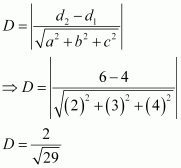
Thus, the distance between the lines is units.
Hence, the correct answer is D.
Q23 : The planes: 2x – y + 4z = 5 and 5x – 2.5y + 10z = 6 are
(A) Perpendicular (B) Parallel (C) intersect y-axis
(C) passes through
Answer :
The equations of the planes are
2x – y + 4z = 5 … (1)
5x – 2.5y + 10z = 6 … (2)
It can be seen that,
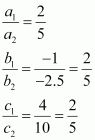 ∴
∴ Therefore, the given planes are parallel.
Hence, the correct answer is B.