
Short answers : Solutions of Questions on Page Number : 364
NCERT Solutions for Class 11 Accountancy Financial Accounting Part-2 Chapter 1 – Financial Statements – I
Q1 :What are the objectives of preparing financial statements?
Answer :
The following are the objectives of preparing financial statements.
1. To ascertain profit earned or loss incurred by a business during an accounting period. This is estimated by preparing Trading and Profit and Loss Account.
2. To ascertain the true financial position of a business. This is reflected by the Balance Sheet.
3. To enable comparison of current year’s performance with that of the previous year’s, i.e., intra-firm comparisons. Also, to compare own performance with that of the other firms in the same industry, i.e., inter-firm comparisons.
4. To assess the solvency and credit worthiness of the business
5. To provide various provisions and reserves to meet unforeseen future conditions and to toughen the financial position of the business
6. To provide vital information to facilitate various users of accounting information in decision making process.
Q2 :What is the purpose of preparing trading and profit and loss account?
Answer :
The purposes of preparing Trading Account are:
1. To calculate gross profit earned or gross loss incurred during an accounting period
2. To estimate the cost of goods sold
3. To record direct expenses (i.e., expenses incurred on the purchases and manufacturing of goods)
4. To measure the adequacy and reasonability of direct expenses incurred by comparing purchases with direct expenses incurred
5. To compare the realised efficiency and performance with the desired or proposed targets
The purposes of preparing Profit and Loss Account are:
1. To calculate net profit or net loss
2. To ascertain net profit ratio and to compare this year’s net profit ratio with that of the desired and proposed target in order to assess the efficiency and effectiveness
3. To measure the adequacy and reasonability of indirect expenses incurred by ascertaining ratio between indirect expenses and net profit
4. To compare current year’s actual performance with desired and planned performance
5. To provide various provisions and reserves to meet unforeseen future conditions and to toughen the financial position of the business
Q3 : Explain the concept of cost of goods sold?
Answer : Cost of goods sold (COGS) is the cost of merchandise that is sold to the customers. It includes cost of raw materials purchased, direct expenses incurred, value of opening stock, i.e., the value of the last year’s unsold stock and excludes closing stock if any, i.e., the value of current year’s unsold stock. The formula to calculate COGS is:
Cost of Goods Sold = Opening Stock + Purchases + Direct Expenses – Closing Stock
Q4 :What is a balance sheet? What are its characteristics?
Answer :
Balance Sheet is a statement prepared to ascertain values of assets and liabilities of a business on a particular date. It is called Balance Sheet as it contain balances of real and personal accounts, which are not closed on a particular date.
Characteristics of Balance Sheet
1. It is a statement of assets and liabilities.
2. The total of Assets side must be equal to Liabilities sides.
3. It is prepared at a particular date.
4. It helps in ascertaining the financial position of the business.
Q5 :Distinguish between capital and revenue expenditure and state whether the following statements are items of capital or revenue expenditure:
(a) Expenditure incurred on repairs and whitewashing at the time of purchase of an old building in order to make it usable.
(b) Expenditure incurred to provide one more exit in a cinema hall in compliance with a government order.
(c) Registration fees paid at the time of purchase of a building
(d) Expenditure incurred in the maintenance of a tea garden which will produce tea after four years.
(e) Depreciation charged on a plant.
(f) The expenditure incurred in erecting a platform on which a machine will be fixed.
(g) Advertising expenditure, the benefits of which will last for four years.
Answer :
|
Basis of Difference |
Capital Expenditure |
Revenue Expenditure |
|
Meaning |
It is incurred to increase the earning capacity of a |
It is incurred to maintain the earning capacity of a |
|
Purpose |
It is incurred to acquire fixed assets to carry out |
It is incurred to conduct day to day activities. |
|
Benefits |
The benefits of such expenditures can be availed for |
The benefits of such expenditures can only be availed |
|
Nature |
It is non-recurring by nature. |
It is generally recurring in nature. |
|
Shown |
Capital expenditure is shown in the assets side of the |
Revenue expenditure is shown in the debit side of the |
(a) Capital expenditure
(b) Revenue expenditure
(c) Capital expenditure
(d) Capital expenditure
(e) Revenue expenditure
(f) Capital expenditure
(g) Deferred revenue expenditure
Q6 :What is an operating profit?
Answer :
Operating profit is a profit earned though normal activities of a business. It is the excess of gross profit over operating expenses. In other words, it is the excess of operating revenue over operating cost. It is also termed as earning before interest and tax (EBTI). It does not include incomes and expenses that are not related to main course of the business.
It is calculated by following formulae:
Operating Profit = Gross Profit – Operating Expenses
Or,
Operating Profit = Sales – Operating Cost
Operating Profit = Sales – COGS – Operating Expenses
Operating expenses include office and administrative expenses, selling and distribution expenses, discount, bad debts, etc.
Long answers : Solutions of Questions on Page Number : 364
Q1 : What are financial statements? What information do they provide?
Answer :
Every business firm wants to know its financial position at the end of an accounting period. In order to assess its financial position, profit earned or loss incurred during an accounting period, the book value of its assets and liabilities is to be ascertained. In order to serve this purpose, financial statements are prepared. Financial statements are the statements showing profitability and financial position of a business at the end of the year. It includes:
1. Income statements, viz., Trading and Profit and Loss Account, which represents direct and indirect expenses incurred to generate revenues. On one hand, trading account discloses either gross profit or gross loss, on the other hand, profit and loss account discloses either net profit or net loss.
2. Statement of financial position, viz., Balance Sheet, which enlists the book value of all the assets and liabilities of the firm. Balance Sheet discloses the true financial position, solvency and credit worthiness of the business.
The information provided by the financial statements is in the form of gross profit or gross loss, net profit or net loss and book value of the assets and their liabilities. The value and relevance of the information provided by the financial statements varies from one user of accounting information to another. Various users of accounting information can be explained graphically as below.
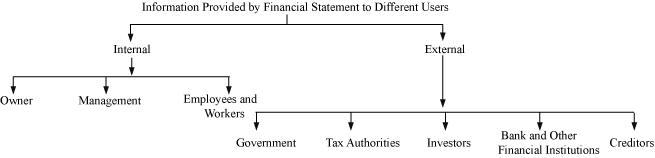
1. Internal: Internal users are those persons who are directly related to the business. For example, owners, management, employees, workers, etc.
a. Owners: The information required by owners about profit earned or loss incurred during an accounting period. This information is provided by the financial statements in form of gross (net) profit or gross (net) loss.
b. Management: Financial statements provide vital information to the management for decision making, designing policies and future plans. There are various parameters such as ratio of direct (indirect) expenses to gross (net) profit, by the help of which management can check the adequacy, control and relevance of various expenses incurred and plans and policies implemented.
c. Employees and workers: They expect bonus at the year end, which is directly related to the profit of that particular period. The net profit as disclosed by the profit and loss account forms the basis of this expectation.
2. External: External users are those persons and institutions that are indirectly related to the business. For example, government, tax authorities, investors, etc.
a. Government: Government needs information in order to ascertain various macroeconomic variables, such as national income, GDP, employment opportunities generated, etc.
b. Tax authorities: Tax department is interested in knowing the actual sales, production, turnovers and exports and imports by the business. Tax department levies various taxes, such as income tax, VAT, excise tax, etc. The information disclosed by the financial statements form the basis of estimation of the tax dues of the business.
c. Investors: Financial statements help to know about the earning capacity, scope and potential to grow and to assess financial position of the business. It also helps in knowing various investments made by the business and also investments made by the organisations and individuals in the business. This information helps the investors to assess and determine whether investments by them will be fruitful or not.
d. Bank and other financial institutions: Financial statements provide information to banks and other financial institutions, such as LIC, GIC, etc., about the credit worthiness, solvency and repaying capacity of the business.
e. Creditors: Financial statements provide information to the creditors about the goodwill of the business and its credit worthiness and repaying capacity.
Q2 :What are closing entries? Give four examples of closing entries.
Answer :
The balances of all nominal accounts are transferred to the Trading and Profit and Loss Account. The entries required for such transfers are termed as closing entries.
The examples of closing entries are given below.
1. Closing entries to transfer the following items to the debit side of trading account from Trial Balance:
| Trading A/c |
Dr. |
|
| To Opening Stock A/c | ||
| To Purchase A/c | ||
| To Wages A/c | ||
| To Carriage A/c | ||
| To All Other Direct Expenses A/c | ||
| (Transferred debit balances to Trading Aaccount) | ||
2. Closing entries to transfer the following items to the credit side of trading account from Trial Balance:
| Sales A/c |
Dr. |
|
| Closing Stock A/c |
Dr. |
|
| To Trading A/c | ||
| (Transferred credit balances to Trading Account) | ||
3. Closing entries to transfer the following items to the debit side of Profit and Loss Account from Trial Balance:
| Profit and Loss A/c |
Dr. |
|
| To Salaries | ||
| To Rent | ||
| To Bad Debts | ||
| To All in Direct Expenses
(Transferred debit balances to Profit and Loss Account) |
||
4. Closing entries to transfer the following items to the credit side of Profit and Loss Account from Trial Balance:
| Commission Received A/c |
Dr. |
|
| Interest Received A/c |
Dr. |
|
| All Other Indirect Income A/c |
Dr. |
|
| To Profit and Loss A/c | ||
| (Transferred credit balances
to Profit and Loss Account) |
||
Q3 :Discuss the need of preparing a balance sheet.
Answer :
The needs to prepare a Balance Sheet are given below.
1. It helps in determining the nature and book value of various assets, such as fixed assets, investments, current assets, etc. at the end of an accounting period.
2. It helps in ascertaining the nature and amount of various liabilities like long term liabilities, current liabilities, provisions, etc., which a business owes.
3. It discloses important information about capital invested in a business. The additional capital invested during the accounting period, drawings of the owners and profit (or loss) added to (or deducted from) the capital of the business.
4. It helps in assessing the solvency of a business.
5. It discloses the true financial position of a business at a particular point of time.
6. It lays down the basis for maintaining new books for next accounting period.
Q4 :What is meant by Grouping and Marshalling of assets and liabilities? Explain the ways in which a balance sheet may be marshalled.
Answer :
The rationale behind preparing financial statements is to present a summarised version of all financial activities in such a manner that all users can interpret and understand the information easily, appropriately and also take decisions accordingly.
Grouping of assets and liabilities: Grouping means showing similar assets and liabilities under a single head. For example, all assets that can be used for more than a year are clubbed together under the heading ‘fixed assets’, for example, building, furniture, machinery, etc.
Marshalling of asset and liabilities: When assets and liabilities are shown in a particular order of liquidity or permanence, they are said to be marshalled.
1. In order of liquidity: Liquidity means convertibility into cash. Assets that can be converted into cash in least possible time, i.e., more liquid assets are recorded first, followed by the lesser liquid assets. In a balance sheet, cash in hand is recorded at first and goodwill at last. In the same way, liabilities that are to be paid first, i.e., high priority liabilities are recorded first, followed by the lower priority ones. In a balance sheet, current liabilities are recorded first and then the long term liabilities and capital at the last.
|
Balance |
||||||
|
Liabilities |
Amount Rs |
Assets |
Amount Rs |
|||
|
Current Liabilities: |
Current Assets: |
|||||
|
Bills Payable |
– |
Cash in Hand |
– |
|||
|
Sunday Creditors |
– |
Cash at Bank |
– |
|||
|
Bank Overdraft |
– |
Bills Receivable |
– |
|||
|
Long Term Loans |
|
– |
Debtors |
– |
||
|
Capital: |
Closing Stock |
– |
||||
|
Opening balance |
– |
Long Term Investments |
||||
|
|
Add: |
– |
Fixed Assets: |
|||
|
|
Less: |
– |
– |
Furniture |
– |
|
|
|
Plant and Machinery |
– |
||||
|
|
Land and Building |
– |
||||
|
|
Goodwill |
– |
||||
|
|
– |
– |
||||
|
|
||||||
|
|
|
|
|
|
|
|
2. In order of permanence: It is just the reverse of the above method. In this, assets and liabilities are arranged in their reducing level of permanence. The assets with higher degree of permanence are recorded first, followed by the assets with lower degree of permanence. For example, goodwill, land and building have the highest degree of permanence and hence are recorded at the top, whereas, cash at bank and cash in hand are recorded at the bottom. In the same way, liabilities are shown according to their life in the business. Liabilities with higher level of permanence like, capital is recorded at the top and other liabilities with lower permanence are recorded at the bottom.
|
Balance |
||||||||
|
Liabilities |
Amount Rs |
Assets |
Amount Rs |
|||||
|
Capital: |
Fixed assets: |
|
||||||
|
Opening Balance |
– |
Goodwill |
|
– |
||||
|
|
Add: |
– |
Land and Building |
|
– |
|||
|
Less: |
– |
– |
Plant and Machinery |
|
– |
|||
|
Furniture |
– |
|||||||
|
Long Term Loans |
– |
Long Term Investments |
|
|||||
|
Current Liabilities: |
Current Assets: |
|
||||||
|
Bank Overdraft |
– |
Closing Stock |
|
– |
||||
|
Sunday Creditors |
– |
Debtors |
|
– |
||||
|
Bill Payable |
– |
Bills Receivable |
|
– |
||||
|
Cash at Bank |
|
– |
||||||
|
Cash in Hand |
– |
|||||||
|
|
||||||||
|
|
||||||||
|
|
– | – | ||||||
|
|
|
|
|
|
|
|
||
Numerical questions : Solutions of Questions on Page Number : 364
Q1 : From the following balances taken from the books of Simmi and Vimmi Ltd. for the year ending March 31, 2003, calculate the gross profit.
|
|
Rs |
|
Closing stock |
2,50,000 |
|
Net sales during the |
40,00,000 |
|
Net purchases during the |
15,00,000 |
|
Opening stock |
15,00,000 |
|
Direct expenses |
80,000 |
Answer:
|
Trading Account as on |
|||
|
Dr. |
Cr. |
||
|
Particulars |
Amount Rs |
Particulars |
Amount Rs |
|
Opening Stock |
15,00,000 |
Net Sales |
40,00,000 |
|
Net Purchases |
15,00,000 |
Closing Stock |
2,50,000 |
|
Direct Expenses |
80,000 |
|
|
|
Gross Profit |
11,70,000 |
|
|
|
|
42,50,000 |
|
42,50,000 |
|
|
|
|
|
Q2 : From the following balances extracted from the books of M/s Ahuja and Nanda. Calculate the amount of:
(a)Cost of goods available for sale
(b)Cost of goods sold during the year
(c)Gross Profit
|
|
Rs |
|
Opening stock |
25,000 |
|
Credit purchases |
7,50,000 |
|
Cash purchases |
3,00,000 |
|
Credit sales |
12,00,000 |
|
Cash sales |
4,00,000 |
|
Wages |
1,00,000 |
|
Salaries |
1,40,000 |
|
Closing stock |
30,000 |
|
Sales return |
50,000 |
|
Purchases return |
10,000 |
Answer:
(a) Cost of Goods Sold Available for Sales
Or
Cost of Goods Manufactured = Opening Stock + Net Purchases + Wages
= 25,000 + 10,40,000 + 1,00,000
= Rs 11,65,000
(b) Cost of Goods Sold = Opening Stock + Net Purchases + Wages – Closing Stock
= 25,000 + 10,40,000 + 1,00,000 – 30,000
= Rs 11,35,000
Or
Cost of Goods Sold = Net Sales – Gross Profit
= 15,50,000 – 4,15,000
= Rs 11,35,000
(c)
|
Trading Account |
|||||||
|
Dr. |
Cr. |
||||||
|
Particulars |
Amount Rs |
Particulars |
Amount Rs |
||||
|
Opening Stock |
25,000 |
Sales |
|
||||
|
Purchases |
|
|
Add: Credit Sales |
12,00,000 |
|
||
|
Add: Credit Purchases |
7,50,000 |
|
|
Add: Cash Sales |
4,00,000 |
|
|
|
Add: Cash Purchases |
3,00,000 |
|
|
16,00,000 |
|
||
|
10,50,000 |
|
|
Less: |
(50,000) |
15,50,000 |
||
|
Less: |
(10,000) |
10,40,000 |
|
|
|
||
|
Wages |
|
1,00,000 |
|
Closing Stock |
|
30,000 |
|
|
Gross Profit |
|
4,15,000 |
|
|
|
||
|
|
15,80,000 |
|
|
15,80,000 |
|||
|
|
|
|
|
|
|
|
|
Gross Profit Rs 4,15,000
Q3 : Calculate the amount of gross profit and operating profit on the basis of the following balances extracted from the books of M/s Rajiv and Sons for the year ended March 31, 2005.
|
Rs |
|
|
Opening stock |
50,000 |
|
Net sales |
11,00,000 |
|
Net purchases |
6,00,000 |
|
Direct expenses |
60,000 |
|
Administration |
45,000 |
|
Selling and distribution |
65,000 |
|
Loss due to fire |
20,000 |
|
Closing stock |
70,000 |
Answer:
|
Trading Account as on |
|||
|
Dr. |
Cr. |
||
|
Particulars |
Amount Rs |
Particulars |
Amount Rs |
|
Opening Stock |
50,000 |
Net Sales |
11,00,000 |
|
Net Purchases |
6,00,000 |
Closing Stock |
70,000 |
|
Direct Expenses |
60,000 |
||
|
Gross Profit |
4,60,000 |
||
|
11,70,000 |
11,70,000 |
||
Operating Profit = Sales – (Opening Stock + Net Purchases + Direct Expenses + Administration Expenses +
Selling and Distribution Expenses) + Closing Stock
= 11,00,000 – (50,000 + 6,00,000 + 60,000 + 45,000 + 65,000) + 70,000
= Rs 3,50,000
Q4 :Operating profit earned by M/s Arora and Sachdeva in 2005-06 was Rs 17,00,000. Its non-operating incomes were Rs 1,50,000 and non-operating expenses were Rs 3,75,000. Calculate the amount of net profit earned by the firm.
Answer :
Net Profit = Operating Profit + Non-operating Income – Non-operating Expenses
= 17,00,000 + 1,50,000 – 3,75,000
= Rs 14,75,000
Net profit earned by M/S Arora and Sachdeva in 2005-06 is Rs 14,75,000.
Q5 : The following are the extracts from the trial balance of M/s Bhola and Sons as on March 31, 2005
|
Account title |
Debit Rs |
Credit Rs |
|
Opening Stock |
2,00,000 |
|
|
Purchases |
8,10,000 |
|
|
Sales |
10,10,000 |
|
|
10,10,000 |
10,10,000 |
|
(Only relevant items)
Closing Stock as on date was valued at Rs 3,00,000.
You are required to record the necessary journal entries and show how the above items will appear in the trading and profit and loss account and balance sheet of M/s Bhola and Sons.
Answer :
|
Books of M/s Bhola and Sons Journal |
||||||
|
Date |
Particulars |
L.F. |
Debit Amount Rs |
Credit Amount |
||
|
2006 |
||||||
|
Mar.31 |
Trading A/c |
Dr. |
10,10,000 |
|||
|
To Opening Stock A/c |
2,00,000 |
|||||
|
To Purchases A/c |
8,10,000 |
|||||
|
(Balances from Purchases transferred to Trading |
||||||
|
Mar.31 |
Sales A/c |
Dr. |
10,10,000 |
|||
|
Closing Stock A/c |
3,00,000 |
|||||
|
To Trading A/c |
13,10,000 |
|||||
|
(Balance from sales and to Trading Account) |
||||||
|
Mar.31 |
Trading A/c |
Dr. |
3,00,000 |
|||
|
To Profit and Loss (Gross |
3,00,000 |
|||||
|
(Balance of Trading Account to Profit and Loss |
||||||
|
Trading Account as on |
|||
|
Dr. |
Cr. |
||
|
Particulars |
Amount Rs |
Particulars |
Amount Rs |
|
Opening Stock |
2,00,000 |
Sales |
10,10,000 |
|
Purchases |
8,10,000 |
Closing Stock |
3,00,000 |
|
Profit and Loss A/c |
3,00,000 |
||
|
13,10,000 |
13,10,000 |
||
|
Balance Sheet as on March 31, 2005 |
|||
|
Liabilities |
Amount Rs |
Assets |
Amount Rs |
|
Closing Stock |
3,00,000 |
||
Q6 :Prepare trading and profit and loss account and balance sheet, as on March 31, 2005 :
|
Account Title |
Amount Rs |
Account Title |
Amount Rs |
|
Machinery |
27,000 |
Capital |
60,000 |
|
Sundry debtors |
21,600 |
Bills payable |
2,800 |
|
Drawings |
2,700 |
Sundry creditors |
1,400 |
|
Purchases |
58,500 |
Sales |
73,500 |
|
Wages |
15,000 |
||
|
Sundry expenses |
600 |
||
|
Rent and taxes |
1,350 |
||
|
Carriage inwards |
450 |
||
|
Bank |
4,500 |
||
|
Openings stock |
6,000 |
Closing stock, as on March 31, 2005 Rs 22,400
Answer :
|
Trading Account as on |
|||
|
Dr. |
Cr. |
||
|
Particulars |
Amount Rs |
Particulars |
Amount Rs |
|
Opening Stock |
6,000 |
Sales |
73,500 |
|
Purchases |
58,500 |
Closing Stock |
22,400 |
|
Wages |
15,000 |
||
|
Carriage Inwards |
450 |
||
|
Profit and Loss (Gross |
15,950 |
||
|
95,900 |
95,900 |
||
|
Profit and Loss |
||||
|
Dr. |
Cr. |
|||
|
Particulars |
Amount Rs |
Particulars |
Amount Rs |
|
|
Sundry Expenses |
600 |
Trading (Gross Profit) |
15,950 |
|
|
Rent and Taxes |
1,350 |
|||
|
Net Profit |
14,000 |
|||
|
15,950 |
15,950 |
|||
|
Balance Sheet as on March |
|||||
|
Liabilities |
Amount Rs |
Assets |
Amount Rs |
||
|
Capital |
60,000 |
Fixed |
|||
|
Add: Net Profit |
14,000 |
Machinery |
27,000 |
||
|
74,000 |
|||||
|
Less: |
2,700 |
71,300 |
Current |
||
|
Bank |
4,500 |
||||
|
Sundry Creditors |
1,400 |
Closing Stock |
22,400 |
||
|
Bills Payable |
2,800 |
Sundry Debtors |
21,600 |
||
|
75,500 |
75,500 |
||||
Q7 : The following trial balance is extracted from the books of M/s Ram on March 31, 2011. You are required to prepare trading and profit and loss account and the balance sheet as on date:
|
Account title |
Amount Rs |
Account title |
Amount Rs |
|
Debtors |
12,000 |
Apprenticeship premium |
5,000 |
|
Purchases |
50,000 |
Loan |
10,000 |
|
Coal, gas and water |
6,000 |
Bank overdraft |
1,000 |
|
Factory wages |
11,000 |
Sales |
80,000 |
|
Salaries |
9,000 |
Creditors |
13,000 |
|
Rent |
4,000 |
Capital |
20,000 |
|
Discount |
3,000 |
||
|
Advertisement |
500 |
||
|
Drawings |
1,000 |
||
|
Loan |
6,000 |
||
|
Petty cash |
500 |
||
|
Sales return |
1,000 |
||
|
Machinery |
5,000 |
||
|
Land and building |
10,000 |
||
|
Income tax |
100 |
||
|
Furniture |
9,900 |
Answer :
|
Trading Account as on March 31, 2011 |
|||||||||
|
Dr. |
Cr. |
||||||||
|
Particulars |
Amount Rs |
Particulars |
Amount Rs |
||||||
|
Purchases |
50,000 |
Sales |
80,000 |
||||||
|
Coal, Gas and Water |
6,000 |
Less: Sales Return |
1,000 |
79,000 |
|||||
|
Factory Wages |
11,000 |
||||||||
|
Profit and Loss (Gross Profit) |
12,000 |
||||||||
|
79,000 |
79,000 |
||||||||
|
Profit and Loss Account as on March 31, 2011 |
|||
|
Dr. |
Cr. |
||
|
Particulars |
Amount Rs |
Particulars |
Amount Rs |
|
Salaries |
9,000 |
Trading (Gross Profit) |
12,000 |
|
Rent |
4,000 |
Apprenticeship Premium |
5,000 |
|
Discount |
3,000 |
||
|
Advertisement |
500 |
||
|
Net Profit |
500 |
||
|
17,000 |
17,000 |
||
|
Balance Sheet as on March 31, 2011 |
|||||||
|
Liabilities |
Amount Rs |
Assets |
Amount Rs |
||||
|
Capital |
20,000 |
Machinery |
5,000 |
||||
|
Add: Profit and Loss (Net Profit) |
500 |
Land and Building |
10,000 |
||||
|
20,500 |
Furniture |
9,900 |
|||||
|
Less: Drawings |
(1,000) |
Loan (Given) |
6,000 |
||||
|
Less: Income Tax |
(100) |
19,400 |
Debtors |
12,000 |
|||
|
Petty Cash |
500 |
||||||
|
Loan (Taken) |
10,000 |
||||||
|
Creditors |
13,000 |
||||||
|
Bank Overdraft |
1,000 |
||||||
|
43,400 |
43,400 |
||||||
Q8 : The following is the trial balance of Manju Chawla on March 31, 2011. You are required to prepare trading and profit and loss account and a balance sheet as on date:
|
Account title |
Debit Amount Rs |
Credit Amount Rs |
|
Opening stock |
10,000 |
|
|
Purchases and sales |
40,000 |
80,000 |
|
Returns |
200 |
600 |
|
Productive wages |
6,000 |
|
|
Dock and Clearing charges |
4,000 |
|
|
Donation and charity |
600 |
|
|
Delivery van expenses |
6,000 |
|
|
Lighting |
500 |
|
|
Sales tax collected |
1,000 |
|
|
Bad debts 600 |
||
|
Misc. incomes |
6,000 |
|
|
Rent from tenants |
2,000 |
|
|
Royalty |
4,000 |
|
|
Capital |
40,000 |
|
|
Drawings |
2,000 |
|
|
Debtors and Creditors |
6,000 |
7,000 |
|
Cash |
3,000 |
|
|
Investment |
6,000 |
|
|
Patents |
4,000 |
|
|
Land and Machinery |
43,000 |
Closing stock Rs 2,000.
Answer :
|
Trading Account as on March 31, 2011 |
|||||||
|
Dr. |
Cr. |
||||||
|
Particulars |
Amount Rs |
Particulars |
Amount Rs |
||||
|
Opening Stock |
10,000 |
Sales |
80,000 |
||||
|
Purchases |
40,000 |
Less: Sales Returns |
(200) |
79,800 |
|||
|
Less: Purchases Returns |
(600) |
39,400 |
|||||
|
Productive Wages |
6,000 |
Closing Stock |
2,000 |
||||
|
Dock and Clearing Charges |
4,000 |
||||||
|
Royalty |
4,000 |
||||||
|
Profit and Loss (Gross Profit) |
18,400 |
||||||
|
81,800 |
81,800 |
||||||
|
Profit and Loss Account as on March 31, 2011 |
|||
|
Dr. |
Cr. |
||
|
Particulars |
Amount Rs |
Particulars |
Amount Rs |
|
Donation and Charity |
600 |
Trading (Gross Profit) |
18,400 |
|
Delivery Van Expenses |
6,000 |
Misc. Incomes |
6,000 |
|
Lighting |
500 |
Rent from Tenants |
2,000 |
|
Bad Debts |
600 |
||
|
Net Profit |
18,700 |
||
|
26,400 |
26,400 |
||
Note: As per the solution, net profit is Rs 18,700; however, according to the answer given in the book, it is Rs 18,400.
|
Balance Sheet as on March 31, 2011 |
|||||||||
|
Liabilities |
Amount Rs |
Assets |
Amount Rs |
||||||
|
Capital |
40,000 |
Patents |
4,000 |
||||||
|
Add: Profit and Loss (Net Profit) |
18,700 |
Land and Machinery |
43,000 |
||||||
|
58,700 |
Investment |
6,000 |
|||||||
|
Less: Drawings |
(2,000) |
56,700 |
Debtors |
6,700 |
|||||
|
Cash |
3,000 |
||||||||
|
Sales Tax Collected |
1,000 |
Closing Stock |
2,000 |
||||||
|
Creditors |
7,000 |
||||||||
|
64,700 |
64,700 |
||||||||
Note: There is a misprint in the trial balance given in the question. In order to match the trial balance, debtors have been taken as Rs 6,700; however, the debtors given in the trial balance is Rs 60,000.
Q9 : The following is the trial balance of Mr. Deepak as on March 31, 2011. You are required to prepare trading account, profit and loss account and a balance sheet as on date:
|
Account title |
Debit Amount Rs |
Account title |
Credit Amount |
|
Drawings |
36,000 |
Capital |
2,50,000 |
|
Insurance |
3,000 |
Bills payable |
3,600 |
|
General expenses |
29,000 |
Creditors |
50,000 |
|
Rent and taxes |
14,400 |
Discount received |
10,400 |
|
Lighting (factory) |
2,800 |
Purchases return |
8,000 |
|
Travelling expenses |
7,400 |
Sales |
4,40,000 |
|
Cash in hand |
12,600 |
||
|
Bills receivable |
5,000 |
||
|
Sundry debtors |
1,04,000 |
||
|
Furniture |
16,000 |
||
|
Plant and Machinery |
1,80,000 |
||
|
Opening stock |
40,000 |
||
|
Purchases |
1,60,000 |
||
|
Sales return |
6,000 |
||
|
Carriage inwards |
7,200 |
||
|
Carriage outwards |
1,600 |
||
|
Wages |
84,000 |
||
|
Salaries |
53,000 |
Closing stock Rs 35,000.
Answer :
|
Trading Account as on March 31, 2011 |
||||||||
|
Dr. |
Cr. |
|||||||
|
Particulars |
Amount Rs |
Particulars |
Amount Rs |
|||||
|
Opening Stock |
40,000 |
Sales |
4,40,000 |
|||||
|
Purchases |
1,60,000 |
Less: Sales Return |
6,000 |
4,34,000 |
||||
|
Less: Purchases Return |
(8,000) |
1,52,000 |
Closing Stock |
35,000 |
||||
|
Lighting (Factory) |
2,800 |
|||||||
|
Carriage Inwards |
7,200 |
|||||||
|
Wages |
84,000 |
|||||||
|
Profit and Loss (Gross Profit) |
1,83,000 |
|||||||
|
4,69,000 |
4,69,000 |
|||||||
|
Profit and Loss Account as on March 31, 2011 |
||||||||
|
Dr. |
Cr. |
|||||||
|
Particulars |
Amount Rs |
Particulars |
Amount Rs |
|||||
|
Insurance |
3,000 |
Trading (Gross Profit) |
1,83,000 |
|||||
|
General Expenses |
29,000 |
Discount Received |
10,400 |
|||||
|
Rent and Taxes |
14,400 |
|||||||
|
Travelling Expenses |
7,400 |
|||||||
|
Carriage Outwards |
1,600 |
|||||||
|
Salaries |
53,000 |
|||||||
|
Net Profit |
85,000 |
|||||||
|
1,93,400 |
1,93,400 |
|||||||
|
Balance Sheet as on March 31, 2011 |
|||||
|
Liabilities |
Amount Rs |
Assets |
Amount Rs |
||
|
Capital |
2,50,000 |
Plant and Machinery |
1,80,000 |
||
|
Add: Net Profit |
85,000 |
Furniture |
16,000 |
||
|
3,35,000 |
Sundry Debtors |
1,04,000 |
|||
|
Less: Drawings |
(36,000) |
2,99,000 |
Closing Stock |
35,000 |
|
|
Bills Receivable |
5,000 |
||||
|
Creditors |
50,000 |
Cash in Hand |
12,600 |
||
|
Bills Payable |
3,600 |
||||
|
3,52,600 |
3,52,600 |
||||
Q10 : Prepare trading and profit and loss account and balance sheet from the following particulars as on March 31, 2011.
|
Account Title |
Debit Amount Rs |
Credit Amount Rs |
|
Purchases and Sales |
3,52,000 |
5,60,000 |
|
Return inwards and Return outwards |
9,600 |
12,000 |
|
Carriage inwards |
7,000 |
|
|
Carriage outwards |
3,360 |
|
|
Fuel and power |
24,800 |
|
|
Opening stock |
57,600 |
|
|
Bad debts |
9,950 |
|
|
Debtors and Creditors |
1,31,200 |
48,000 |
|
Capital |
3,48,000 |
|
|
Investment |
32,000 |
|
|
Interest on investment |
3,200 |
|
|
Loan |
16,000 |
|
|
Repairs |
2,400 |
|
|
General expenses |
17,000 |
|
|
Wages and salaries |
28,800 |
|
|
Land and buildings |
2,88,000 |
|
|
Cash in hand |
32,000 |
|
|
Miscellaneous receipts |
160 |
|
|
Sales tax collected |
8,350 |
Closing stock Rs 30,000.
|
Trading Account as on March 31, 2011 |
||||||||||||
|
Dr. |
Cr. |
|||||||||||
|
Particulars |
Amount Rs |
Particulars |
Amount Rs |
|||||||||
|
Opening Stock |
57,600 |
Sales |
5,60,000 |
|||||||||
|
Purchases |
3,52,000 |
Less: Return Inwards |
(9,600) |
5,50,400 |
||||||||
|
Less: Return Outwards |
(12,000) |
3,40,000 |
Closing Stock |
30,000 |
||||||||
|
Carriage Inwards |
7,000 |
|||||||||||
|
Fuel and Power |
24,800 |
|||||||||||
|
Wages and Salaries |
28,800 |
|||||||||||
|
Profit and Loss (Gross Profit) |
1,22,200 |
|||||||||||
|
5,80,400 |
5,80,400 |
|||||||||||
|
Profit and Loss Account as on March 31, 2011 |
|||
|
Dr. |
Cr. |
||
|
Particulars |
Amount Rs |
Particulars |
Amount Rs |
|
Carriage Outwards |
3,360 |
Trading (Gross Profit) |
1,22,200 |
|
Bad Debts |
9,950 |
Interest on Investment |
3,200 |
|
Repairs |
2,400 |
Miscellaneous Receipts |
160 |
|
General Expenses |
17,000 |
||
|
Net Profit |
92,850 |
||
|
1,25,560 |
1,25,560 |
||
|
Balance Sheet as on March 31,2011 |
|||||||
|
Liabilities |
Amount Rs |
Assets |
Amount Rs |
||||
|
Capital |
3,48,000 |
Land and Building |
2,88,000 |
||||
|
Add: Net Profit |
92,850 |
4,40,850 |
Investment |
32,000 |
|||
|
Debtors |
1,31,200 |
||||||
|
Loan |
16,000 |
Closing Stock |
30,000 |
||||
|
Creditors |
48,000 |
Cash in Hand |
32,000 |
||||
|
Sales Tax Collected |
8,350 |
||||||
|
5,13,200 |
5,13,200 |
||||||
Q11 : From the following trial balance of Mr. A. Lal, prepare trading, profit and loss account and balance sheet as on March 31, 2011.
|
Account Title |
Debit Amount Rs |
Credit Amount Rs |
|
Stock as on April 01, 2005 |
16,000 |
|
|
Purchases and Sales |
67,600 |
1,12,000 |
|
Returns inwards and outwards |
4,600 |
3,200 |
|
Carriage inwards |
1,400 |
|
|
General expenses |
2,400 |
|
|
Bad debts |
600 |
|
|
Discount received |
1,400 |
|
|
Bank over draft |
10,000 |
|
|
Interest on bank overdraft |
600 |
|
|
Commission received |
1,800 |
|
|
Insurance and taxes |
4,000 |
|
|
Scooter expenses |
200 |
|
|
Salaries |
8,800 |
|
|
Cash in hand |
4,000 |
|
|
Scooter |
8,000 |
|
|
Furniture |
5,200 |
|
|
Building |
65,000 |
|
|
Debtors and Creditors |
6,000 |
16,000 |
|
Capital |
50,000 |
Closing stock Rs 15,000.
As per the question, this year should be 2010 and not 2005.
Answer:
|
Trading Account as on March 31, 2011 |
|||||||||||
|
Dr. |
Cr. |
||||||||||
|
Particulars |
Amount Rs |
Particulars |
Amount Rs |
||||||||
|
Opening Stock |
16,000 |
Sales |
1,12,000 |
||||||||
|
Purchases |
67,600 |
Less: Sales Return Inwards |
(4,600) |
1,07,400 |
|||||||
|
Less: Return Outwards |
(3,200) |
64,400 |
Closing Stock |
15,000 |
|||||||
|
Carriage Inwards |
1,400 |
||||||||||
|
Profit and Loss (Gross Profit) |
40,600 |
||||||||||
|
1,22,400 |
1,22,400 |
||||||||||
|
Profit and Loss Account as on March 31, 2011 |
|||
|
Dr. |
Cr. |
||
|
Particulars |
Amount Rs |
Particulars |
Amount Rs |
|
General Expenses |
2,400 |
Trading (Gross Profit) |
40,600 |
|
Bad Debts |
600 |
Discount Received |
1,400 |
|
Interest on Bank Overdraft |
600 |
Commission Received |
1,800 |
|
Insurance and Taxes |
4,000 |
||
|
Scooter Expenses |
200 |
||
|
Salaries |
8,800 |
||
|
Net Profit |
27,200 |
||
|
43,800 |
43,800 |
||
|
Balance Sheet as on March 31, 2011 |
|||||||
|
Liabilities |
Amount Rs |
Assets |
Amount Rs |
||||
|
Capital |
50,000 |
Building |
65,000 |
||||
|
Add: Net Profit |
27,200 |
77,200 |
Furniture |
5,200 |
|||
|
Scooter |
8,000 |
||||||
|
Creditors |
16,000 |
Debtors |
6,000 |
||||
|
Bank Overdraft |
10,000 |
Closing Stock |
15,000 |
||||
|
Cash in Hand |
4,000 |
||||||
|
1,03,200 |
1,03,200 |
||||||
Q12 : Prepare trading and profit and loss account and balance sheet of M/s Royal Traders from the following balances as on March 31, 2011.
|
Debit balances |
Amount Rs |
Credit balances |
Amount Rs |
|
Stock |
20,000 |
Sales |
2,45,000 |
|
Cash |
5,000 |
Creditors |
10,000 |
|
Bank |
10,000 |
Bills payable |
4,000 |
|
Carriage on purchases |
1,500 |
Capital |
2,00,000 |
|
Purchases |
1,90,000 |
||
|
Drawings |
9,000 |
||
|
Wages |
55,000 |
||
|
Machinery |
1,00,000 |
||
|
Debtors |
27,000 |
||
|
Postage |
300 |
||
|
Sundry expenses |
1,700 |
||
|
Rent |
4,500 |
||
|
Furniture |
35,000 |
Closing stock Rs 8,000
Answer :
|
Trading Account as on March 31, 2011 |
|||
|
Dr. |
Cr. |
||
|
Particulars |
Amount Rs |
Particulars |
Amount Rs |
|
Opening Stock |
20,000 |
Sales |
2,45,000 |
|
Purchases |
1,90,000 |
Closing Stock |
8,000 |
|
Carriage on Purchases |
1,500 |
Profit and Loss (Gross Loss) |
13,500 |
|
Wages |
55,000 |
||
|
2,66,500 |
2,66,500 |
||
|
Profit and Loss Account as on March 31, 2011 |
|||
|
Dr. |
Cr. |
||
|
Particulars |
Amount Rs |
Particulars |
Amount Rs |
|
Trading (Gross Loss) |
13,500 |
||
|
Postage |
300 |
||
|
Sundry Expenses |
1,700 |
||
|
Rent |
4,500 |
Net Loss |
20,000 |
|
20,000 |
20,000 |
||
|
Balance Sheet of M/s Royal Traders as on March 31, 2011 |
|||||||
|
Liabilities |
Amount Rs |
Assets |
Amount Rs |
||||
|
Capital |
2,00,000 |
Machinery |
1,00,000 |
||||
|
Less: Net Loss |
(20,000) |
Furniture |
35,000 |
||||
|
Less: Drawings |
(9,000) |
1,71,000 |
Debtors |
27,000 |
|||
|
Closing Stock |
8,000 |
||||||
|
Creditors |
10,000 |
Bank |
10,000 |
||||
|
Bills Payable |
4,000 |
Cash |
5,000 |
||||
|
1,85,000 |
1,85,000 |
||||||
Q13 :Prepare trading and profit and loss account from the following particulars of M/s Neema Traders as on March 31, 2011.
|
Account Title |
Debit Account Rs |
Account Title |
Credit Amount Rs |
|
Buildings |
23,000 |
Sales |
1,80,000 |
|
Plant |
16,930 |
Loan |
8,000 |
|
Carriage inwards |
1,000 |
Bills payable |
2,520 |
|
Wages |
3,300 |
Bank overdraft |
4,720 |
|
Purchases |
1,64,000 |
Creditors |
8,000 |
|
Sales return |
1,820 |
Capital |
2,36,000 |
|
Opening stock |
9,000 |
Purchases return |
1,910 |
|
Machinery |
2,10,940 |
||
|
Insurance |
1,610 |
||
|
Interest |
1,100 |
||
|
Bad debts |
250 |
||
|
Postage |
300 |
||
|
Discount |
1,000 |
||
|
Salaries |
3,000 |
||
|
Debtors |
3,900 |
Stock on March 31, 2005 Rs 16,000.
Answer :
|
Trading Account as on March 31, 2011 |
|||||||||||
|
Dr. |
Cr. |
||||||||||
|
Liabilities |
Amount Rs |
Assets |
Amount Rs |
||||||||
|
Opening Stock |
9,000 |
Sales |
1,80,000 |
||||||||
|
Purchases |
1,64,000 |
Less: Sales Return |
(1,820) |
1,78,180 |
|||||||
|
Less: Purchases Return |
(1,910) |
1,62,090 |
Closing Stock |
16,000 |
|||||||
|
Carriage Inwards |
1,000 |
||||||||||
|
Wages |
3,300 |
||||||||||
|
Profit and Loss (Gross Profit) |
18,790 |
||||||||||
|
1,94,180 |
1,94,180 |
||||||||||
|
Profit and Loss Account as on March 31, 2011 |
|||
|
Dr. |
Cr. |
||
|
Particulars |
Amount Rs |
Particulars |
Amount Rs |
|
Insurance |
1,610 |
Trading (Gross Profit) |
18,790 |
|
Interest |
1,100 |
||
|
Bad Debts |
250 |
||
|
Postage |
300 |
||
|
Discount |
1,000 |
||
|
Salaries |
3,000 |
||
|
Net Profit |
11,530 |
||
|
18,790 |
18,790 |
||
|
Balance Sheet as on March 31, 2011 |
||||||
|
Liabilities |
Amount |
Assets |
Amount |
|||
|
Capital |
2,36,000 |
Building |
23,000 |
|||
|
Add: Net Profit |
11,530 |
2,47,530 |
Plant |
16,930 |
||
|
Machinery |
2,10,940 |
|||||
|
Loan |
8,000 |
Debtors |
3,900 |
|||
|
Creditors |
8,000 |
Closing Stock |
16,000 |
|||
|
Bills Payable |
2,520 |
|||||
|
Bank Overdraft |
4,720 |
|||||
|
2,70,770 |
2,70,770 |
|||||
Note: As per the solution, the gross profit, net profit and the total of balance sheet are Rs 18,790, Rs 11,530 and Rs 2,70,770 respectively; whereas, as per the answer given in the book, these are Rs 17,850, Rs 10,590 and Rs 2,69,830.
Q14 : From the following balances of M/s Nilu Sarees as on March 31, 2011. Prepare trading and profit and loss account and balance sheet as on date.
Answer:
|
Account Title |
Debit Account Rs |
Account Title |
Credit Amount Rs |
|
Opening stock |
10,000 |
Sales |
2,28,000 |
|
Purchases |
78,000 |
Capital |
70,000 |
|
Carriage inwards |
2,500 |
Interest |
7,000 |
|
Salaries |
30,000 |
Commission |
8,000 |
|
Commission |
10,000 |
Creditors |
28,000 |
|
Wages |
11,000 |
Bills payable |
2,370 |
|
Rent and taxes |
2,800 |
||
|
Repairs |
5,000 |
||
|
Telephone expenses |
1,400 |
||
|
Legal charges |
1,500 |
||
|
Sundry expenses |
2,500 |
||
|
cash in hand |
12,000 |
||
|
Debtors |
30,000 |
||
|
Machinery |
60,000 |
||
|
Investments |
90,000 |
||
|
Drawings |
18,000 |
Closing stock, as on March 31, 2005 Rs 22,000.
Answer :
|
Trading Account of M/s Nilu Sarees as on March 31, 2011 |
|||
|
Dr. |
Cr. |
||
|
Particulars |
Amount Rs |
Particulars |
Amount Rs |
|
Opening Stock |
10,000 |
Sales |
2,28,000 |
|
Purchases |
78,000 |
Closing Stock |
22,000 |
|
Carriage Inwards |
2,500 |
||
|
Wages |
11,000 |
||
|
Profit and Loss (Gross Profit) |
1,48,500 |
||
|
2,50,000 |
2,50,000 |
||
Note: As per solution, the Gross profit is Rs 1,48,500; however, the answer given in the book is Rs 1,56,500
|
Profit and Loss Account as on March 31, 2011 |
|||
|
Dr. |
Cr. |
||
|
Particulars |
Amount Rs |
Particulars |
Amount Rs |
|
Salaries |
30,000 |
Trading (Gross Profit) |
1,48,500 |
|
Commission |
10,000 |
Interest |
7,000 |
|
Rent and Taxes |
2,800 |
Commission |
8,000 |
|
Repairs |
5,000 |
||
|
Telephone Expenses |
1,400 |
||
|
Legal Charges |
1,500 |
||
|
Sundry Expenses |
2,500 |
||
|
Net Profit |
1,10,300 |
||
|
1,63,500 |
1,63,500 |
||
|
Balance Sheet as on March 31, 2011 |
|||||||
|
Liabilities |
Amount Rs |
Assets |
Amount Rs |
||||
|
Capital |
70,000 |
Machinery |
60,000 |
||||
|
Add: Net Profit |
1,10,300 |
Investments |
90,000 |
||||
|
1,80,300 |
Debtors |
30,000 |
|||||
|
Less: Drawings |
(18,000) |
1,62,300 |
Closing Stock |
22,000 |
|||
|
Cash in Hand |
12,000 |
||||||
|
Creditors |
28,000 |
||||||
|
Bills Payable |
2,370 |
||||||
|
Suspense |
21,330 |
||||||
|
2,14,000 |
2,14,000 |
||||||
Q15 : Prepare trading and profit and loss account of M/s Sports Equipments for the year ended March 31, 2011 and balance sheet as on that date:
|
Account Title |
Debit Amount Rs |
Credit Amount Rs |
|
Opening stock |
50,000 |
|
|
Purchases and sales |
3,50,000 |
4,21,000 |
|
Sales returns |
5,000 |
|
|
Capital |
3,00,000 |
|
|
Commission |
4,000 |
|
|
Creditors |
1,00,000 |
|
|
Bank overdraft |
28,000 |
|
|
Cash in hand |
32,000 |
|
|
Furniture |
1,28,000 |
|
|
Debtors |
1,40,000 |
|
|
Plants |
60,000 |
|
|
Carriage on purchases |
12,000 |
|
|
Wages |
8,000 |
|
|
Rent |
15,000 |
|
|
Bad debts |
7,000 |
|
|
Drawings |
24,000 |
|
|
Stationery |
6,000 |
|
|
Travelling expenses |
2,000 |
|
|
Insurance |
7,000 |
|
|
Discount |
5,000 |
|
|
Office expenses |
2,000 |
losing stock as on March 31, 2011 Rs 2,500
Answer:
|
Trading Account as on March 31, 2011 |
||||||||
|
Dr. |
Cr. |
|||||||
|
Particulars |
Amount Rs |
Particulars |
Amount Rs |
|||||
|
Opening Stock |
50,000 |
Sales |
4,21,000 |
|||||
|
Purchases |
3,50,000 |
Less: Sales Return |
5,000 |
4,16,000 |
||||
|
Carriage on Purchases |
12,000 |
Closing Stock |
2,500 |
|||||
|
Wages |
8,000 |
Profit and Loss (Gross Loss) |
1,500 |
|||||
|
4,20,000 |
4,20,000 |
|||||||
|
Profit and Loss Account as on March 31, 2011 |
|||
|
Dr. |
Cr. |
||
|
Particulars |
Amount Rs |
Particulars |
Amount Rs |
|
Trading (Gross Loss) |
1,500 |
Commission |
4,000 |
|
Rent |
15,000 |
Net Loss |
41,500 |
|
Bad Debts |
7,000 |
||
|
Stationery |
6,000 |
||
|
Travelling Expenses |
2,000 |
||
|
Insurance |
7,000 |
||
|
Discount |
5,000 |
||
|
Office Expenses |
2,000 |
||
|
45,500 |
45,500 |
||
|
Balance Sheet as on March 31, 2011 |
||||||||
|
Liabilities |
Amount Rs |
Assets |
Amount Rs |
|||||
|
Capital |
3,00,000 |
Plants |
60,000 |
|||||
|
Less: Net Loss |
(41,500) |
Furniture |
1,28,000 |
|||||
|
Less: Drawings |
(24,000) |
2,34,500 |
Debtors |
1,40,000 |
||||
|
Closing Stock |
2,500 |
|||||||
|
Creditors |
1,00,000 |
Cash in Hand |
32,000 |
|||||
|
Bank Overdraft |
28,000 |
|||||||
|
3,62,500 |
3,62,500 |
|||||||