
Exercise 6.1 : Solutions of Questions on Page Number : 116
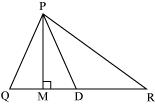
Q1 : In ΔPQR, D is the mid-point of .
is __________.
PD is __________.
Is QM = MR?
Answer :
(i) Altitude
(ii) Median
(iii) No
NCERT Solutions for Class 7 Maths Chapter 6 – The Triangle and its Properties
Q2 : Draw rough sketches for the following:
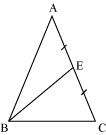
(a) In ΔABC, BE is a median.
(b) In ΔPQR, PQ and PR are altitudes of the triangle.
(c) In ΔXYZ, YL is an altitude in the exterior of the triangle.
Answer :
(a)
(b)
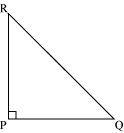
(c)
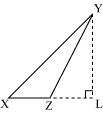
Here, it can be observed that for ΔXYZ, YL is an altitude drawn exterior to side XZ which is extended up to point L.
Q3 : Verify by drawing a diagram if the median and altitude of an isosceles triangle can be same.
Answer :
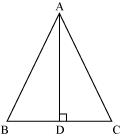
Draw a line segment AD perpendicular to BC. It is an altitude for this triangle. It can be observed that the length of BD and DC is also same. Therefore, AD is also a median of this triangle.
Exercise 6.2 : Solutions of Questions on Page Number : 118
Q1 :Find the value of the unknown exterior angle x in the following diagrams:
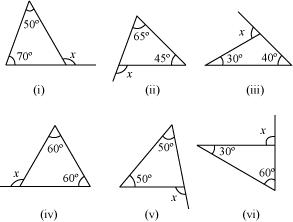
Answer :
(i) x = 50° + 70° (Exterior angle theorem)
x = 120°
(ii) x = 65° + 45° (Exterior angle theorem)
= 110°
(iii) x = 40° + 30° (Exterior angle theorem)
= 70°
(iv) x = 60° + 60° (Exterior angle theorem)
= 120°
(v) x = 50° + 50° (Exterior angle theorem)
= 100°
(vi) x = 30° + 60° (Exterior angle theorem)
= 90°
Q2 : Find the value of the unknown interior angle x in the following figures:
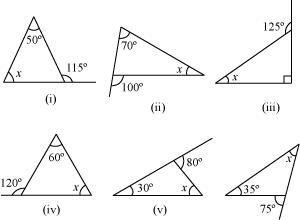
Answer :
(i) x + 50° = 115° (Exterior angle theorem)
x = 115° – 50° = 65°
(ii) 70° + x = 100° (Exterior angle theorem)
x = 100° – 70° = 30°
(iii) x + 90° = 125° (Exterior angle theorem)
x = 125° – 90° = 35°
(iv) x + 60° = 120° (Exterior angle theorem)
x = 120° – 60° = 60°
(v) x + 30° = 80° (Exterior angle theorem)
x = 80° – 30° = 50°
(vi) x + 35° = 75° (Exterior angle theorem)
x = 75º – 35º = 40°
Exercise 6.3 : Solutions of Questions on Page Number : 121
Q1 : Find the value of the unknown x in the following diagrams:
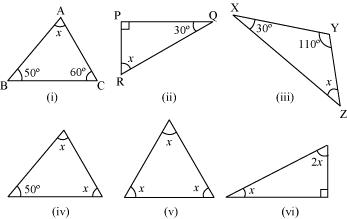
Answer :
The sum of all interior angles of a triangle is 180°. By using this property, these problems can be solved as follows.
(i) x + 50° + 60° = 180°
x + 110° = 180°
x = 180° – 110° = 70°
(ii) x + 90° + 30° = 180°
x + 120° = 180°
x = 180° – 120° = 60°
(iii) x + 30° + 110° = 180°
x + 140° = 180°
x = 180° – 140° = 40°
(iv) 50° + x + x = 180°
50° + 2x = 180°
2x = 180° – 50° = 130°

(v) x + x + x = 180°
3x = 180°

(vi) x + 2x + 90° = 180°
3x = 180° – 90° = 90 º
Q2 : Find the value of the unknowns x and y in the following diagrams:
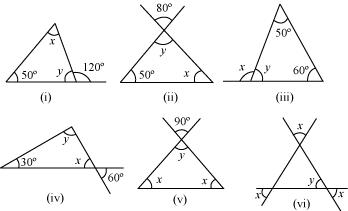
Answer :
(i) y + 120° = 180° (Linear pair)
y = 180° – 120 º = 60 º
x + y + 50° = 180° (Angle sum property)
x + 60° + 50° = 180°
x + 110° = 180°
x = 180° – 110° = 70°
(ii) y = 80° (Vertically opposite angles)
y + x + 50° = 180° (Angle sum property)
80° + x + 50° = 180°
x + 130 º = 180°
x = 180° – 130 º = 50°
(iii) y + 50° + 60° = 180° (Angle sum property)
y = 180° – 60° – 50° = 70°
x + y = 180° (Linear pair)
x = 180° – y = 180° – 70° = 110°
(iv) x = 60 º (Vertically opposite angles)
30° + x + y = 180°
30° + 60° + y = 180°
y = 180° – 30° – 60° = 90°
(v) y = 90° (Vertically opposite angles)
x + x + y = 180° (Angle sum property)
2x + y = 180°
2x + 90° = 180°
2x = 180° – 90° = 90°

(vi)

y = x (Vertically opposite angles)
a = x (Vertically opposite angles)
b = x (Vertically opposite angles)
a + b + y = 180° (Angle sum property)
x + x + x = 180°
3x = 180°

y = x = 60°
Exercise 6.4 : Solutions of Questions on Page Number : 126
Q1 : Is it possible to have a triangle with the following sides?
(i) 2 cm, 3 cm, 5 cm
(ii) 3 cm, 6 cm, 7 cm
(iii) 6 cm, 3 cm, 2 cm
Answer :
In a triangle, the sum of the lengths of either two sides is always greater than the third side.
(i) Given that, the sides of the triangle are 2 cm, 3 cm, 5 cm.
It can be observed that,
2 + 3 = 5 cm
However, 5 cm = 5 cm
Hence, this triangle is not possible.
(ii) Given that, the sides of the triangle are 3 cm, 6 cm, 7 cm.
Here, 3 + 6 = 9 cm > 7 cm
6 + 7 = 13 cm > 3 cm
3 + 7 = 10 cm > 6 cm
Hence, this triangle is possible.
(iii) Given that, the sides of the triangle are 6 cm, 3 cm, 2 cm.
Here, 6 + 3 = 9 cm > 2 cm
However, 3 + 2 = 5 cm < 6 cm
Hence, this triangle is not possible.
Q2 : Take any point O in the interior of a triangle PQR. Is
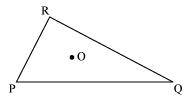
(i) OP + OQ > PQ?
(ii) OQ + OR > QR?
(iii) OR + OP > RP?
Answer :
If O is a point in the interior of a given triangle, then three triangles ΔOPQ, ΔOQR, and ΔORP can be constructed. In a triangle, the sum of the lengths of either two sides is always greater than the third side.
(i) Yes, as ΔOPQ is a triangle with sides OP, OQ, and PQ.
OP + OQ > PQ
(ii) Yes, as ΔOQR is a triangle with sides OR, OQ, and QR.
OQ + OR > QR
(iii) Yes, as ΔORP is a triangle with sides OR, OP, and PR.
OR + OP > PR
Q3 : AM is a median of a triangle ABC.
Is AB + BC + CA > 2 AM?
(Consider the sides of triangles ΔABM and ΔAMC.)
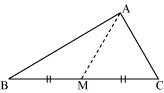
Answer :
In a triangle, the sum of the lengths of either two sides is always greater than the third side.
In ΔABM,
AB + BM > AM (i)
Similarly, in ΔACM,
AC + CM > AM (ii)
Adding equation (i) and (ii),
AB + BM + MC + AC > AM + AM
AB + BC + AC > 2AM
Yes, the given expression is true.
Q4 : ABCD is quadrilateral.
Is AB + BC + CD + DA >AC + BD?
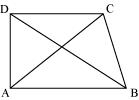
Answer :
In a triangle, the sum of the lengths of either two sides is always greater than the third side.
Considering ΔABC,
AB + BC > CA (i)
In ΔBCD,
BC + CD > DB (ii)
In ΔCDA,
CD + DA > AC (iii)
In ΔDAB,
DA + AB > DB (iv)
Adding equations (i), (ii), (iii), and (iv), we obtain
AB + BC + BC + CD + CD + DA + DA + AB > AC + BD + AC + BD
2AB + 2BC + 2CD +2DA > 2AC + 2BD
2(AB + BC + CD + DA) > 2(AC + BD)
(AB + BC + CD + DA) > (AC + BD)
Yes, the given expression is true.
Q5 : ABCD is quadrilateral.
Is AB + BC + CD + DA < 2 (AC + BD)?
Answer :
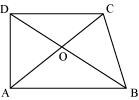
In a triangle, the sum of the lengths of either two sides is always greater than the third side. Considering
ΔOAB, OA + OB > AB (i)
In ΔOBC,
OB + OC > BC (ii)
In ΔOCD,
OC + OD > CD (iii)
In ΔODA,
OD + OA > DA (iv)
Adding equations (i), (ii), (iii), and (iv), we obtain
OA + OB + OB + OC + OC + OD + OD + OA > AB + BC + CD + DA
2OA + 2OB + 2OC + 2OD > AB + BC + CD + DA
2OA + 2OC + 2OB + 2OD > AB + BC + CD + DA
2(OA + OC) + 2(OB + OD) > AB + BC + CD + DA
2(AC) + 2(BD) > AB + BC + CD + DA
2(AC + BD) > AB + BC + CD + DA
Yes, the given expression is true.
Q6 : The lengths of two sides of a triangle are 12 cm and 15 cm. Between what two measures should the length of the third side fall?
Answer :
In a triangle, the sum of the lengths of either two sides is always greater than the third side and also, the difference of the lengths of either two sides is always lesser than the third side. Here, the third side will be lesser than the sum of these two (i.e., 12 + 15 = 27) and also, it will be greater than the difference of these two (i.e., 15 – 12 = 3). Therefore, those two measures are 27cm and 3 cm.
Exercise 6.5 : Solutions of Questions on Page Number : 130
Q1 : PQR is a triangle right angled at P. If PQ = 10 cm and PR = 24 cm, find QR.
Answer :
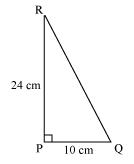
By applying Pythagoras theorem in ΔPQR,
(PQ)2 + (PR)2 = (RQ)2
(10)2 + (24)2 = RQ2
100 + 576 = (QR)2
676 = (QR)2
QR = 26 cm
Q2 : ABC is a triangle right angled at C. If AB = 25 cm and AC = 7 cm, find BC.
Answer :
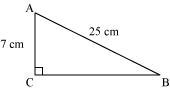
By applying Pythagoras theorem in ΔABC,
(AC)2 + (BC)2 = (AB)2
(BC)2 = (AB)2 – (AC)2
(BC)2 = (25)2 – (7)2
(BC)2 = 625 – 49 = 576
BC = 24 cm
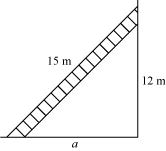
Q3 : A 15 m long ladder reached a window 12 m high from the ground on placing it against a wall at a distance a. Find the distance of the foot of the ladder from the wall.
Answer :
By applying Pythagoras theorem,
(15)2 = (12)2 + a2
225 = 144 + a2
a2 = 225 – 144 = 81
a = 9 m
Therefore, the distance of the foot of the ladder from the wall is 9 m.
Q4 : Which of the following can be the sides of a right triangle?
(i) 2.5 cm, 6.5 cm, 6 cm
(ii) 2 cm, 2 cm, 5 cm
(iii) 1.5 cm, 2 cm, 2.5 cm
In the case of right-angled triangles, identify the right angles.
Answer :
(i) 2.5 cm, 6.5 cm, 6 cm
(2.5)2 = 6.25
(6.5)2 = 42.25
(6)2 = 36
It can be observed that,
36 + 6.25 = 42.25
(6)2 + (2.5)2 = (6.5)2
The square of the length of one side is the sum of the squares of the lengths of the remaining two sides. Hence, these are the sides of a right-angled triangle. Right angle will be in front of the side of 6.5 cm measure.
(ii) 2 cm, 2 cm, 5 cm
(2)2 = 4
(2)2 = 4
(5)2 = 25
Here, (2)2 + (2)2 ≠ (5)2
The square of the length of one side is not equal to the sum of the squares of the lengths of the remaining two sides. Hence, these sides are not of a right-angled triangle.
(iii) 1.5 cm, 2 cm, 2.5 cm
(1.5)2 = 2.25
(2)2 = 4
(2.5)2 = 6.25
Here,
2.25 + 4 = 6.25
(1.5)2 + (2)2 = (2.5)2
The square of the length of one side is the sum of the squares of the lengths of the remaining two sides. Hence, these are the sides of a right-angled triangle.
Right angle will be in front of the side of 2.5 cm measure.
Q5 : A tree is broken at a height of 5 m from the ground and its top touches the ground at a distance of 12 m from the base of the tree. Find the original height of the tree.
Answer :
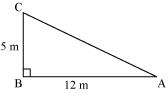
In the given figure, BC represents the unbroken part of the tree. Point C represents the point where the tree broke and CA represents the broken part of the tree. Triangle ABC, thus formed, is right-angled at B.
Applying Pythagoras theorem in ΔABC,
AC2 = BC2 + AB2
AC2 = (5 m)2 + (12 m)2
AC2 = 25 m2 + 144 m2 = 169 m2
AC = 13 m
Thus, original height of the tree = AC + CB = 13 m + 5 m = 18 m
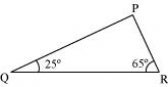
Q6 : Angles Q and R of a ΔPQR are 25° and 65°.
Write which of the following is true:
(i) PQ2 + QR2= RP2
(ii) PQ2 + RP2= QR2
(iii) RP2 + QR2= PQ2
Answer :
The sum of the measures of all interior angles of a triangle is 180º.
∠ PQR + ∠ PRQ + ∠ QPR = 180º
25º + 65º + ∠ QPR = 180º
90º + ∠ QPR = 180º
∠ QPR = 180º – 90º = 90º
Therefore, Δ PQR is right-angled at point P.
Hence, (PR)2 + (PQ)2 = (QR)2
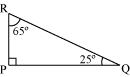
Thus, (ii) is true.
Q7 : Find the perimeter of the rectangle whose length is 40 cm and a diagonal is 41 cm.
Answer :
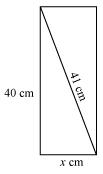
In a rectangle, all interior angles are of 90º measure. Therefore, Pythagoras theorem can be applied here.
(41)2 = (40)2 + x2
1681 = 1600 + x2
x2 = 1681 – 1600 = 81
x = 9 cm
Perimeter = 2(Length + Breadth)
= 2(x + 40)
= 2 (9 + 40)
= 98 cm
Q8 : The diagonals of a rhombus measure 16 cm and 30 cm. Find its perimeter.
Answer :
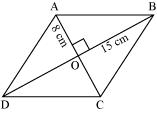
Let ABCD be a rhombus (all sides are of equal length) and its diagonals, AC and BD, are intersecting each other at point O. Diagonals in a rhombus bisect each other at 90 º. It can be observed that
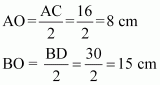
By applying Pythagoras theorem in ΔAOB,
OA2 + OB2 = AB2
82 + 152 = AB2
64 + 225 = AB2
289 = AB2
AB = 17
Therefore, the length of the side of rhombus is 17 cm.
Perimeter of rhombus = 4 × Side of the rhombus = 4 × 17 = 68 cm