
Exercise 5.1 : Solutions of Questions on Page Number : 103
NCERT Solutions for Class 11 Maths Chapter 5 Complex Numbers and Quadratic Equations
Q1 :Express the given complex number in the form a + ib: 
Answer :
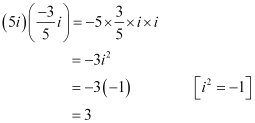
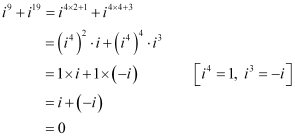
Q2 :Express the given complex number in the form a + ib: i9 + i19
Answer :
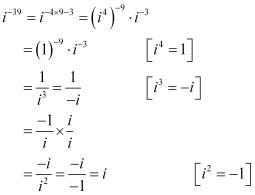
Q3 :Express the given complex number in the form a + ib: i-39
Answer :
Q4 :Express the given complex number in the form a + ib: 3(7 + i7) + i(7 + i7)
Answer :

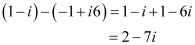
Q5 :Express the given complex number in the form a + ib: (1 – i) – (-1 + i6)
Answer :
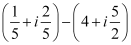
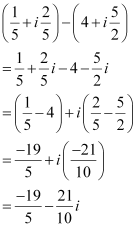
Q6 :Express the given complex number in the form a + ib:
Answer :
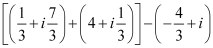
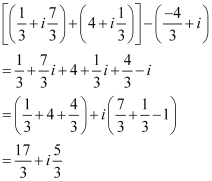
Q7 :Express the given complex number in the form a + ib:
Answer :
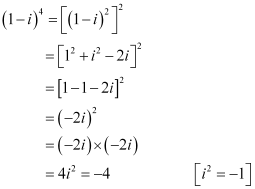
Q8 :Express the given complex number in the form a + ib: (1 – i)4
Answer :
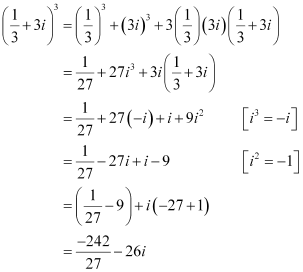
Q9 :Express the given complex number in the form a + ib: 
Answer :
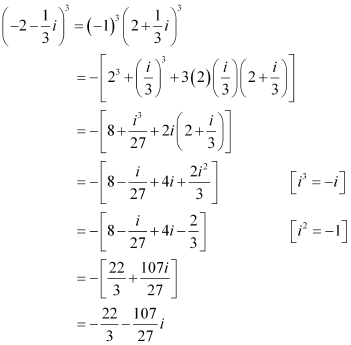
Q10 :Express the given complex number in the form a + ib: 
Answer :
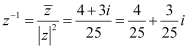
Q11 :Find the multiplicative inverse of the complex number 4 – 3i
Answer :
Let z = 4 – 3i
Then, = 4 + 3i and  Therefore, the multiplicative inverse of 4 – 3i is given by
Q12 :Find the multiplicative inverse of the complex number
 Answer :
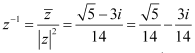
Let z =  Therefore, the multiplicative inverse of is given by
Q13 :Find the multiplicative inverse of the complex number -i
Answer :
Let z = -i
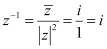
 Therefore, the multiplicative inverse of -i is given by
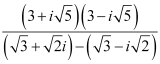
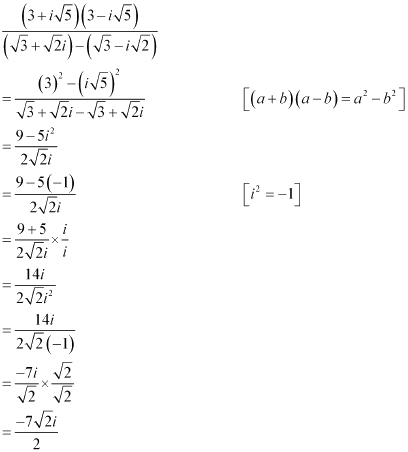
Q14 :Express the following expression in the form of a + ib.
Answer :
Exercise 5.2 : Solutions of Questions on Page Number : 108
Q1 :Find the modulus and the argument of the complex number 
Answer :

On squaring and adding, we obtain
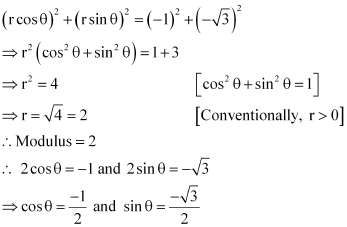
Since both the values of sin θand cos θ are negative and sinθand cosθare negative in III quadrant, 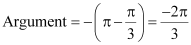
Thus, the modulus and argument of the complex number  are 2 and
  respectively.
Q2 :Find the modulus and the argument of the complex number

Answer :

On squaring and adding, we obtain
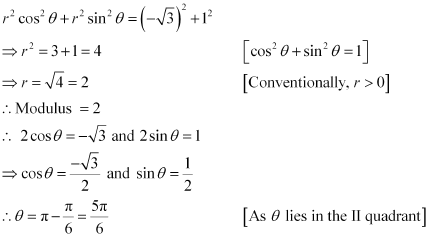
Thus, the modulus and argument of the complex number  are 2 and
  respectively.
Q3 :Convert the given complex number in polar form: 1 – i
Answer :
1 – i
Let rcos θ = 1 and rsin θ = -1
On squaring and adding, we obtain
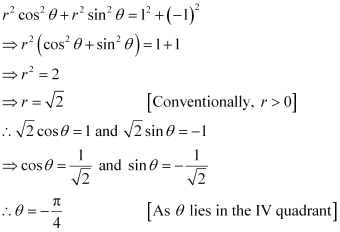
 This is the required polar form.
Q4 :Convert the given complex number in polar form: – 1 + i
Answer :
-1 + i
Let rcos θ =-1 and rsin θ = 1
On squaring and adding, we obtain
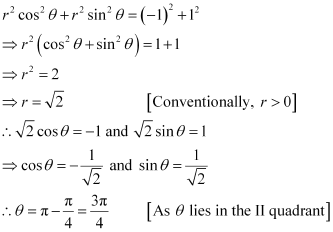
It can be written,

This is the required polar form.
Q5 :Convert the given complex number in polar form: – 1 – i
Answer :
– 1 – i
Let rcos θ = -1 and rsin θ = -1
On squaring and adding, we obtain
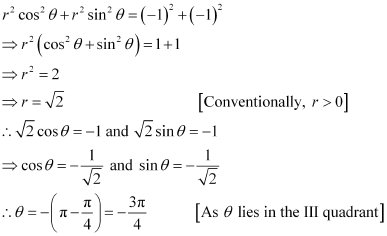
 This is the required polar form.
Q6 :Convert the given complex number in polar form: -3
Answer :
-3
Let rcos θ = -3 and rsin θ = 0
On squaring and adding, we obtain
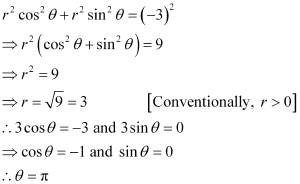
 This is the required polar form.
Q7 :Convert the given complex number in polar form: 
Answer :
Let rcos θ =and rsin θ = 1
On squaring and adding, we obtain
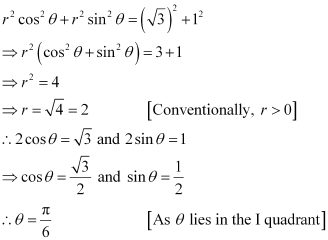
 This is the required polar form.
Q8 : Convert the given complex number in polar form: i
Answer:
i
Let rcosθ = 0 and rsin θ = 1
On squaring and adding, we obtain
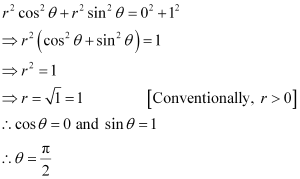
 This is the required polar form.
Exercise 5.3 : Solutions of Questions on Page Number : 109
Q1 :Solve the equation x2 + 3 = 0
Answer :
The given quadratic equation is x2 + 3 = 0
On comparing the given equation with ax2 + bx + c = 0, we obtain
a = 1, b = 0, and c = 3
Therefore, the discriminant of the given equation is
D = b2 – 4ac = 02 – 4 × 1 × 3 = -12
Therefore, the required solutions are
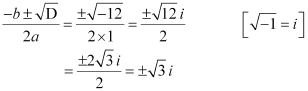
Q2 :Solve the equation 2x2 + x + 1 = 0
Answer :
The given quadratic equation is 2x2 + x + 1 = 0
On comparing the given equation with ax2 + bx + c = 0, we obtain
a = 2, b = 1, and c = 1
Therefore, the discriminant of the given equation is
D = b2 – 4ac = 12 – 4 × 2 × 1 = 1 – 8 = – 7
Therefore, the required solutions are 
Q3 :Solve the equation x2 + 3x + 9 = 0
Answer :
The given quadratic equation is x2 + 3x + 9 = 0
On comparing the given equation with ax2 + bx + c = 0, we obtain
a = 1, b = 3, and c = 9
Therefore, the discriminant of the given equation is
D = b2 – 4ac = 32 – 4 × 1 × 9 = 9 – 36 = -27
Therefore, the required solutions are

Q4 :Solve the equation -x2 + x – 2 = 0
Answer :
The given quadratic equation is -x2 + x – 2 = 0
On comparing the given equation with ax2 + bx + c = 0, we obtain
a = -1, b = 1, and c = -2
Therefore, the discriminant of the given equation is
D = b2 – 4ac = 12 – 4 × (-1) × (-2) = 1 – 8 = -7
Therefore, the required solutions are

Q5 :Solve the equation x2 + 3x + 5 = 0
Answer :
The given quadratic equation is x2 + 3x + 5 = 0
On comparing the given equation with ax2 + bx + c = 0, we obtain
a = 1, b = 3, and c = 5
Therefore, the discriminant of the given equation is
D = b2 – 4ac = 32 – 4 × 1 × 5 =9 – 20 = -11
Therefore, the required solutions are

Q6 :Solve the equation x2 – x + 2 = 0
Answer :
The given quadratic equation is x2 – x + 2 = 0
On comparing the given equation with ax2 + bx + c = 0, we obtain
a = 1, b = -1, and c = 2
Therefore, the discriminant of the given equation is
D = b2 – 4ac = (-1)2 – 4 × 1 × 2 = 1 -“ 8 = -7
Therefore, the required solutions are

Q7 :Solve the equation

Answer :
The given quadratic equation is
On comparing the given equation with ax2 + bx + c = 0, we obtain
a = , b = 1, and c =
Therefore, the discriminant of the given equation is
D = b2 – 4ac = 12 – – = 1 – 8 = -7
Therefore, the required solutions are

Q8 :Solve the equation 
Answer :
The given quadratic equation is
On comparing the given equation with ax2 + bx + c = 0, we obtain
a = , b =
, b = , and c =
Therefore, the discriminant of the given equation is
D = b2 – 4ac = 
Therefore, the required solutions are

Q9 :Solve the equation 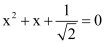
Answer :
The given quadratic equation is
This equation can also be written as

On comparing this equation with ax2 + bx + c = 0, we obtain
a =  , b = , and c = 1
Therefore, the required solutions are

Q10 :Solve the equation 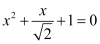
Answer :
The given quadratic equation is
This equation can also be written as

On comparing this equation with ax2 + bx + c = 0, we obtain
a = , b = 1, and c =

Therefore, the required solutions are

Exercise Miscellaneous : Solutions of Questions on Page Number : 112
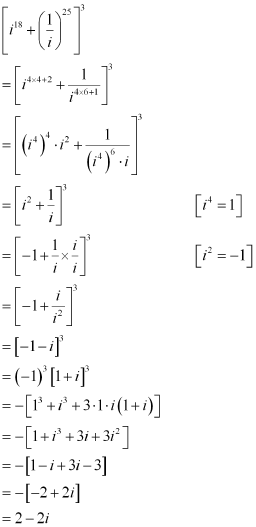
Q1 :Evaluate: 
Answer :
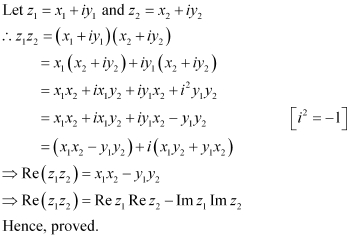
Q2 :For any two complex numbers z1 and z2, prove that
Re (z1z2) = Re z1 Re z2 – Im z1 Im z2
Answer :
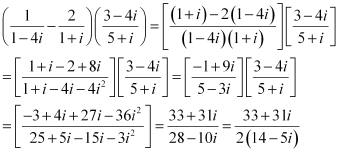
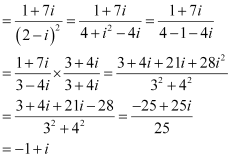
Q3 :Reduce to the standard form. 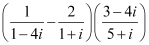
Answer :
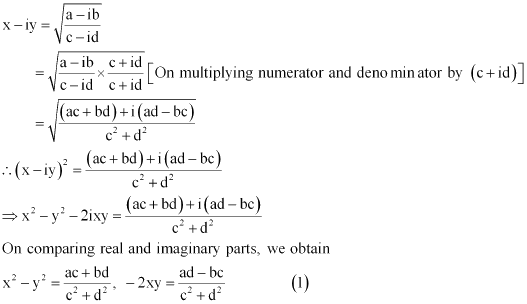
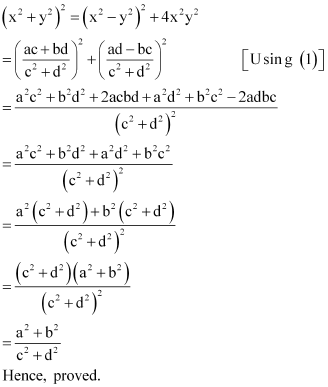
Q4 :If x – iy =  prove that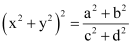
Answer :
Q5 :Convert the following in the polar form:
(i)  , (ii)
Answer :
(i) Here, 
Let r cos θ = -1 and r sin θ = 1
On squaring and adding, we obtain
r2 (cos2 θ + sin2 θ) = 1 + 1
⇒ r2 (cos2 θ + sin2 θ) = 2
⇒ r2 = 2 [cos2 θ + sin2 θ = 1]

∴ z = r cos θ + i r sin θ

This is the required polar form
(ii) Here, 
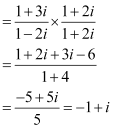
Let r cos θ = -1 and r sin θ = 1
On squaring and adding, we obtain
r2 (cos2 θ + sin2 θ) = 1 + 1
⇒r2 (cos2 θ + sin2 θ) = 2
⇒ r2 = 2 [cos2 θ + sin2 θ = 1]
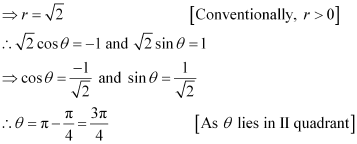
∴z = r cos θ + i r sin θ

This is the required polar form.
Q6 :Solve the equation 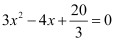
Answer :
The given quadratic equation is
This equation can also be written as

On comparing this equation with ax2 + bx + c = 0, we obtain
a = 9, b = -12, and c = 20
Therefore, the discriminant of the given equation is
D = b2 – 4ac = (-12)2 – 4 × 9 × 20 = 144 – 720 = -576
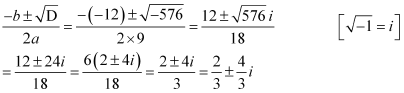
Therefore, the required solutions are
Q7 :Solve the equation 
Answer :
The given quadratic equation is
This equation can also be written as
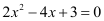
On comparing this equation with ax2 + bx + c = 0, we obtain
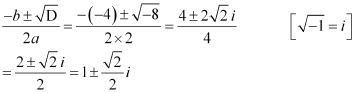
a = 2, b = -4, and c = 3
Therefore, the discriminant of the given equation is
D = b2 – 4ac = (-4)2 – 4 × 2 × 3 = 16 – 24 = -8
Therefore, the required solutions are
Q8 :Solve the equation 27x2 – 10x + 1 = 0
Answer :
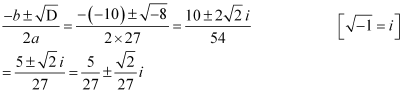
The given quadratic equation is 27x2 – 10x + 1 = 0
On comparing the given equation with ax2 + bx + c = 0, we obtain
a = 27, b = -10, and c = 1
Therefore, the discriminant of the given equation is
D = b2 – 4ac = (-10)2 – 4 × 27 × 1 = 100 – 108 = -8
Therefore, the required solutions are
Q9 :Solve the equation 21x2 – 28x + 10 = 0
Answer :
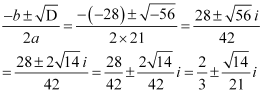
The given quadratic equation is 21x2 – 28x + 10 = 0
On comparing the given equation with ax2 + bx + c = 0, we obtain
a = 21, b = -28, and c = 10
Therefore, the discriminant of the given equation is
D = b2 – 4ac = (-28)2 – 4 × 21 × 10 = 784 – 840 = -56
Therefore, the required solutions are
Q10 :If find 

Answer :
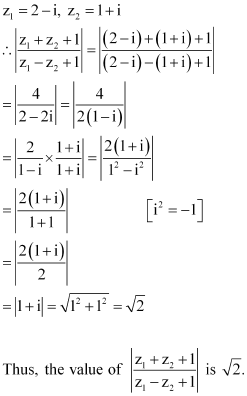
Q11 :If find .
Answer :
Q12 :If a + ib =  , prove that a2 + b2 =
Answer :

On comparing real and imaginary parts, we obtain
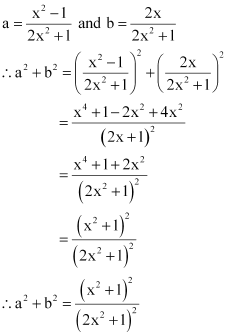
Hence, proved.
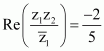
Q13 :Let  . Find
(i)  , (ii)
Answer :
(i)
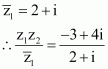
On multiplying numerator and denominator by (2 – i), we obtain
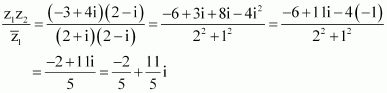
On comparing real parts, we obtain
(ii) 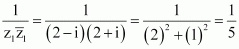
On comparing imaginary parts, we obtain

Q14 :Find the modulus and argument of the complex number  .
.
Answer :
Let  , then
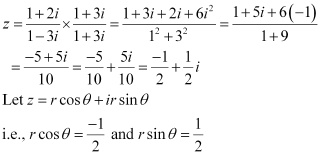
On squaring and adding, we obtain

Therefore, the modulus and argument of the given complex number are respectively.
Q15 :Find the real numbers x and y if (x – iy) (3 + 5i) is the conjugate of -6 – 24i.
Answer :
Let 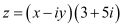

It is given that,


Equating real and imaginary parts, we obtain
3x + 5y =-6 ……. (i)
5x -3y = 24 ……..(ii)
Multiplying equation (i) by 3 and equation (ii) by 5 and then adding them, we obtain
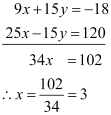
Putting the value of x in equation (i), we obtain
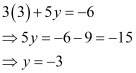
Thus, the values of x and y are 3 and -3 respectively.
Q16 :Find the modulus of 
Answer :
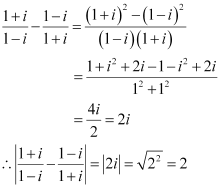
Q17 :If (x + iy)3 = u + iv, then show that 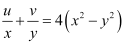
Answer :
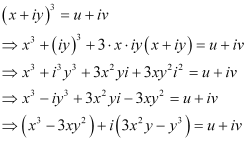
On equating real and imaginary parts, we obtain
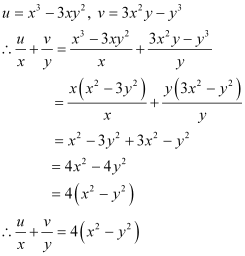
Hence, proved.
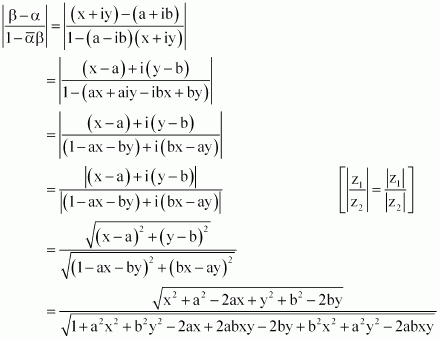
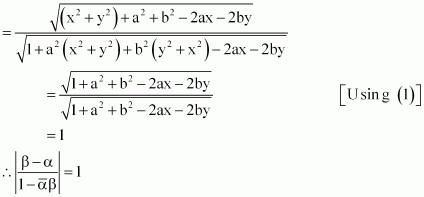
 =1
=1
Q19 :Find the number of non-zero integral solutions of the equation 
Answer :
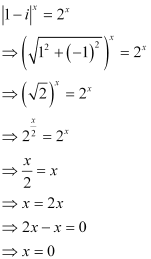
Thus, 0 is the only integral solution of the given equation. Therefore, the number of non-zero integral solutions of the given equation is 0.
Q20 :If (a + ib) (c + id) (e + if) (g + ih) = A + iB, then show that
(a2 + b2) (c2 + d2) (e2 + f2) (g2 + h2) = A2 + B2.
Answer :

On squaring both sides, we obtain
(a2 + b2) (c2 + d2) (e2 + f2) (g2 + h2) = A2 + B2
Hence, proved.
Q21 :If  , then find the least positive integral value of m.
Answer :
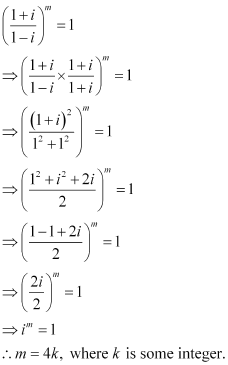
Therefore, the least positive integer is 1.
Thus, the least positive integral value of m is 4 (= 4 × 1).