
Unit 2 Physical Features of India Exercise Solutions
Exercise : Solutions of Questions on Page Number : 15
Q1 : Choose the right answer from the four alternatives given below.
(i) A landmass bound by sea on three sides is referred to as
(a) Coast (c) Peninsula
(b) Island (d) None of the above
(ii) Mountain ranges in the eastern part of India forming its boundary with Myanmar are collectively called as
(a) Himachal (c) Purvachal
(b) Uttarakhand (d) None of the above
(iii) The western coastal strip, south of Goa is referred to as
(a) Coromandel (c) Kannad
(b) Konkan (d) Northern Circar
(iv) The highest peak in the Eastern Ghats is
(a) Anai Mudi (c) Mahendragiri
(b) Kanchenjunga (d) Khasi
Answer :
(i) A landmass bound by sea on three sides is referred to as
(a) Coast (c) Peninsula
(b) Island (d) None of the above
(ii) Mountain ranges in the eastern part of India forming its boundary with Myanmar are collectively called as
(a) Himachal (c) Purvachal
(b) Uttarakhand (d) None of the above
(iii) The western coastal strip, south of Goa is referred to as
(a) Coromandel (c) Kannad
(b) Konkan (d) Northern Circar
(iv) The highest peak in the Eastern Ghats is
(a) Anai Mudi (c) Mahendragiri
(b) Kanchenjunga (d) Khasi
Q2 : Answer the following questions briefly.
(i) What are tectonic plates?
(ii) Which continents of today were part of the Gondwana land?
(iii) What is the bhabar?
(iv) Name the three major divisions of the Himalayas from north to south.
(v) Which plateau lies between the Aravali and the Vindhyan ranges?
(vi) Name the island group of India having coral origin.
Answer :
(i) The convectional currents present below the solid layer of Earth’s crust split the crust or the lithosphere into a number of large fragments. These fragments are called tectonic or lithospheric plates.
(ii) The continents that were part of Gondwana land are Australia, Antarctica and South America.
(iii) The bhabhar is that part of the Northern Plains where the rivers, after descending from the mountains, deposit pebbles. It is a narrow belt, having a width of about 8 to 16 km and lying parallel to the slopes of the Shiwaliks.
(iv) The three major divisions of the Himalayas from north to south are the Great Himalayas/Inner Himalayas/Himadri (Northernmost division), the Lesser Himalayas/Himachal and the Shiwaliks (Southernmost division).
(v) Malwa plateau lies between the Aravali and the Vindhyan ranges.
(vi) Lakshadweep Islands are composed of small coral islands.
Q3 : Project/Activity
Locate the peaks, passes, ranges, plateaus, hills, and duns hidden in the puzzle. Try to find where these features are located. You may start your search horizontally, vertically or diagonally.

Answer :
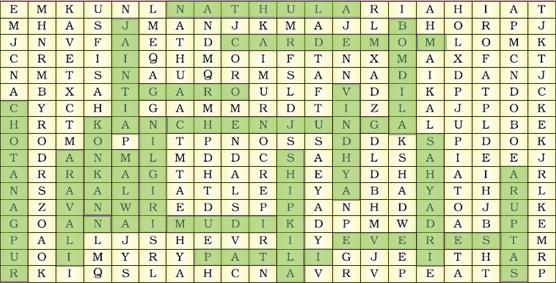
Vertical
CHOTANAGPUR
ARAVALI
KONKAN
JAINTIA
MALWA
NILGIRI
SHIPKILA
VINDHYA
BOMDILA
SAHYADRI
SATPURA
Horizontal
NATHULA
CARDEMOM
GARO
KANCHENJUNGA
ANAIMUDI
EVEREST
PATLI
Q4 : Distinguish between
(i)Converging and diverging tectonic plates
(ii) Bhangarand Khadar
(iii) Western Ghats and Eastern Ghats
Answer :
(i)The Earth’s crust is broken up into several lithospheric or tectonic plates. These plates are constantly moving atop the Earth’s mantle (semi-solid layer of molten rocks). Based upon their motion, tectonic plates are referred to as converging or diverging. Converging tectonic plates move towards each other and form convergent boundary. Diverging tectonic plates move away from each other and form divergent boundary.
(ii)Bhangaris the terrace-like feature present above the flood plains of the rivers. It is composed of older alluvium. It is the largest part of the Northern Plain. The soil of this region contains calcerous deposits locally known as kankar.
The newer, younger deposits of the flood plains are called khadar. This region is very fertile as it gets renewed almost every year. Hence, it is ideal for intensive agriculture.
(iii)
| Western Ghats | Eastern Ghats |
| Mark the western edge of the Deccan Plateau | Mark the eastern edge of the Deccan Plateau |
| Continuous | Discontinuous and irregular |
| Higher; average elevation is 900 – 1600 metres | Lower; average elevation is 600 metres |
| Lie parallel to the western coast along the Arabian Sea | Lie parallel to the eastern coast along the Bay of Bengal |
Q5 : Describe how the Himalayas were formed.
Answer :
According to the Theory of Plate Tectonics, the Earth’s crust was initially a single, giant super-continent called Pangea. Its northern part was the Angara land and the southern part was the Gondwana land. The movement of the molten material below the Earth’s crust caused the crust or the lithosphere to break up into a number of large fragments called lithospheric or tectonic plates. Another important feature of the Earth’s crust at the time was the geosyncline—a narrow, shallow, elongated basin with a sinking bottom in which a considerable thickness of sediments were deposited by the rivers coming from Angara land and Gondwana land—called the Tethys. After separating from the Gondwana land, the Indo-Australian Plate drifted towards the north in the direction of the Eurasian Plate. This resulted in the collision of the two plates, and due to this collision, the sedimentary rocks in the Tethys got folded to form the mountain system of western Asia and the Himalayas.
Q6 : Which are the major physiographic divisions of India? Contrast the relief of the Himalayan region with that of the Peninsular plateau.
Answer :
The major physiographic divisions of India are:
(i) The Himalayan Mountains
(ii) The Northern Plains
(iii) The Peninsular Plateau
(iv) The Indian Desert
(v) The Coastal Plains
(vi) The Islands
| The Himalayan Region | The Peninsular Plateau |
| Having a comparatively recent origin, it is made up of young fold mountains | It is the oldest landmass of the Indian subcontinent; was part of the Gondwana land |
| Consists of the loftiest mountains and deep valleys | Consists of broad and shallow valleys, and rounded hills |
| Formed due to the collision of the Indo-Australian and Eurasian plates | Formed due to the breaking and drifting of the Gondwana land |
| Composed of sedimentary rocks | Composed of igneous and metamorphic rocks |
| From the point of view of geology, this region forms an unstable zone | This region forms a stable zone |
Q7 : Give an account of the Northern Plains of India.
Answer :
The Himalayan upliftment out of the Tethys Sea andthe subsidence of the northern flank of the Peninsular Plateau resulted in the formation of a large basin. Gradually, the rivers flowing from the mountains in the north and the peninsular plateau in the south filled up this depression with deposits of sediments. This led to the formation of the Northern Plains of India.
The formation of the Northern Plains owes largely to the interplay of three major river systems, namely – the Indus, the Ganga and the Brahmaputra along with their tributaries. This physiographic division spreads over an area of 7 lakh square kilometres, and is 2,400 kilometres long and 320 kilometres broad. It is a densely populated region. The rich soil cover, adequate water supply and favourable climate make the region agriculturally very productive.
The Northern Plains are broadly divided into three sections.
The Punjab Plains -Western part of the Northern Plains; formed by the Indus and its tributaries
The Ganga Plains – Largest part of the Northern Plains; extends between Ghaggar and Teesta rivers
The Brahmaputra Plains – Eastern part of the Northern Plains; formed by the Brahmaputra and its tributaries
According to the variations in relief features, the Northern Plains are divided into four regions.
Bhabar- Narrow belt of pebbles lying parallel to the slopes of Shiwaliks
Terai- Wet, swampy, marshy region south of the bhabarbelt
Bhangar- Terrace-like feature composed of older alluvium, lying above the flood plains
Khadar- Newer, younger deposits of the flood plains
Q8 : Write short notes on the following.
(i) The Indian Desert
(ii) The Central Highlands
(iii) The Island groups of India
Answer :
(i) Lying towards the west of the Aravali Hills, the Indian Desert is an undulating sandy plain covered with crescent-shaped and longitudinal sand dunes. This region is characterised by very little rainfall, an arid climate and low vegetation cover. Streams appear only during the rainy season. Luni is the only large river in this region.
(ii) The part of the Peninsular Plateau lying to the north of the Narmada River, covering a major area of the Malwa Plateau, is known as the Central Highlands. They are bound by the Vindhya Range from the south and by the Aravali Hills from the northwest. The further westward extension merges with the Indian Desert while the eastward extension is marked by the Chotanagpur Plateau. The rivers draining this region flow from southwest to northeast. The Central Highlands are wider in the west but narrower in the east.
(iii) India has two groups of islands. The Lakshadweep Islands lie in the Arabian Sea, to the southwest of the mainland. The Andaman and Nicobar Islands lie in the Bay of Bengal, to the southeast of the mainland.
Lakshadweep is composed of small coral islands, covering a small area of 32 square kilometres. Kavaratti Island is its administrative headquarters. The Andaman and Nicobar Islands are bigger in size and are more numerous and scattered. The entire group of islands is divided into Andaman (in the north) and Nicobar (in the south).
Both these island groups are rich in flora and fauna, and are of great strategic importance to the country.