
Exercise 2.1 : Solutions of Questions on Page Number : 32
Q1 :Which of the following expressions are polynomials in one variable and which are not? State reasons for your answer.
(i) (ii)
(ii) (iii)
(iii)
(iv) (v)
(v)
Answer :
(i)
Yes, this expression is a polynomial in one variable x.
(ii)
Yes, this expression is a polynomial in one variable y.
(iii)
No. It can be observed that the exponent of variable t in term  is
is , which is not a whole number. Therefore, this expression is not a polynomial.
(iv)
No. It can be observed that the exponent of variable y in term is – 1, which is not a whole number. Therefore, this expression is not a polynomial.
(v)
No. It can be observed that this expression is a polynomial in 3 variables x, y, and t. Therefore, it is not a polynomial in one variable.
Q2 : Write the coefficients of in each of the following:
(i) (ii)
(ii)
(iii) (iv)
(iv)
Answer :
(i)
In the above expression, the coefficient of  is 1.
is 1.
(ii)
In the above expression, the coefficient of is – 1.
(iii)
In the above expression, the coefficient of is .
.
(iv)

In the above expression, the coefficient of is 0.
Q3 : Give one example each of a binomial of degree 35, and of a monomial of degree 100.
Answer :
Degree of a polynomial is the highest power of the variable in the polynomial.
Binomial has two terms in it. Therefore, binomial of degree 35 can be written as .
.
Monomial has only one term in it. Therefore, monomial of degree 100 can be written as x100.
Q4 : Write the degree of each of the following polynomials:
(i)  (ii)
(ii)
(iii) (iv) 3
Answer :
Degree of a polynomial is the highest power of the variable in the polynomial.
(i)
This is a polynomial in variable x and the highest power of variable x is 3. Therefore, the degree of this polynomial is 3.
(ii)
This is a polynomial in variable y and the highest power of variable y is 2. Therefore, the degree of this polynomial is 2.
(iii)
This is a polynomial in variable t and the highest power of variable t is 1. Therefore, the degree of this polynomial is 1.
(iv) 3
This is a constant polynomial. Degree of a constant polynomial is always 0.
Q5 : Classify the following as linear, quadratic and cubic polynomial:
(i)  (ii)
(ii) (iii)
(iii) (iv)
(iv) (v)
(v)
(vi) (vii)
(vii)
Answer :
Linear polynomial, quadratic polynomial, and cubic polynomial has its degrees as 1, 2, and 3 respectively.
(i) is a quadratic polynomial as its degree is 2.
(ii) is a cubic polynomial as its degree is 3.
(iii) is a quadratic polynomial as its degree is 2.
(iv) 1 + x is a linear polynomial as its degree is 1.
(v) is a linear polynomial as its degree is 1.
(vi) is a quadratic polynomial as its degree is 2.
(vii) is a cubic polynomial as its degree is 3.
Exercise 2.2 : Solutions of Questions on Page Number : 34
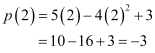
Q1 : Find the value of the polynomial at
(i) x = 0 (ii) x = – 1 (iii) x = 2
Answer :
(i)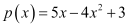
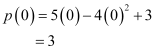
(ii)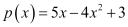
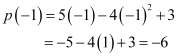
(iii)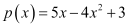
Q2 : Find p(0), p(1) and p(2) for each of the following polynomials:
(i) p(y) = y2 – y + 1 (ii) p(t) = 2 + t + 2t2 – t3
(iii) p(x) = x3 (iv) p(x) = (x – 1) (x + 1)
Answer :
(i) p(y) = y2 – y + 1
p(0) = (0)2 – (0) + 1 = 1
p(1) = (1)2 – (1) + 1 = 1
p(2) = (2)2 – (2) + 1 = 3
(ii) p(t) = 2 + t + 2t2 – t3
p(0) = 2 + 0 + 2 (0)2 – (0)3 = 2
p(1) = 2 + (1) + 2(1)2 – (1)3
= 2 + 1 + 2 – 1 = 4
p(2) = 2 + 2 + 2(2)2 – (2)3
= 2 + 2 + 8 – 8 = 4
(iii) p(x) = x3
p(0) = (0)3 = 0
p(1) = (1)3 = 1
p(2) = (2)3 = 8
(iv) p(x) = (x – 1) (x + 1)
p(0) = (0 – 1) (0 + 1) = (- 1) (1) = – 1
p(1) = (1 – 1) (1 + 1) = 0 (2) = 0
p(2) = (2 – 1 ) (2 + 1) = 1(3) = 3
Q3 : Verify whether the following are zeroes of the polynomial, indicated against them.
(i)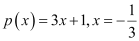 (ii)
(ii)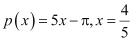
(iii) p(x) = x2 – 1, x = 1, – 1 (iv) p(x) = (x + 1) (x – 2), x = – 1, 2
(v) p(x) = x2 , x = 0 (vi) p(x) = lx + m
(vii)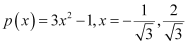 (viii)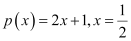
Answer :
(i)If is a zero of given polynomial p(x) = 3x + 1, then
 should be 0.

Therefore, is a zero of the given polynomial.
(ii) If is a zero of polynomial p(x) = 5x – π , then
 should be 0.
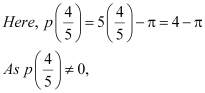
Therefore, is not a zero of the given polynomial.
(iii) If x = 1 and x = – 1 are zeroes of polynomial p(x) = x2 – 1, then p(1) and p( – 1) should be 0.
Here, p(1) = (1)2 – 1 = 0, and
p( – 1) = ( – 1)2 – 1 = 0
Hence, x = 1 and – 1 are zeroes of the given polynomial.
(iv) If x = – 1 and x = 2 are zeroes of polynomial p(x) = (x +1) (x – 2), then p( – 1) and p(2)should be 0.
Here, p( – 1) = ( – 1 + 1) ( – 1 – 2) = 0 ( – 3) = 0, and
p(2) = (2 + 1) (2 – 2 ) = 3 (0) = 0
Therefore, x = – 1 and x = 2 are zeroes of the given polynomial.
(v) If x = 0 is a zero of polynomial p(x) = x2, then p(0) should be zero.
Here, p(0) = (0)2 = 0
Hence, x = 0 is a zero of the given polynomial.
(vi) If is a zero of polynomial p(x) = lx + m, then
 should be 0.
Here,
Therefore, is a zero of the given polynomial.
(vii) If and
and are zeroes of polynomial p(x) = 3x2 – 1, then
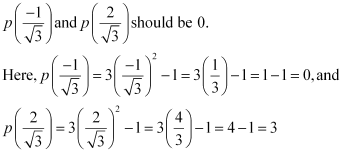
Hence, is a zero of the given polynomial. However, is not a zero of the given polynomial.
(viii) If  is a zero of polynomial p(x) = 2x + 1, then
 should be 0.
Q4 : Find the zero of the polynomial in each of the following cases:
(i) p(x) = x + 5 (ii) p(x) = x – 5 (iii) p(x) = 2x + 5
(iv) p(x) = 3x – 2 (v) p(x) = 3x (vi) p(x) = ax, a ≠ 0
(vii) p(x) = cx + d, c ≠ 0, c, are real numbers.
Answer :
Zero of a polynomial is that value of the variable at which the value of the polynomial is obtained as 0.
(i) p(x) = x + 5
p(x) = 0
x + 5 = 0
x = – 5
Therefore, for x = – 5, the value of the polynomial is 0 and hence, x = – 5 is a zero of the given polynomial.
(ii) p(x) = x – 5
p(x) = 0
x – 5 = 0
x = 5
Therefore, for x = 5, the value of the polynomial is0 and hence, x = 5 is a zero of the given polynomial.
(iii) p(x) = 2x + 5
p(x) = 0
2x + 5 = 0
2x = – 5

Therefore, for , the value of the polynomial is 0 and hence, is a zero of the given polynomial.
(iv) p(x) = 3x – 2
p(x) = 0
3x – 2 = 0
Therefore, for, the value of the polynomial is 0 and hence, is a zero of the given polynomial.
(v) p(x) = 3x
p(x) = 0
3x = 0
x = 0
Therefore, for x = 0, the value of the polynomial is 0 and hence, x = 0 is a zero of the given polynomial.
(vi) p(x) = ax
p(x) = 0
ax = 0
x = 0
Therefore, for x = 0, the value of the polynomial is 0 and hence, x = 0 is a zero of the given polynomial.
(vii) p(x) = cx + d
p(x) = 0
cx+ d = 0

Therefore, for, the value of the polynomial is 0 and hence, is a zero of the given polynomial.
Exercise 2.3 : Solutions of Questions on Page Number : 40
Q1 : Find the remainder when x3 + 3x2 + 3x + 1 is divided by
(i) x + 1 (ii) (iii) x
(iv) x + π (v) 5 + 2x
Answer :
(i) x + 1
By long division,
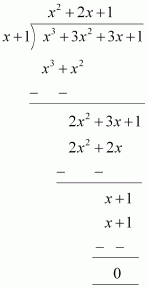
Therefore, the remainder is 0.
(ii)
By long division,
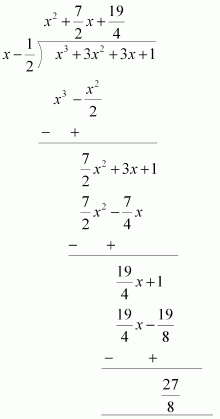
Therefore, the remainder is .
.
(iii) x
By long division,
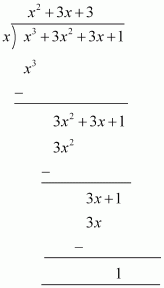 Therefore, the remainder is 1.
(iv) x + π
By long division,
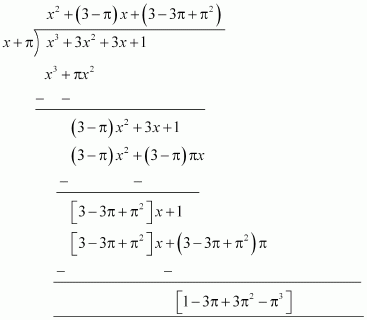
Therefore, the remainder is
(v) 5 + 2x
By long division,
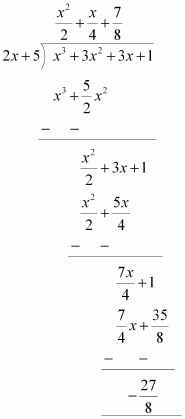
Therefore, the remainder is
Q2 : Find the remainder when x3 – ax2 + 6x – a is divided by x – a.
Answer :
By long division,
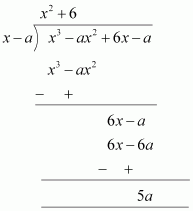
Therefore, when x3 – ax2 + 6x – a is divided by x – a, the remainder obtained is 5a.
Q3 : Check whether 7 + 3x is a factor of 3x3 + 7x.
Answer :
Let us divide (3x3 + 7x) by (7 + 3x). If the remainder obtained is 0, then 7 + 3x will be a factor of 3x3 + 7x.
By long division,
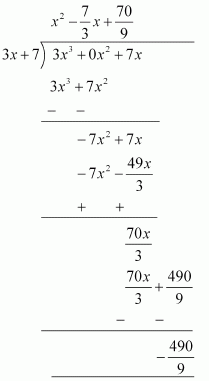
As the remainder is not zero, therefore, 7 + 3x is not a factor of 3x3 + 7x.
Exercise 2.4 : Solutions of Questions on Page Number : 43
Q1 : Determine which of the following polynomials has (x + 1) a factor:
(i) x3 + x2 + x + 1 (ii) x4 + x3 + x2 + x + 1
(iii) x4 + 3x3 + 3x2 + x + 1 (iv)
Answer :
(i) If (x + 1) is a factor of p(x) = x3 + x2 + x + 1, then p ( – 1) must be zero, otherwise (x + 1) is not a factor of p(x).
p(x) = x3 + x2 + x + 1
p( – 1) = ( – 1)3 + ( – 1)2 + ( – 1) + 1
= – 1 + 1 – 1 + 1 = 0
Hence, x + 1 is a factor of this polynomial.
(ii) If (x + 1) is a factor of p(x) = x4 + x3 + x2 + x + 1, then p ( – 1) must be zero, otherwise (x + 1) is not a factor of p(x).
p(x) = x4 + x3 + x2 + x + 1
p( – 1) = ( – 1)4 + ( – 1)3 + ( – 1)2 + ( – 1) + 1
= 1 – 1 + 1 – 1 + 1 = 1
As p( – 1) ≠ 0,
Therefore, x + 1 is not a factor of this polynomial.
(iii) If (x + 1) is a factor of polynomial p(x) = x4 + 3x3 + 3x2 + x + 1, then p( – 1) must be 0, otherwise (x + 1) is not a factor of this polynomial.
p( – 1) = ( – 1)4 + 3( – 1)3 + 3( – 1)2 + ( – 1) + 1
= 1 – 3 + 3 – 1 + 1 = 1
As p( – 1) ≠ 0,
Therefore, x + 1 is not a factor of this polynomial.
(iv) If(x + 1) is a factor of polynomial p(x) = , then p( – 1) must be 0, otherwise (x + 1) is not a factor of this polynomial.
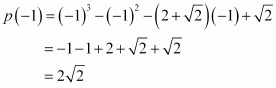
As p( – 1) ≠ 0,
Therefore, (x + 1) is not a factor of this polynomial.
Q2 : Use the Factor Theorem to determine whether g(x) is a factor of p(x) in each of the following cases:
(i) p(x) = 2x3 + x2 – 2x – 1, g(x) = x + 1
(ii) p(x) = x3 + 3x2 + 3x + 1, g(x) = x + 2
(iii) p(x) = x3 – 4x2 + x + 6, g(x) = x – 3
Answer :
(i) If g(x) = x + 1 is a factor of the given polynomial p(x), then p(-1) must be zero.
p(x) = 2x3 + x2 – 2x – 1
p(-1) = 2(-1)3 + (-1)2 – 2(-1) – 1
= 2(-1) + 1 + 2 – 1 = 0
Hence, g(x) = x + 1 is a factor of the given polynomial.
(ii) If g(x) = x + 2 is a factor of the given polynomial p(x), then p(-2) must
be 0.
p(x) = x3 +3x2 + 3x + 1
p(-2) = (-2)3 + 3(-2)2 + 3(-2) + 1
= – 8 + 12 – 6 + 1
= -1
As p(-2) ≠ 0,
Hence, g(x) = x + 2 is not a factor of the given polynomial.
(iii) If g(x) = x – 3 is a factor of the given polynomial p(x), then p(3) must
be 0.
p(x) = x3 – 4x2 + x + 6
p(3) = (3)3 – 4(3)2 + 3 + 6
= 27 – 36 + 9 = 0
Hence, g(x) = x – 3 is a factor of the given polynomial.


Exercise 2.5 : Solutions of Questions on Page Number : 48
Q1 : Use suitable identities to find the following products:
(i) (ii)
(ii)
(iii)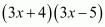 (iv)
(iv)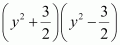
(v)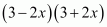
Answer :
(i) By using the identity ,
,

(ii) By using the identity
 ,
,
(iii)
By using the identity  ,
,
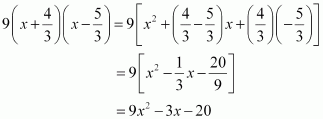
(iv) By using the identity  ,
,
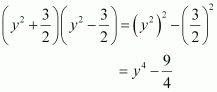
(v) By using the identity ,
,
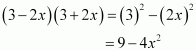
Q2 : Evaluate the following products without multiplying directly:
(i) 103 x 107 (ii) 95 x 96 (iii) 104 x 96
Answer :
(i) 103 × 107 = (100 + 3) (100 + 7)
= (100)2 + (3 + 7) 100 + (3) (7)
[By using the identity, where
where
x = 100, a = 3, and b = 7]
= 10000 + 1000 + 21
= 11021
(ii) 95 × 96 = (100 – 5) (100 – 4)
= (100)2 + ( – 5 – 4) 100 + ( – 5) ( – 4)
[By using the identity, where
where
x = 100, a = – 5, and b = – 4]
= 10000 – 900 + 20
= 9120
(iii) 104 × 96 = (100 + 4) (100 – 4)
= (100)2 – (4)2
= 10000 – 16
= 9984
Q3 : Factorise the following using appropriate identities:
(i) 9x2 + 6xy + y2
(ii)
(iii)
Answer :
(i)

(ii)

(iii)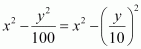

Q4 : Expand each of the following, using suitable identities:
(i) (ii)
(ii)
(iii)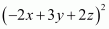 (iv)
(iv)
(v)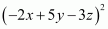 (vi)
(vi)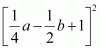
Answer :
It is known that,

(i)

(ii)

(iii)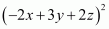

(iv)

(v)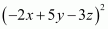

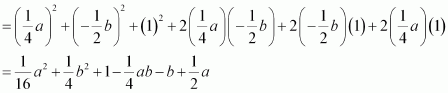
(vi)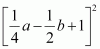
Q5 : Factorise:
(i)
(ii)
Answer :
It is known that,

(i)
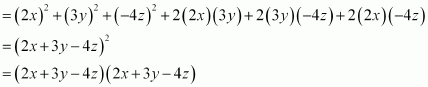
(ii)
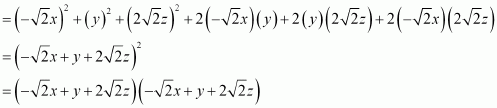
Q6 : Write the following cubes in expanded form:
(i) (ii)
(ii)
(iii)  (iv)
(iv)
Answer :
It is known that,
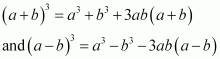
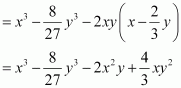
(i)
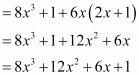
(ii)
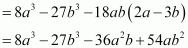
(iii)
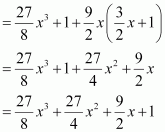
(vi)
Q7 : Evaluate the following using suitable identities:
(i) (99)3 (ii) (102)3 (iii) (998)3
Answer :
It is known that,
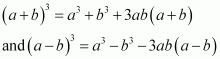
(i) (99)3 = (100 – 1)3
= (100)3 – (1)3 – 3(100) (1) (100 – 1)
= 1000000 – 1 – 300(99)
= 1000000 – 1 – 29700
= 970299
(ii) (102)3 = (100 + 2)3
= (100)3 + (2)3 + 3(100) (2) (100 + 2)
= 1000000 + 8 + 600 (102)
= 1000000 + 8 + 61200
= 1061208
(iii) (998)3= (1000 – 2)3
= (1000)3 – (2)3 – 3(1000) (2) (1000 – 2)
= 1000000000 – 8 – 6000(998)
= 1000000000 – 8 – 5988000
= 1000000000 – 5988008
= 994011992
Q8 : Factorise each of the following:
(i) (ii)
(ii)
(iii) (iv)
(iv)
(v)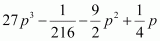
Answer :
It is known that,
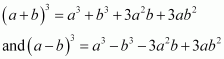
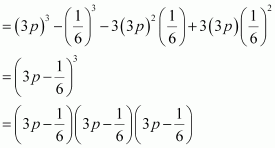
(i)
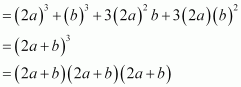
(ii)
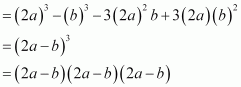
(iii)
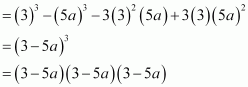
(iv)
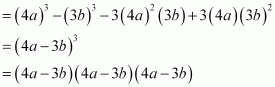
(v)
Q9 : Verify:
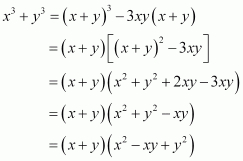
(i)
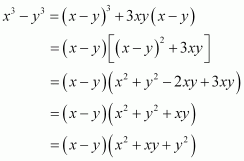
(ii)
Answer :
(i) It is known that,

(ii) It is known that,

Q10 : Factorise each of the following:
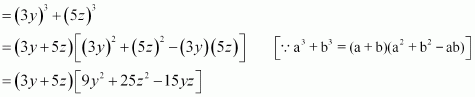
(i)
(ii)
[Hint: See question 9.]
Answer :
(i)
(ii)

Q11 : Factorise:
Answer :
It is known that,

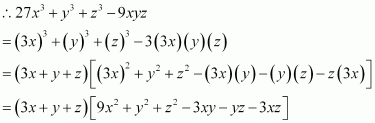
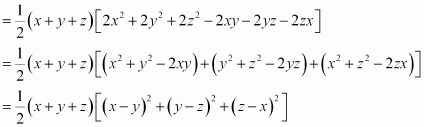
Q12 : Verify that
Answer :
It is known that,

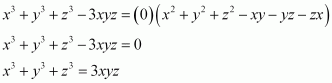
Q13 : If x + y + z = 0, show that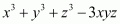 .
.
Answer :
It is known that,

Put x + y + z = 0,
Q14 : Without actually calculating the cubes, find the value of each of the following:
(i)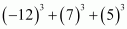
(ii)
Answer :
(i)
Let x = – 12, y = 7, and z = 5
It can be observed that,
x + y + z = – 12 + 7 + 5 = 0
It is known that if x + y + z = 0, then

∴
= – 1260
(ii)
Let x = 28, y = – 15, and z = – 13
It can be observed that,
x + y + z = 28 + ( – 15) + ( – 13) = 28 – 28 = 0
It is known that if x + y + z = 0, then

Q15 : Give possible expressions for the length and breadth of each of thefollowing rectangles, in which their areas are given:

Answer :
Area = Length × Breadth
The expression given for the area of the rectangle has to be factorised. One of its factors will be its length and the other will be its breadth.
(i)
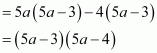
Therefore, possible length = 5a – 3
And, possible breadth = 5a – 4
(ii)
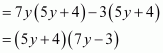
Therefore, possible length = 5y + 4
And, possible breadth = 7y – 3
Q16 : What are the possible expressions for the dimensions of the cuboids whose volumes are given below?

Answer :
Volume of cuboid = Length × Breadth × Height
The expression given for the volume of the cuboid has to be factorised. One of its factors will be its length, one will be its breadth, and one will be its height.
(i)
One of the possible solutions is as follows.
Length = 3, Breadth = x, Height = x – 4
(ii)
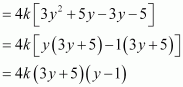
One of the possible solutions is as follows.
Length = 4k, Breadth = 3y + 5, Height = y – 1