Synthetic Fibres and Plastics Class 8 Questions Science Chapter 3
Exercise : Solutions of Questions on Page Number: 41
Q1 :Explain why some fibres are called synthetic.
Answer :
There are some fibres that are prepared by man by using chemicals. These are called synthetic fibres. These are made of small units that join together to form long chains. Examples of synthetic fibres are rayon, nylon, polyester, acrylic, etc.
Q2 :Mark ( ) the correct answer.
Rayon is different from synthetic fibres because
(a) it has a silk-like appearance.
(b) it is obtained from wood pulp.
(c) its fibres can also be woven like those of natural fibres.
Answer :
Rayon is different from synthetic fibres because
(a) it has a silk-like appearance.
(b) it is obtained from wood pulp. (correct)
(c) its fibres can also be woven like those of natural fibres.
Q3 :Fill in the blanks with appropriate words.
(a) Synthetic fibres are also called _______ __or _______ __fibres.
(b) Synthetic fibres are synthesised from raw materials called _______ __.
(c) Like synthetic fibres, plastic is also a _______ __.
Answer :
(a) Synthetic fibres are also called __artificial__or __man-made__fibres.
(b) Synthetic fibres are synthesised from raw materials called __petrochemicals__.
(c) Like synthetic fibres, plastic is also a __polymer__.
Q4 :Give examples which indicate that nylon fibres are very strong.
Answer :
Nylon fibres are very strong. It is used for making ropes used for climbing rocks and for making parachutes. Their usage shows that nylon fibres have high tensile strength.
Q5 :Explain why plastic containers are favoured for storing food.
Answer :
The characteristics that make plastics favourable for storing food items are:
(i) Light weight
(ii) Lower price
(iii) Good strength
(iv) Easy handling
Q6 :Explain the difference between thermoplastic and thermosetting plastics.
Answer :
There are two types of plastics: Thermosetting plastics and Thermoplastics.
| Thermosetting plastic | Thermoplastic |
| Thermosetting plastic cannot be bent easily. It may break when forced to bend. | Thermoplastic can be bent easily. |
| Thermosetting plastic cannot be softened by heating. Thus, it cannot be reshaped once moulded. | Thermoplastic can be softened easily by heating. Thus, it can be reshaped. |
Q7 :Explain why the following are made of thermosetting plastics.
(a) Saucepan handles
(b) Electric plugs/switches/plug boards
Answer :
(a) Saucepan handles are made of thermosetting plastics because these plastics do not get softened on heating. Also, thermosetting plastics such as bakelite are poor conductors of heat.
(b) Thermosetting plastics such as bakelite are poor conductors of heat and electricity. Therefore, they are used for making electric plugs, switches, plug boards, etc.
Q8 :Categorize the materials of the following products into ‘can be recycled’ and ‘cannot be recycled’.
Telephone instruments, plastic toys, cooker handles, carry bags, ball point pens, plastic bowls, plastic covering on electrical wires, plastic chairs, electrical switches.
Answer :
| Cannot be recycled | Can be recycled |
| Telephone instruments | Plastic toys |
| Cooker handles | Plastic chairs |
| Electrical switches | Carry bags |
| Plastic covering on electrical wires | |
| Ball point pens | |
| Plastic bowls |
Q9 :Rana wants to buy shirts for summer. Should he buy cotton shirts or shirts made from synthetic material? Advise Rana, giving your reason.
Answer :
Rana should buy shirts made from cotton. This is because cotton is a good absorber of water. It can soak the sweat coming out of our body and expose it to the environment. Thus, it helps in evaporating the liquid (sweat), thereby cooling our body.
Q10 : Give examples to show that plastics are non-corrosive in nature.
Answer :
Plastics are not corroded even if they come in contact with strong chemicals. This is because of their non-reactive nature with most materials. For example, the cleansing chemicals that we use at home are stored in plastic bottles, instead of metal containers.
Q11 : Should the handle and bristles of a tooth brush be made of the same material? Explain your answer.
Answer :
No. The handle and bristles of a tooth brush should be made of different materials. The handle of a toothbrush should be hard and strong, while the bristles should be soft and flexible.
Q12 : ‘Avoid plastics as far as possible’. Comment on this advice.
Answer :
Plastics are non-biodegradable. Once introduced into the environment, they take several years to decompose. Plastics add to the environmental pollution. They cannot be burnt as when burnt, they release poisonous gases. Plastic bags thrown in the garbage dump are swallowed by animals like cows. These plastic bags choke their respiratory system and can even prove fatal. Therefore, we should avoid plastics as far as possible.
Q13 : Match the terms of column A correctly with the phrases given in column B.
| A | B | ||
| (i) | Polyester | (a) | Prepared by using wood pulp |
| (ii) | Teflon | (b) | Used for making parachutes and stockings |
| (iii) | Rayon | (c) | Used to make non-stick cookware |
| (iv) | Nylon |
(d) | Fabrics do not wrinkle easily |
Answer:
| A | B | ||
| (i) | Polyester | (a) | Fabrics do not wrinkle easily |
| (ii) | Teflon | (b) | Used to make non-stick cookware |
| (iii) | Rayon | (c) | Prepared by using wood pulp |
| (iv) | Nylon | (d) | Used for making parachutes and stockings |
Q14 : ‘Manufacturing synthetic fibres is actually helping conservation of forests’. Comment.
Answer :
Raw materials for natural fibres are mainly derived from plants and this means cutting a lot of trees. This leads to deforestation. But raw materials of synthetic materials are mainly petrochemicals. Hence, manufacturing synthetic fibres helps in the conservation of forests.
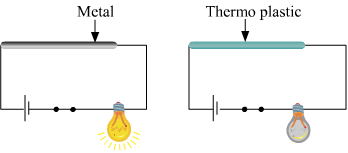
Q15 : Describe an activity to show that thermoplastic is a poor conductor of electricity.
Answer :
We will design a circuit to see that thermoplastics are poor conductors of electricity. We need a bulb, some wires, a battery, a piece of metal, and a plastic pipe. Set up the circuit first with the metal and then with the plastic pipe (as shown in the figure). After you switch on the current, you will observe that the bulb glows in the former case. In the latter case, the bulb does not glow. Hence, a plastic pipe (which is a thermoplastic) is shown to be a poor conductor of electricity.