
Class 6 Maths Chapter -8 Decimals
Exercise 8.1
1. Using the given diagram write the data in form of numbers in the table given below:
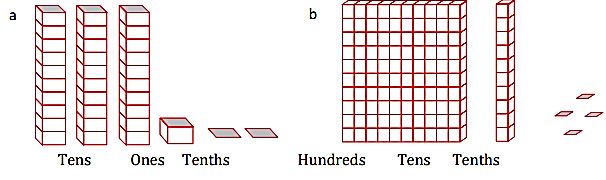
| Hundreds (100) | Tens(10) | Ones(1) | Tenths(⅒) |
| – | – | – | – |
| – | – | – | – |
Answer:
| Hundreds (100) | Tens(10) | Ones(1) | Tenths(⅒) | Number |
| 0 | 3 | 1 | 2 | 31.2 |
| 1 | 1 | 0 | 4 | 110.4 |
2. Write the given decimals in the place value table.
(a) 20.4
(b) 0.4
(c) 18.5
(d) 302.1
Answer:
| Hundreds (100) | Tens(10) | Ones(1) | Tenths(⅒) | Number | |
| (a) | 0 | 2 | 0 | 4 | 20.4 |
| (b) | 0 | 0 | 0 | 4 | 0.4 |
| (c) | 0 | 1 | 8 | 5 | 18.5 |
| (d) | 3 | 0 | 2 | 1 | 302.1 |
3. Write the given values in the form of decimals:
(a) five-tenths
(b) Four tens and seven-tenths
(c) Sixteen point three
(d) Six hundred and eight-ones
(e) Nine hundred point one
Answer:
(a) five-tenths = 5 tenths
= 5⁄10
= 0.5
(b) Four tens and seven-tenths = 4 tens and 7 tenths
= (4×10)+7⁄10
= 40 + 0.7
= 40.7
(c) Sixteen point three = 16.3
(d) Six hundred and eight-ones = 6 hundreds + 8 ones
= 600 + 8
= 608
(e) Nine hundred point one = 900.1
4. Write the fractions given below in the form of decimals:
(a)5⁄10
(b) 3+7⁄10
(c) 200+60+5+1⁄10
(d) 70+8⁄10
(e) 88⁄10
(f) 42⁄10
(g) 3⁄2
(h) 2⁄5
(i) 12⁄5
(j) 33⁄5
(k) 41⁄2
Answer:
(a) 5⁄10 = 0.5
(b) 3+7⁄10= 3.7
(c) 200+60+5+1⁄10 = 200 + 60 + 5 + 0.1
= 265.1
(d) 70+8⁄10 = 70 + 0.8
= 70.8
(e) 88⁄10 = 80+8⁄10
= 80⁄10 + 8⁄10
= 8 + 0.8
= 8.8
(f) 42⁄10 = 4 + 2⁄10
= 4 + 0.2
= 4.2
(g)3⁄2 = 3×5⁄2×5
= 15⁄10
= 10+5⁄10
= 10⁄10+5⁄10
= 1 + 0.5
= 1.5
(h) 2⁄5 = 2×2⁄5×2
= 4⁄10
= 0.4
(i) 12⁄5 = 12×2⁄5×2
= 24⁄10
= 20+4⁄10
= 20⁄10+ 4⁄10
= 2 + 0.4
= 2.4
(j) 33⁄5 = 3 + 3⁄5
= 3 + 3×2⁄5×2
= 3 + 6⁄10
= 3 + 0.6
= 3.6
(k) 41⁄2 = 4 + 1⁄2
= 4 + 1×5⁄2×5
= 4 + 5⁄10
= 4 + 0.5
= 4.5
5. Write the given decimals in the form of fraction. Reduce them to the lowest terms:
(a) 0.6
(b) 2.5
(c) 1.0
(d) 3.8
(e) 13.7
(f) 21.2
(g) 6.4
Answer:
(a) 0.6 = 6⁄10
= 35
(b) 2.5 = 25⁄10
= 52
(c) 1.0 = 10⁄10
= 1
(d) 3.8 = 38⁄10
= 195
(e) 13.7 = 137⁄10
(f) 21.2 = 212⁄10
= 1065
(g) 6.4 = 64⁄10
= 325
6. Express the following as cm using decimals:
(a) 30 mm
(b) 2 mm
(c) 116 mm
(d) 4cm 2mm
(e) 162 mm
(f) 83 mm
Answer:
(a) Since, 10mm = 1cm
Therefore, 1mm = 1⁄10 cm
Therefore, 30mm = 1⁄10 x 30 = 3.0cm
(b) Since, 10 mm =1cm
Therefore, 1mm = 1⁄10 cm
Therefore, 2mm = 1⁄10 x 2 = 0.2 cm
(c) Therefore, 116 mm = 1⁄10 x 116 = 11.6 cm
(d) Since, 10mm = 1cm
4cm+2⁄10cm
4 + 0.2 = 4.2 cm
(e) 1mm = 110 cm
162 mm = 1⁄10×162=16.2cm
(f) Since, 10 mm = 1cm
Therefore, 1mm = 1⁄10 cm
Therefore, 83 mm = 1⁄10×83=8.3cm
7. Between which two whole numbers do the given numbers lie? Then find the closest whole number to the given numbers.

(a) 5.1
(b) 0.8
(c) 6.4
(d) 2.6
(e) 4.9
(f) 9.1
Answer:
(a) From 5 to 6, 5.1 is nearest to 5.
(b) From 0 to 1, 0.8 is nearest to 1.
(c) From 6 to 7, 6.4 is nearest to 6.
(d) From 2 to 3, 2.6 is nearest to 3.
(e) From 4 to 5, 4.9 is nearest to 5.
(f) From 9 to 10, 9.1 is nearest to 9
8. Show the given numbers on number line:
(a) 0.2
(b)1.9
(c) 1.1
(d) 2.5
Answer:

9. From the given number line, write down decimal number represented by the points P, Q, R and S.

Answer:
P = 0 + 8⁄10
= 0.8
Q = 1 + 3⁄10
= 1 + 0.3
= 1.3
R = 2 + 2⁄10
= 2 + 0.2
= 2.2
S = 2 + 9⁄10
= 2 + 0.9
= 2.9
10. (a) The length of Mahesh’s textbook is 10 cm and 6 mm. What will be the length of textbook in cm?
(b) The length of a rose plant is 75 mm. Write the length in cm form.
Answer:
(a) 10 cm 6 mm = 9 cm + 6 mm
= 9 + 6⁄10
= 9.6 cm
(b) 75 mm = 75⁄10 cm
= 7.5 cm
Exercise 8.2
1. Write numbers according to the information given in the form of table.
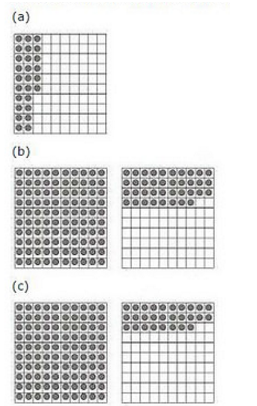
| Ones | Tenths | Hundredths | Number | |
| (a) | – | – | – | – |
| (b) | – | – | – | – |
| (c) | – | – | – | – |
Answer:
| Ones | Tenths | Hundredths | Number | |
| (a) | 0 | 5 | 6 | 0.56 |
| (b) | 1 | 0 | 8 | 1.08 |
| (c) | 1 | 2 | 7 | 1.27 |
2. Write the numbers from the table given below showing place value of numbers.
| Hundreds (100) | Tens (10) | Ones (1) | Tenths (1⁄10) | Hundredths (1⁄100) | Thousandths (1⁄1000) | |
| (a) | 0 | 0 | 2 | 5 | 7 | 0 |
| (b) | 1 | 0 | 6 | 4 | 9 | 1 |
| (c) | 0 | 1 | 8 | 9 | 2 | 0 |
| (d) | 2 | 1 | 3 | 5 | 0 | 3 |
| (e) | 0 | 2 | 3 | 0 | 1 | 5 |
Answer
(a) 2+5⁄10+7⁄100=2+0.5+0.07=2.57
(b) 100+6+4⁄10+9⁄100+1⁄1000 =100+6+0.4+0.09+0.001=106.491
(c) 10+8+9⁄10+2⁄100=10+8+0.9+0.02=18.92
(d) 200+10+3+510+31000=200+10+3+0.5+0.003=213.503
(e) 20+3+1⁄100+5⁄1000=20+3+0.01+0.005=23.015
3. Write the decimal values given below in place value table.
(a) 0.46
(b) 1.73
(c) 3.08
(d) 12.69
(e) 452.103
Answer
(a) 0.46=0.4+0.06=4⁄10+6⁄100
(b) 1.73=1+0.7+0.03=1+7⁄10+3⁄100
(c) 3.08=3+0.08=3+8⁄100
(d) 12.69=10+2+0.6+0.09=12+6⁄10+9⁄100
(e) 452.103=400+50+2+0.1+0.003=452+1⁄10+3⁄1000
| Hundreds (100) | Tens (10) | Ones (1) | Tenths (1⁄10) | Hundredths (1⁄100) | Thousandths (1⁄1000) | |
| (a) | 0 | 0 | 0 | 4 | 6 | 0 |
| (b) | 0 | 0 | 1 | 7 | 3 | 0 |
| (c) | 0 | 0 | 3 | 0 | 8 | 0 |
| (d) | 0 | 1 | 2 | 6 | 9 | 0 |
| (e) | 4 | 5 | 2 | 1 | 0 | 3 |
4. Write the following in the form of decimals.
(a) 30+8+5⁄10+2⁄100
(b) 200+50+3+4⁄100
(c) 8⁄10+2⁄100+7⁄1000
(d) 25+6⁄10+9⁄1000
(e) 600+37+7⁄100
(f) 1+2⁄1000
Answer
(a) 30+8+5⁄10+2⁄100 = 30 + 8 + 0.5 + 0.02 = 38.52
(b) 200+50+3+4⁄100 = 200 + 50 + 3 + 0.04 = 253.04
(c) 8⁄10+2⁄100+7⁄1000 = 0.8 + 0.02 + 0.007 = 0.827
(d) 25+6⁄10+9⁄1000 = 25 + 0.6 + 0.009 = 25.609
(e) 600+37+7⁄100 = 600 + 37 + 0.07 = 637.07
(f) 1+2⁄1000 = 1 + 0.002 = 1.002
5. Write in words the given below decimals.
(a) 0.05
(b) 1.35
(c) 106.54
(d) 12.09
(e) 0.058
(f) 2.007
(g) 102.107
Answer
(a) 0.05 = zero point zero five
(b) 1.35= one point three five
(c) 106.54 = one zero six point five four
(d) 12.09 = one two point three zero nine
(e) 0.058 = zero point zero five eight
(f) 2.007 = two point zero zero seven
(g) 102.107 = one zero two point one zero seven
6. Decimals are given below. Between which numbers in 10th places will the number will lie on number line?
(a) 0.08
(b) 0.23
(c) 0.97
(d) 0.15
(e) 0.46
(f) 0.68
(g) 0.89
Answer
(a) 0.08 – 0 and 0.1
(b) 0.23 – 0.2 and 0.3
(c) 0.97 – 0.9 and 1.0
(d) 0.15 – 0.1 and 0.2
(e) 0.46 – 0.4 and 0.5
(f) 0.68 – 0.6 and 0.7
(g) 0.89 – 0.8 and 0.9
7. Write the following decimals in the form of fractions in the lowest terms.
(a) 0.04
(b) 0.65
(c) 0.50
(d) 0.24
(e) 0.15
(f) 0.115
(g) 0.095
Answer
(a) 0.04 = 40⁄100 = 4⁄10= 25
(b) 0.65 = 65⁄100 = 13⁄20
(c) 0.50 = 50⁄100 = 5⁄10= 1⁄2
(d) 0.24 = 24⁄100 = 6⁄25
(e) 0.15 = 15⁄100 = 3⁄20
(f) 0.115 = 115⁄1000= 23⁄200
(g) 0.095 = 95⁄1000= 19⁄200
Exercise 8.3
Q1.Which number is greater?
0.3 or 0.5
0.08 or 0.03
5 or 0.9
0.3 or 0.03
2.6 or 2.61
0.09 or 0.019
1.7 or 1.70
5.36 or 5.26
2.6 or 2.6000
4.89 or 4.9
Answer
1. 0.3 or 0.5
In these numbers, whole part is same but the tenth part of 0.3 is smaller than 0.5.
Therefore, 0.5 > 0.3
2. 0.08 or 0.03
In these numbers the hundredth place of 0.08 is greater than 0.03.
Therefore, 0.08 > 0.03
3. 5 or 0.9
In these numbers, whole part 5 is greater than 0 in 0.9.
Therefore, 5 > 0.9
4. 0.3 or 0.03
In these numbers the tenth place of 0.3 is greater than 0.03.
Therefore, 0.3 > 0.03
5. 2.6 or 2.61
In these numbers the hundredth place of 2.6 is smaller than 2.61.
Therefore, 2.61 > 2.6
6. 0.09 or 0.019
In these numbers, hundredth place of 0.019 is smaller than 0.09.
Therefore, 0.09 > 0.019
7. 1.7 or 1.70
In these numbers, whole part is same. Even tenth place is equal. But in first number there is no hundredth place that means that there is zero. So both the numbers are equal.
Therefore, 1.7 = 1.70
8. 5.26 or 5.36
In these numbers, whole part 5 is same. Now tenth place of 5.26 is smaller than that of 5.36.
Therefore, 5.36 > 5.26
9. 2.6 or 2.6000
In these numbers, whole part 2 is equal. Tenth place is also same. But there are three zeros in case of second number. In first number it is till tenth place but it implies that there are zeros present. So they are equal.
Therefore, 2.6 = 2.6000
10. 4.89 or 4.9
In these numbers, the whole part is same but tenth place of 4.89 is smaller than that of 4.9.
Therefore, 4.9 > 4.89
Exercise 8.4
Q1. Express in the form of rupees using decimal places.
6 paise
85 paise
30 paise
60 rupees 40 paise
625 paise
450 paise
Answer
We know that, 100 paise is equal to 1 rupee.
6 paise = 6⁄100 rupees = Re 0.06
85 paise = 85⁄100 rupees = Re 0.85
30 paise = 30⁄100 rupees = Re 0.30
60 rupees 40 paise = 60+40⁄100 = Re 60.40
625 paise = (625⁄100) rupees = Re 6.25
450 paise = 450⁄100 rupees = Re 4.50
Q2. Express the following in the form of metres using decimal places.
16 cm
5 cm
3 m 25 cm
5 m 8 cm
625 cm
213 cm
Answer
We know that, 100 cm is equal to 1 m.
16 cm = 16⁄100 m = 0.16 m
5 cm = 5⁄100 m = 0.05 m
3 m 25 cm = (3+25⁄100) m = 3.25 m
5 m 8 cm = (5+8⁄100) m = 5.08 m
625 cm = 625⁄100 m = 6.25 m
213 cm = 213⁄100 m = 2.13 m
Q3. Express the following in the form of centimetres using decimal places.
6 mm
50 mm
155 mm
10 cm 8 mm
98 mm
289 mm
Answer
We know that, 10 mm is equal to 1 cm.
6 mm = 6⁄10 cm = 0.6 cm
50 mm = 50⁄10 cm = 5.0 cm
155 mm = 155⁄10 cm = 15.5 cm
10 cm 8 mm = 10+8⁄10 cm = 10.8 cm
98 mm = 98⁄10 cm = 9.8 cm
289 mm = 289⁄10 cm = 28.9 cm
Q4. Express the following in the form of kilometres using decimal places.
9 m
78 m
825 m
9456 m
25 km 726 m
Answer
We know that, 1000 m is equal to 1 km.
9 m = 9⁄1000 km = 0.009 km
78 m = 78⁄1000km = 0.078 km
825 m = 825⁄1000 km = 0.825 km
9456 m = 9456⁄1000 km = 9.456 km
25 km 726 m = (25 + 726⁄1000) km = (25 + 0.726) km = 25.726 km
Q5. Express the following in the form of kilograms using decimal places.
5 g
56 g
654 g
5452 g
15 kg 348 g
54681 g
Answer
We know that, 1000 g is equal to 1 kg.
5 g = 5⁄1000 kg = 0.005 kg
56 g = 56⁄1000 kg = 0.056 kg
654 g = 654⁄1000 kg = 0.654 kg
5452 g = 5452⁄1000 kg = 5.452 kg
15 kg 348 g = (15 + 348⁄1000) kg = (15 + 0.348) kg = 15.348 kg
54681 g = 54681⁄1000 kg = 54.681 kg