
Reproduction is one of the most fundamental processes that sustain life on Earth. It is the process by which living organisms produce new individuals of the same species. In NCERT Class 12th Biology, the first chapter “Reproduction in Organisms” delves into the various modes of reproduction, including sexual and asexual reproduction, and how different organisms use them to perpetuate their species. This chapter explores the processes of gametogenesis, fertilization, and embryonic development, providing a comprehensive understanding of the various aspects of reproduction in organisms.
In this article, we will take a closer look at the NCERT Class 12th Biology Solutions for Chapter 1, which will help students gain a deeper understanding of the complex processes involved in reproduction.
NCERT Class 12 Biology Solutions Chapter 1 Reproduction in Organisms
Question 1: Why is reproduction essential for organisms?
Answer:
Reproduction is a fundamental feature of all living organisms. It is a biological process through which living organisms produce offspring’s similar to them. Reproduction ensures the continuance of various species on the Earth. In the absence of reproduction, the species will not be able to exist for a long time and may soon get extinct.
Question 2: Which is a better mode of reproduction sexual or asexual? Why?
Answer :
Sexual reproduction is a better mode of reproduction. It allows the formation of new variants by the combination of the DNA from two different individuals, typically one of each sex. It involves the fusion of the male and the female gamete to produce variants, which are not identical to their parents and to themselves. This variation allows the individual to adapt to constantly changing and challenging environments. Also, it leads to the evolution of better suited organisms which ensures greater survival of a species. On the contrary, asexual reproduction allows very little or no variation at all. As a result, the individuals produced are exact copies of their parents and themselves.
Question 3: Why is the offspring formed by asexual reproduction referred to as clone?
Answer:
A clone is a group of morphologically and genetically identical individuals. In the process of asexual reproduction, only one parent is involved and there is no fusion of the male and the female gamete. As a result, the offsprings so produced are morphologically and genetically similar to their parents and are thus, called clones.
Question 4: Offspring formed due to sexual reproduction have better chances of survival. Why? Is this statement always true?
Answer:
Sexual reproduction involves the fusion of the male and the female gamete. This fusion allows the formation of new variants by the combination of the DNA from two (usually) different members of the species. The variations allow the individuals to adapt under varied environmental conditions for better chances of survival.
However, it is not always necessary that the offspring produced due to sexual reproduction has better chances of survival. Under some circumstances, asexual reproduction is more advantageous for certain organisms. For example, some individuals who do not move from one place to another and are well settled in their environment. Also, asexual reproduction is a fast and a quick mode of reproduction which does not consume much time and energy as compared to sexual reproduction.
Question 5: How does the progeny formed from asexual reproduction differ from those formed by sexual reproduction?
Answer:
| Progeny formed from asexual reproduction | Progeny formed from sexual reproduction |
| Asexual reproduction does not involve the fusion of the male and the female gamete. Organisms undergoing this kind of reproduction produce offspring’s that are morphologically and genetically identical to them. | Sexual reproduction involves the fusion of the male and the female gamete of two individuals, typically one of each sex. Organisms undergoing this kind of reproduction produce offspring’s that are not identical to them. |
| Offsprings thus produced do not show variations and are called clones. | Offspring’s thus produced show variations from each other and their parents. |
Q6 : Distinguish between asexual and sexual reproduction. Why is vegetative reproduction also considered as a type of asexual reproduction?
Answer:
| Sexual reproduction | Asexual reproduction |
| It involves the fusion of the male and female gamete. | It does not involves the fusion of the male and the female gamete |
| It requires two (usually) different individuals. | It requires only one individual. |
| The individuals produced are not identical to their parents and show variations from each other and also, from their parents. | The individuals produced are identical to the parent and are hence, called clones. |
| Most animals reproduce sexually. Both sexual and asexual modes of reproduction are found in plants. | Asexual modes of reproduction are common in organisms having simple organizations such as algae and fungi. |
| It is a slow process. | It is a fast process. |
Vegetative propagation is a process in which new plants are obtained without the production of seeds or spores. It involves the propagation of plants through certain vegetative parts such as the rhizome, sucker, tuber, bulb, etc. It does not involve the fusion of the male and the female gamete and requires only one parent. Hence, vegetative reproduction is considered as a type of asexual reproduction.
Question 7: What is vegetative propagation? Give two suitable examples.
Answer:
Vegetative propagation is a mode of asexual reproduction in which new plants are obtained from the vegetative parts of plants. It does not involve the production of seeds or spores for the propagation of new plants. Vegetative parts of plants such as runners, rhizomes, suckers, tubers, etc. can be used as propagules for raising new plants.
Examples of vegetative reproduction are:
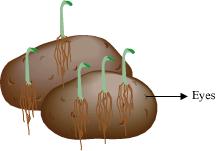
1. Eyes of potato:
The surface of a potato has several buds called eyes. Each of these buds when buried in soil develops into a new plant, which is identical to the parent plant.
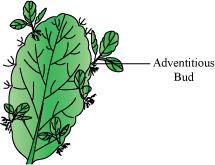
2. Leaf buds of Bryophyllum: The leaves of Bryophyllum plants bear several adventitious buds on their margins. These leaf buds have the ability to grow and develop into tiny plants when the leaves get detached from the plant and come in contact with moist soil.
Question 8: Define: (a) Juvenile phase, (b) Reproductive phase, (c) Senescent phase.
Answer:
(a) Juvenile phase:
It is the period of growth in an individual organism after its birth and before it reaches reproductive maturity.
(b) Reproductive phase:
It is the period when an individual organism reproduces sexually.
(c) Senescent phase:
It is the period when an organism grows old and loses the ability to reproduce.
Question 9: Higher organisms have resorted to sexual reproduction in spite of its complexity. Why?
Answer:
Although sexual reproduction involves more time and energy, higher organisms have resorted to sexual reproduction in spite of its complexity. This is because this mode of reproduction helps introduce new variations in progenies through the combination of the DNA from two (usually) different individuals. These variations allow the individual to cope with various environmental conditions and thus, make the organism better suited for the environment. Variations also lead to the evolution of better organisms and therefore, provide better chances of survival. On the other hand, asexual reproduction does not provide genetic differences in the individuals produced.
Question 10: Explain why meiosis and gametogenesis are always interlinked?
Answer:
Meiosis is a process of reductional division in which the amount of genetic material is reduced. Gametogenesis is the process of the formation of gametes. Gametes produced by organisms are haploids (containing only one set of chromosomes), while the body of an organism is diploid. Therefore, for producing haploid gametes (gametogenesis), the germ cells of an organism undergo meiosis. During the process, the meiocytes of an organism undergo two successive nuclear and cell divisions with a single cycle of DNA replication to form the haploid gametes.
Question 11: Identify each part in a flowering plant and write whether it is haploid (n) or diploid
(2n).
(a) Ovary ———————————
(b) Anther ———————————
(c) Egg ———————————
(d) Pollen ———————————
(e) Male gamete ———————————
(f ) Zygote ———————————
Answer(a) Ovary Diploid (2n)
(b) Anther Diploid (2n)
(c) Egg Haploid (n)
(d) Pollen Haploid (n)
(e) Male gamete Haploid (n)
(f ) Zygote Diploid (2n)
Question 12: Define external fertilization. Mention its disadvantages.
Answer:
External fertilization is the process in which the fusion of the male and the female gamete takes place outside the female body in an external medium, generally water. Fish, frog, starfish are some organisms that exhibit external fertilization.
Disadvantages of external fertilization:
In external fertilization, eggs have less chances of fertilization. This can lead to the wastage of a large number of eggs produced during the process.
Further, there is an absence of proper parental care to the offspring, which results in a low rate of survival in the progenies.
Question 13: Differentiate between a zoospore and a zygote.
Answer:
| Zoospore | Zygote |
| A zoospore is a motile asexual spore that utilizes the flagella for movement. | A zygote is a non-motile diploid cell formed as a result of fertilization. |
| It is an asexual reproductive structure. | It is formed as a result of sexual reproduction. |
Question 14: Differentiate between gametogenesis from embryogenesis.
Answer:
| Gametogenesis | Embryogenesis |
| It is the process of the formation of haploid male and female gametes from diploid meiocytes through the process of meiosis. | It is the process of the development of the embryo from the repeated mitotic divisions of the diploid zygote. |
Question 15: Describe the post-fertilization changes in a flower.
Answer:
Fertilization is the process of the fusion of the male and the female gamete to form a diploid zygote. After fertilization, the zygote divides several times to form an embryo. The fertilized ovule forms a seed. The seed contains an embryo, enclosed in a protective covering, called the seed coat. As the seed grows further, other floral parts wither and fall off. This leads to the growth of the ovary, which enlarges and ripens to become a fruit with a thick wall called the pericarp.
Question 16: What is a bisexual flower? Collect five bisexual flowers from your neighborhood and with the help of your teacher find out their common and scientific names.
Answer:
A flower that contains both the male and female reproductive structure (stamen and pistil) is called a bisexual flower. Examples of plants bearing bisexual flowers are:
(1) Water lily ( Nymphaea odorata)
(2) Rose (Rosa multiflora )
(3) Hibiscus (Hibiscus Rosa-sinensis )
(4) Mustard ( Brassica nigra)
(5) Petunia (Petunia hybrida)
Question 17: Examine a few flowers of any cucurbit plant and try to identify the staminate and
pistillate flowers. Do you know any other plant that bears unisexual flowers?
Answer:
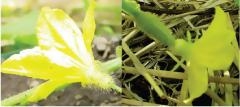
Cucurbit plant bears unisexual flowers as these flowers have either the stamen or the pistil. The staminate flowers bear bright, yellow coloured petals along with stamens that represent the male reproductive structure. On the other hand, the pistillate flowers bear only the pistil that represents the female reproductive structure.
Other examples of plants that bear unisexual flowers are corn, papaya, cucumber, etc.
Question 18: Why are offspring of oviparous animals at a greater risk as compared to offspring of
viviparous animals?
Answer:
Oviparous animals lay eggs outside their body. As a result, the eggs of these animals are under continuous threat from various environmental factors. On the other hand, in viviparous animals, the development of the egg takes place inside the body of the female. Hence, the offspring of an egg-laying or oviparous animal is at greater risk as compared to the offspring of a viviparous animal, which gives birth to its young ones.