
Exercise : Solutions of Questions on Page Number : 131
Q1 : Talk to two workers (For example, construction workers, farm workers, factory workers, workers at any shop) to find out if they are receiving the minimum wages laid down by law.
Answer :
Attempt this question on your own.
Q2 : What are the advantages to foreign companies in setting up production in India?
Answer :
Foreign companies gain many advantages in setting up production in India. Foremost amongst these is cheap labour. The population boom in India has led to large scale unemployment, as a result, a worker’s worth in India is lesser because one worker can easily replace another. This also accounts for lower wages. Due to the workers’ vulnerability, companies cut production costs by lowering work conditions and increasing work hours. This trend is unfortunate because it has led to disasters like the Bhopal Gas Tragedy of 1984. However, availability of cheap labour is a chief advantage for foreign companies in setting up production in India.
Q3 : Do you think the victims of the Bhopal gas tragedy got justice? Discuss.
Answer :
The victims of the Bhopal gas tragedy got justice, but this statement is debatable. Some victims were adequately compensated, while others are still struggling for a fair judgment to be taken on a violation of their rights. 8,000 people died, while another 50,000 were rendered handicapped and hence unable to earn a livelihood. The company which owned the pesticide factory- Union Carbide, did not accept responsibility for the deaths and left in a hurry, leaving behind harmful toxic chemicals that are contaminating water in Bhopal even today. UC was fined a measly $470 million from a $3 billion civil case, for this catastrophe. Financial compensation for the victims’ families was adequate but survivors of this disaster are still fighting for safe drinking water, health-care facilities and jobs.
Q4 : What do we mean when we speak of law enforcement? Who is responsible for enforcement? Why is enforcement so important?
Answer :
Law enforcement implies the government’s responsibility as lawmaker and enforcer, to ensure obedience to its laws by everyone within the State that it governs. It is the responsibility of the government to ascertain that laws are not violated by anyone. Enforcement is important to maintain the democratic status of India; if foreign companies are allowed to maintain low working conditions, then this interferes with the Fundamental Right of the Right to Life, of a worker. Hence, enforcement is necessary to protect the people.
Q5 : How can laws ensure that markets work in a manner that is fair? Give two examples to support your answer.
Answer :
Laws can ensure that markets work in a fair manner. The frequently upgraded Minimum Wages Law ensures that workers are not exploited and over-worked by companies that hire them. Also, a law keeping checks on the quality of production makes sure that sub-standard goods do not enter the market.
Q6 : Imagine yourself to be a worker working in a chemical factory, which has received orders from the government to move to a different site 100 kms away from the present location. Write about how your life would change? Read out your response in the classroom.
Answer :
Attempt this question on your own.
Q7 : Write a paragraph on the various roles of the government that you have read about in this unit.
Answer :
The government plays a large number of roles in any state. In Unit five, the government’s role in the economic sector is explained. This includes providing public facilities like water supply, healthcare and sanitation and ensuring that these amenities are not overtaken by private enterprises; the government also plays a pivotal role in law enforcement, which is of utmost importance in the economic sector. The government makes laws to protect workers in production factories- laws on minimum wages, controlling working conditions and safety measures. It also makes laws for markets that protect consumers against over-pricing and sub-standard products. The government has a law against child labour and it also punishes organizations that do not follow policies put in place to protect the environment against pollution.
Q8 : What are the sources of environmental pollution in your area? Discuss with respect to (a) air; (b) water and (c) soil. What are the steps being taken to reduce the pollution? Can you suggest some other measures?
Answer :
Attempt this question on your own.
Q9 : How was environment treated earlier? What has been the change in perception? Discuss.
Answer :
Earlier, the environment was treated with more respect and an effort was made to keep it clean and healthy. Nowadays, with the advent of globalization, we pay little or no attention to the environment we live in. In earlier times, life was less fast-paced and our ancestors and predecessors respected nature and the earth as life-giving entities. Factories, vehicles and pollution-causing things were lesser in number but today, with growing demand and technology we have ruined nature and its aspects. This has had a telling result on the environment, global warming being one of the most alarming consequences of the same. Hence, there is a need to sit up and take notice of the changes in the environment and implement modes to correct our wrongs before it gets too late.
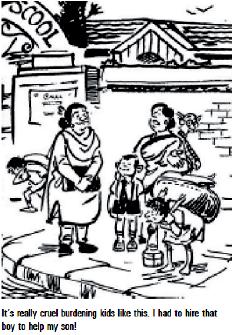
Q10 : What do you think the famous cartoonist R.K. Laxman is trying to convey in this cartoon? How does it relate to the 2006 law that you read about on page 123?
Answer :
The famous cartoonist R.K. Laxman, in this cartoon, is trying to convey an ironical perception of the double standards and hypocrisy some of us follow. A mother is complaining about the heavy bags that children are made to carry to school, but she hires another “child” servant to do the same without a wee bit of sympathy for the less fortunate child who has to work and earn a living.
This relates to the 2006 Child Labour Prevention Act that banned children under the age of 14 years from work, making it a punishable offence for those who employed these children. Unfortunately, 74% of child domestic labour today is under the age of 16. R.K. Laxman, in his cartoon, is pointing towards this very glitch and how the government has not taken adequate action to enforce this law.