
Exercise : Solutions of Questions on Page Number : 110
Q1 : Explain the importance of reproduction in organisms.
Answer :
Reproduction is a biological process through which living organisms produce offspring similar to themselves. Living organisms reproduce to maintain their number and for the continuation of their species. Thus, reproduction ensures the continuation of similar kinds of individuals.
Q2 : Describe the process of fertilization in human beings.
Answer :
Fertilization involves the fusion of the male and the female gamete. The male and the female gametes are released from the male and the female reproductive organs. Sperms or male gametes are released from the male reproductive organ i.e., the penis. These sperms then enter the female body through the vagina. Then, they travel through the fallopian tubes where they meet the eggs. Hence, the process of fertilization takes place in the fallopian tubes.
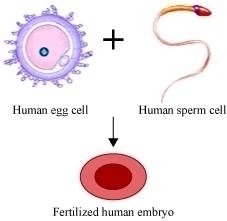
During fertilization, the haploid nucleus of the sperm and that of the ovum fuse with each other to form the zygote. This zygote divides to form an embryo which in turn develops into a foetus.
Q3 : Choose the most appropriate answer.
(a) Internal fertilization occurs
(i) in female body.
(ii) outside female body.
(iii) in male body.
(iv) outside male body.
(b) A tadpole develops into an adult frog by the process of
(i) fertilization
(ii) metamorphosis
(iii) embedding
(iv) budding
(c) The number of nuclei present in a zygote is
(i) none
(ii) one
(iii) two
(iv) four
Answer :
(a) (i) Internal fertilization occurs in the female body.
(b) (ii) A tadpole develops into an adult frog by the process of metamorphosis.
(c) (ii) The number of nuclei present in a zygote is one.
Q4 : Indicate whether the following statements are True (T) or False (F).
(a) Oviparous animals give birth to young ones. ( )
(b) Each sperm is a single cell. ( )
(c) External fertilization takes place in frogs. ( )
(d) A new human individual develops from a cell called gamete. ( )
(e) Egg laid after fertilization is made up of a single cell. ( )
(f) Amoeba reproduces by budding. ( )
(g) Fertilization is necessary even in asexual reproduction. ( )
(h) Binary fission is a method of asexual reproduction. ( )
(i) A zygote is formed as a result of fertilization. ( )
(j) An embryo is made up of a single cell. ( )
Answer :
(a) Oviparous animals give birth to young ones. (F)
(b) Each sperm is a single cell. (T)
(c) External fertilization takes place in frogs. (T)
(d) A new human individual develops from a cell called gamete. (F)
(e) Egg laid after fertilization is made up of a single cell. (T)
(f) Amoeba reproduces by budding. (F)
(g) Fertilization is necessary even in asexual reproduction. (F)
(h) Binary fission is a method of asexual reproduction. (T)
(i) A zygote is formed as a result of fertilization. (T)
(j) An embryo is made up of a single cell. (F)
Q5 : Give two differences between a zygote and a foetus.
Answer :
| Zygote | Foetus |
| It is a fertilized egg formed after the fusion of the sperm with the egg. | It is a stage of the embryo that shows all the main recognizable body parts of a mature organism. |
| The zygote divides several times to form an embryo. | An embryo gradually develops into a foetus. |
Q6 : Define asexual reproduction. Describe two methods of asexual reproduction in animals.
Answer :
Asexual reproduction is a mode of reproduction that does not involve the fusion of the male and the female gamete. It requires only one parent, and the offsprings produced are exact copies of their parents.
Two methods of asexual reproduction in animals are:
(i) Binary fission:
It is a type of asexual reproduction in which a single cell divides into two halves. Organisms that reproduce through binary fission are bacteria and Amoeba. In Amoeba, the division of cells can take place in any plane. It involves the division of its nucleus into two nuclei, which is followed by the division of its body into two halves. Each half of the body receives a nucleus.

Binary fission in Amoeba
(ii) Budding:
Budding involves the formation of a new individual from the bulges, known as buds formed on the parent body. This method of reproduction is common in Hydra.In Hydra, thecells divide rapidly at a specific site and develop as an outgrowth, called the bud. These buds, while being attached to the parent plant, develop into smaller individuals. When these individuals become mature enough, they detach from the parent’s body and become independent individuals.
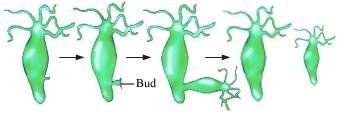
Budding in Yeast
Q7 : In which female reproductive organ does the embryo get embedded?
Answer :
The embryo gets embedded in the wall of the uterus. The embryo while it is still attached to the uterus gradually develops various body parts such as hands, legs, head, eyes, etc. The embryo is then called a foetus.
Q8 : What is metamorphosis? Give examples.
Answer :
Metamorphosis is a biological process of transforming a larva into an adult. This involves relatively sudden and abrupt changes in the animal’s structure. Frogs and insects are examples of organisms showing metamorphosis. The life cycle of a frog has three distinct stages:
EGG → TADPOLE → ADULT
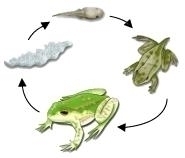
Life cycle of a frog
The tadpole that emerges from the egg contains gills, a tail, and a small circular mouth. They can swim freely in water. The tadpole grows and involves abrupt changes in its structure and develops into a mature frog. A tadpole’s metamorphosis begins with the development of limbs, lung development, and finally the absorption of the tail by the body.
Q9 : Differentiate between internal fertilization and external fertilization.
Answer :
| Internal fertilization | External fertilization |
| It involves the fusion of the male and the female gamete inside the female body. | It involves the fusion of the male and the female gamete outside the female body. |
| Chances of the survival of the offspring are more. Therefore, a small number of eggs are produced. | Chances of survival of the offspring are less. Therefore, a large number of eggs are produced. |
| Humans, cows, hens are organisms showing internal fertilization. | Fish, frog, starfish are organisms showing external fertilization. |
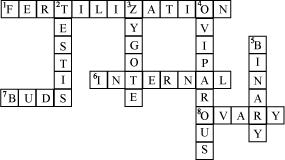
Q10 : Complete the crossword puzzle using the hints given below.
Across
1. The process of the fusion of the gametes.
6. The type of fertilization in hen.
7. The term used for bulges observed on the sides of the body of Hydra.
8. Eggs are produced here.
Down
2. Sperms are produced in these male reproductive organs.
3. Another term for the fertilized egg.
4. These animals lay eggs.
5. A type of fission in amoeba.
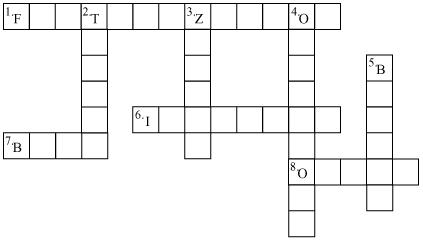 v
v
Answer :
Across
1. FERTILIZATION
6. INTERNAL
7. BUDS
8. OVARY
Down
2. TESTIS
3. ZYGOTE
4. OVIPAROUS
5. BINARY
.