Exercise : Solutions of Questions on Page Number : 86
Q1 : Fill in the blanks:
(a) A place where animals are protected in their natural habitat is called a __ .
(b) Species found only in a particular area are known as ______.
(c) Migratory birds fly to far away places because of ____ _ changes.
Answer :
(a) A place where animals are protected in their natural habitat is called a sanctuary__.
(b) Species found only in a particular area are known as __endemic__.
(c) Migratory birds fly to far away places because of __climatic__ changes.
Q2 : Differentiate between the following.
(a) Wildlife sanctuary and biosphere reserve
(b) Zoo and wildlife sanctuary
(c) Endangered and extinct species
(d) Flora and fauna
Answer :
(a)
| Wildlife sanctuary | Biosphere reserve |
| It is an area within which animals are protected from possible dangers such as hunting. Their habitat is also conserved in this area. | It is a large protected area constructed for the conservation of biodiversity. |
| It provides protection and suitable living conditions to wild animals. | It helps in the conservation of various life forms such as plants, animals, and micro-organisms. |
| Pachmarhi sanctuary is a wildlife sanctuary. | Pachmarhi biosphere reserve is a popular biosphere reserve. |
(b)
| Zoo | Wild life sanctuary |
| It is a facility in which animals are kept for public exhibition. | It is an area within which animals are protected from possible dangers such as hunting. Their habitat is also conserved in this area. |
| It is an artificial habitat. | It conserves the natural habitat of animals. |
(c)
| Endangered species | Extinct species |
| It is a population of species that is on the verge of becoming extinct. | It is a population of species that no longer exists. Hence, it is extinct. |
| Blue whale, tiger, leopard, etc. are examples of endangered species. | Dodo, passenger pigeon, etc. are examples of extinct species. |
(d)
| Flora | Fauna |
| It is a population of species that is on the verge of becoming extinct. | It is a population of species that no longer exists. Hence, it is extinct. |
| Blue whale, tiger, leopard, etc. are examples of endangered species. | Dodo, passenger pigeon, etc. are examples of extinct species. |
Q3 : Discuss the effects of deforestation on the following.
(a) Wild animals
(b) Environment
(c) Villages (Rural areas)
(d) Cities (Urban areas)
(e) Earth
(f) The next generation
Answer :
(a) Effects of deforestation on wild animals:
Deforestation is the removal of trees or other vegetation from an area for industrial, agricultural, or other purposes. Trees and other vegetation form the habitat of many animals. Hence, if the habitat of wild animals is destroyed, then their numbers would automatically decline.
(b) Effects of deforestation on the environment:
Plants absorb CO2 from the atmosphere to perform photosynthesis. If plants are destroyed, then the level of CO2 in the atmosphere will rise. As a result, CO2 will trap more heat radiations, thereby adding to global warming. An increase in the temperature of the Earth will disturb the natural water cycle. As a result, there will be a change in the rainfall pattern. This could lead to floods or droughts.
(c) Effects of deforestation on villages:
Roots of plants hold soil particles together. In the absence of plants, the top layer of the soil will be easily removed by the action of high speed winds or water flow. Thus, deforestation increases the chances of soil erosion. As a result, soil loses humus and become less fertile. Hence, a fertile land, which is a source of living for farmers in villages, gets converted into a desert.
(d) Effects of deforestation on cities:
Deforestation in cities can increase the risk of many natural calamities such as floods and droughts in that area. Also, it can lead to global warming due to an increase in the level of CO2 in the atmosphere as a result of vehicular and industrial pollution. This increase in temperature can disturb the natural water cycle of an area
(e) Effects of deforestation on the Earth:
As a result of deforestation, chances of desertification, droughts, floods, etc. increase. Deforestation can also increase the level of CO2 in the Earth. It will lead to an increase in temperature i.e., global warming. As a result, the entire natural water cycle will get disrupted. This again increases the risk of natural calamities.
(f) Effects of deforestation on the next generation:
Deforestation is slowly changing our environmental conditions. It is responsible for global warming, soil erosion, greenhouse effect, drought, floods, and many other global problems. As a result, the next generation will have to face severe consequences of deforestation.
Q4 : What will happen if:
(a) we go on cutting trees.
(b) the habitat of an animal is disturbed.
(c) the top layer of soil is exposed.
Answer :
(a) If we go on cutting trees, the natural habitat of many animals will get completely destroyed. As a result, the biodiversity of many areas will be severely affected. Also, there will be an increase in the temperature of the Earth as a result of global warming, which can disturb the natural water cycle. As a result, there will be a change in the rainfall pattern. This could lead to floods or droughts. This will also increase the risk of soil erosion, desertification, and natural calamities.
(b) The habitat of an animal provides it with necessities such as shelter, food, and protection. If the habitat of an animal is disturbed, then it will be forced to go to other places in search of food and shelter. The animal could get killed by other animals in this process.
(c) If the top layer of soil is exposed, then it will gradually expose the lower layer of soil, which is hard and rocky in nature. This type of soil is less fertile as it contains less humus. Continued soil erosion will make the land barren or infertile.
Q5 : Answer in brief:
(a) Why should we conserve biodiversity?
(b) Protected forests are also not completely safe for wild animals. Why?
(c) Some tribals depend on the jungle. How?
(d) What are the causes and consequences of deforestation?
(e) What is Red Data Book?
(f) What do you understand by the term migration?
Answer :
(a) Biodiversity refers to the number and variety of various life forms such as plants, animals, and micro-organisms in an area. Plants and animals depend on each other for survival. This means that the destruction of either of the two will affect the life of the other. Hence, we need to conserve biodiversity to maintain the balance of nature.
(b) Protected forests are not completely safe for wild animals because people who live near or adjacent to forests use resources from forests to fulfil their own requirements. In this process, wild animals are killed and sold for lucrative amounts of money.
(c) Tribals gather food, fodder, and fallen branches of trees from forests. Hence, they depend on forests for their daily requirements.
(d) Causes of deforestation:
(i) Forests are cleared for accommodating expanding urban areas and for fulfilling their ever-increasing requirements.
(ii) Forests are destroyed to clear land for crops and cattle grazing.
(iii) Trees are cut down to be used for firewood.
Consequences of deforestation:
(i) Soil erosion
(ii) Loss of biodiversity
(iii) Floods and droughts
(iv) Climate change due to global warming
(v) Disruption of water cycle
(e) Red Data Book is a source book that maintains an international list of all endangered animal and plant species. This book is maintained by IUCN (International Union for Conservation of Nature and Natural resources).
(f) Migration refers to the movement of an organism or a group of organisms from its natural habitat to another place at a particular time every year. Organisms migrate from one place to another to avoid inhabitable climatic conditions or for breeding.
Q6 : In order to meet the ever-increasing demand in factories and for shelter, trees are being continually cut. Is it justified to cut trees for such projects? Discuss and prepare a brief report.
Answer :
No. It is not at all justified to cut trees to meet the ever increasing demands of human population. Forests are the habitat of several organisms including wild animals. They provide us with good quality air as they give out O2 and absorb the harmful CO2 gas from the atmosphere. In the process, they prevent the excessive heating of the atmosphere. They prevent soil erosion and natural calamities such as floods and droughts. They increase the fertility of the soil and help conserve biodiversity. The cutting of forests to meet the demands of growing human population will lead to global warming, soil erosion, greenhouse effect, droughts, floods, and many more problems. The destruction of forests will disturb the balance of nature. Hence, forests must be conserved.
Q7 : How can you contribute to the maintenance of green wealth of your locality? Make a list of actions to be taken by you.
Answer :
I can help in maintaining the green wealth of my locality by taking care of the plants and trees growing in or around my locality. I can plant more and more trees. I can also encourage the people in my locality to plant more trees by informing them about the importance of growing trees. I can make young children aware of the effects that deforestation has on our environment and on our planet. I can also ask them to water the plants daily, which will take very little of their time. I believe planting new trees is as important as taking care of the existing trees.
Q8 : Explain how deforestation leads to reduced rainfall.
Answer :
Deforestation is the removal of trees or other vegetation from an area for industrial, agricultural, or other purposes. Plants or trees absorb CO2 from the atmosphere. If plants are destroyed, then the level of CO2 in the atmosphere will rise. The high levels of CO2 in the atmosphere will trap more heat radiations, leading to global warming. This increase in temperature of the Earth will disturb the natural water cycle. As a result of disruption in the water cycle, there will be a change in the rainfall pattern. The reduced amount of rainwater can cause droughts.
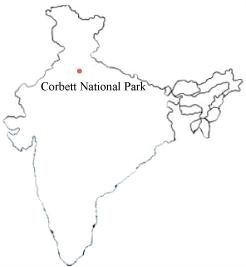
Q9 : Find out about national parks in your state. Identify and show their location on the outline map of India.
Answer :
One of the national parks located near Delhi is the Corbett National Park.
Q10 : Why should paper be saved? Prepare a list of ways by which you can save paper.
Answer :
Paper should be saved because it takes around seventeen full grown trees to make one tonne of paper. Trees, as we know, are important to maintain a balance of nature. Therefore, in order to save trees and prevent the impact of their loss on living organisms, we need to save paper.
Ways by which paper can be saved:
(i) Collect used paper and recycle it.
(ii) Use both sides of a paper for writing.
(iii) Spread awareness about the importance of paper.
(iv) Use paper intelligently.
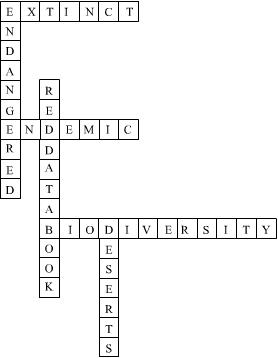
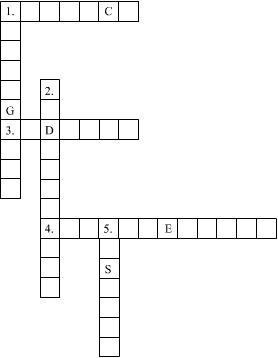
Q11 : Complete the world puzzle.
Down
1. Species on the verge of extinction.
2. A book carrying information about endangered species.
5. Consequence of deforestation.
Across
1. Species which have vanished.
3. Species found only in a particular habitat.
4. Variety of plants, animals and microorganisms found in an area.
Answer :
Down
1. ENDANGERED
2. RED DATA BOOK
5. DESERTS
Across
1. EXTINCT
3. ENDEMIC
4. BIODIVERSITY