
Exercise : Solutions of Questions on Page Number : 45
Q1 : Answer the following questions.
(i) Which are the two factors on which the growth of vegetation mostly depends?
(ii) Which are the three broad categories of natural vegetation?
(iii) Name the two hardwood trees commonly found in tropical evergreen forest.
(iv) In which part of the world are tropical deciduous forests found?
(v) In which climatic conditions are citrus fruits cultivated?
(vi) Mention the uses of coniferous forest.
(vii) In which part of the world is seasonal grassland found?
Answer :
(i) Temperature and moisture are the two factors on which the growth of vegetation mostly depends.
(ii) The three broad categories of natural vegetation are forests, grasslands and shrubs.
(iii) Rosewood and ebony are hardwood trees commonly found in tropical evergreen forests.
(iv) Tropical deciduous forests are monsoon forests found in large parts of India, Northern Australia and Central America.
(v) Citrus fruits are cultivated in Mediterranean climate, i.e., regions experiencing hot, dry summers and mild, rainy winters.
(vi) Coniferous forests are home to softwood trees. The woods of these trees are used for making pulp, which is used for manufacturing paper and newsprint. Match boxes and packing boxes are also made from softwood.
(vii) Seasonal grasslands or temperate grasslands are found in the mid-latitudinal zones and in the interior parts of continents.
Q2 : Tick the correct answer.
(i) Mosses and lichens are found in
(a) Desert Vegetation
(b) Tropical evergreen forest
(c) Tundra vegetation
(ii) Thorny bushes are found in
(a) Hot and humid tropical climate
(b) Hot and dry desert climate
(c) Cold polar climate
(iii) In tropical evergreen forest, one of the common animals is
(a) Monkey
(b) Giraffe
(c) Camel
(iv) One important variety of coniferous forest is
(a) Rosewood
(b) Pine
(c) Teak
(v) Steppe grassland is found in
(a) S. Africa
(b) Australia
(c) Russia
Answer :
(i)Mosses and lichens are found in
(a) Desert Vegetation
(b) Tropical evergreen forest
(c) Tundra vegetation
(ii)Thorny bushes are found in
(a) Hot and humid tropical climate
(b) Hot and dry desert climate
(c) Cold polar climate
(iii)In tropical evergreen forest, one of the common animals is
(a) Monkey
(b) Giraffe
(c) Camel
(iv)One important variety of coniferous forest is
(a) Rosewood
(b) Pine
(c) Teak
(v)Steppe grassland is found in
(a) S. Africa
(b) Australia
(c) Russia
Q3 : Match the following.
| (i) Walrus | (a) Softwood tree |
| (ii) Cedar | (b) An animal of tropical deciduous forest |
| (iii) Olives | (c) A polar animal |
| (iv) Elephant | (d) Temperate grassland in Australia |
| (v) Campos | (e) Thorny shrubs |
| (vi) Downs | (f) A citrus fruit |
| – | (g) Tropical grassland of Brazil |
Answer :
| (i) Walrus | (c) A polar animal |
| (ii) Cedar | (a) Softwood tree |
| (iii) Olives | (f) A citrus fruit |
| (iv) Elephant | (b) An animal of tropical deciduous forest |
| (v) Campos | (g) Tropical grassland of Brazil |
| (vi) Downs | (d) Temperate grassland in Australia |
Q4 : Give reasons.
(i) The animals in Polar region have thick fur and thick skin.
(ii) Tropical deciduous trees shed their leaves in the dry season.
(iii) The type and thickness of vegetation changes from place to place.
Answer :
(i) The Polar region is characterised by extremely cold weather. The animals found in this region have thick fur and thick skin to protect themselves from the cold climatic conditions.
(ii)The tropical deciduous trees are found in regions characterised by seasonal changes. The trees shed their leaves in the dry season to conserve water.
(iii)Growth of vegetation depends upon factors like temperature, moisture, slope and thickness of soil. Due to the variations in these factors from place to place, the type and thickness of vegetation also varies from place to place.
Exercise : Solutions of Questions on Page Number : 46
Q5 : For fun.
In the crossword table given below, some words are hidden. They are all about vegetation and wildlife and are to be found horizontally and vertically. Two have been worked out for you. Work in pairs with a friend.

Answer :
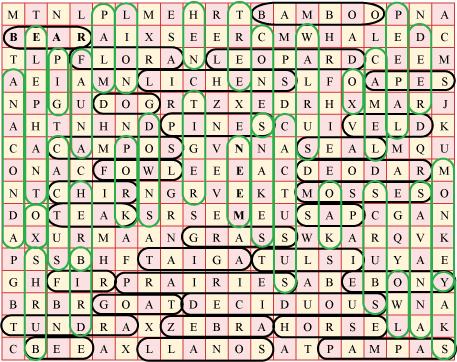
Horizontal
| Bamboo | Veld | Tea | Goat |
| Bear | Campos | Sap | Deciduous |
| Flora | Seal | Grass | Tundra |
| Leopard | Fowl | Taiga | Zebra |
| Lichens | Deodar | Tulsi | Horse |
| Apes | Chir | Fir | Bee |
| Dog | Mosses | Prairies | Llanos |
| Pines | Teak | Ebony | Pampas |
Vertical
| Anaconda | Bird | Neem | Owl |
| Elephant | Palm | Cones | Deer |
| Ox | Lion | Snakes | Savanna |
| Shrub | Pork | Walrus | Monkey |
| Pig | Downs | Oak | Yaks |
| Cactus | Hen | Camel | – |
| Fauna | Tiger | Scrubs | – |
| Herb | Tree | Peepal | – |