
Exercise : Solutions of Questions on Page Number : 27
Q1 : Answer the following questions.
(i) What is atmosphere?
(ii) Which two gases make the bulk of the atmosphere?
(iii) Which gas creates greenhouse effect in the atmosphere?
(iv) What is weather?
(v) Name three types of rainfall?
(vi) What is air pressure?
Answer :
(i)The huge blanket of air surrounding the Earth is called atmosphere.
(ii)Nitrogen and oxygen make the bulk of the atmosphere.
(iii)Carbon dioxide creates greenhouse effect in the atmosphere.
(iv)Weather refers to the short-term changes in the atmosphere. It is the hour-to-hour, day-to-day condition of the atmosphere.
(v)Convectional rainfall, orographic rainfall and cyclonic rainfall are the three types of rainfall.
(vi)Air pressure is defined as the pressure exerted by the weight of air on the Earth’s surface.
Q2 : Tick the correct answer.
(i) Which of the following gases protects us from harmful sun rays?
(a) Carbon dioxide (b) Nitrogen (c) Ozone
(ii) The most important layer of the atmosphere is
(a) Troposphere (b) Thermosphere (c) Mesosphere
(iii) Which of the following layers of the atmosphere is free from clouds?
(a) Troposphere (b) Stratosphere (c) Mesosphere
(iv) As we go up the layers of the atmosphere, the pressure
(a) Increases (b) Decreases (c) Remains the same
(v) When precipitation comes down to the Earth in the liquid form, it is called
(a) Cloud (b) Rain (c) Snow
Answer :
(i)Which of the following gases protects us from harmful sun rays?
(a) Carbon dioxide (b) Nitrogen (c) Ozone
(ii)The most important layer of the atmosphere is
(a) Troposphere (b) Thermosphere (c) Mesosphere
(iii)Which of the following layers of the atmosphere is free from clouds?
(a) Troposphere (b) Stratosphere (c) Mesosphere
(iv)As we go up the layers of the atmosphere, the pressure
(a) Increases (b) Decreases (c) Remains the same
(v)When precipitation comes down to the Earth in the liquid form, it is called
(a) Cloud (b) Rain (c) Snow
Q3 : Match the following.
| (i) Trade Winds | (a) Incoming solar energy |
| (ii) Loo | (b) Seasonal wind |
| (iii) Monsoon | (c) Horizontal movement of air |
| (iv) Wind | (d) Layer of ozone gas |
| – | (e) Permanent wind |
| – | (f) Local wind |
Answer :
| (i) Trade Winds | (e) Permanent wind |
| (ii) Loo | (f) Local wind |
| (iii) Monsoon | (b) Seasonal wind |
| (iv) Wind | (c) Horizontal movement of air |
Q4 : Give reasons.
(i) Wet clothes take longer time to dry on a humid day?
(ii) Amount of insolation decreases from Equator towards Poles?
Answer :
(i)Things remain damp and wet, and take longer time to dry when the atmosphere around them is damp and wet. Humidity is the amount of moisture or water vapour present in air at any moment in time. On a humid day, the air is full of water vapour. As the air gets warmer, its capacity to hold the water vapour increases. As a result, conditions become more and more humid. Hence, wet clothes take longer time to dry on a humid day.
(ii) Insolation refers to the incoming solar radiations intercepted by the Earth. The amount of sunlight received by the regions close to the Equator is greater than the amount of sunlight received by the regions close to the Poles. This is because of the tilt of the Earth’s axis. As a result of this tilt, the incoming solar radiations cover a greater area at the Equator than at the Poles.
Exercise : Solutions of Questions on Page Number : 28
Q5 : For fun.
(i) Solve this Crossword puzzle with the help of given clues:
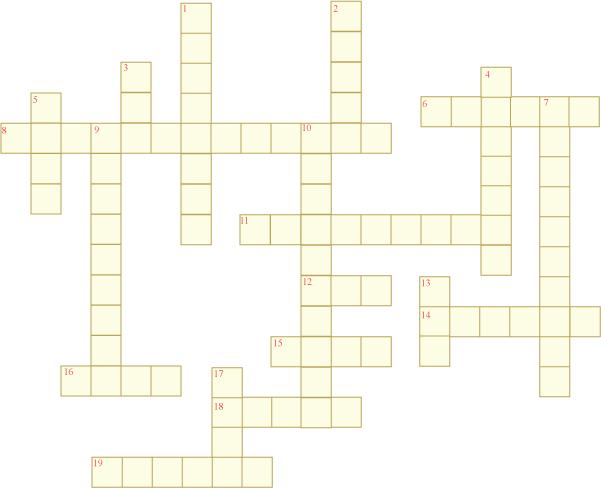
| Across | Down |
| 6. An Indian tree having extraordinary quality of providing oxygen round the clock | 1. Amount of water vapour in air |
| 8. Gas present in atmosphere occupying only 0.03% by volume | 2. Condensation of water vapours around dust particles in atmosphere |
| 11. Outermost layer of atmosphere | 3. Example of local wind blowing in summer in northern India |
| 12. Mixture of many gases | 4. Short-term changes in atmosphere |
| 14. Life-giving gas | 5. Precipitation in liquid form |
| 15. Air in motion | 7. Blanket of air around the Earth |
| 16. An Indian tree valued highly for medicinal properties | 9. Instrument to measure pressure |
| 18. Gas protecting us from harmful sunrays | 10. Incoming solar radiation |
| 19. Low pressure area | 13. Reduces visibility in winters |
| – | 17. It is ……. time when Sun is overhead |
(ii) Make a weather calendar for one week. Use pictures or symbols to show different types of weather. You can use more than one symbol in a day, if the weather changes. For example, the sun comes out when rain stops. An example is given below:
| Day | Weather |
1. |
Sunny day |
| 2. | |
| 3. | |
| 4. | |
| 5. | |
| 6. | |
| 7. |
Answer :
(i)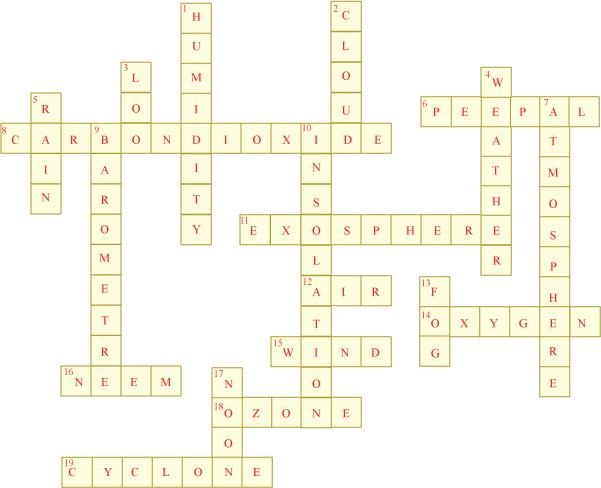
(ii) Your weather calendar could look like this.
| Day | Weather |
| 1. |
Clear and sunny day |
2. |
Mainly cloudy |
3. |
Cloudy and grey |
4. |
Cloudy, with moderate rainfall |
5. |
Partly to mainly cloudy, with heavy rainfall and possibility of lightning |
6. |
Partly to mainly cloudy, with light rainfall |
7. |
Mainly sunny |