
List of subtopics covered in Chapter 5 – Morphology of Flowering Plants
| Number | Subtopic |
| 5.1 | The root |
| 5.2 | The stem |
| 5.3 | The leaf |
| 5.4 | The inflorescence |
| 5.5 | The flower |
| 5.6 | The fruit |
| 5.7 | The seed |
| 5.8 | Semi-technical description of a typical flowering plant |
| 5.9 | Description of some important families |
NCERT Solutions for Class 11 Biology Chapter 5 – Morphology of Flowering Plants
Class 11 Biology Chapter 5 Morphology of Flowering Plants NCERT Solution is given below.
Question 1: What is meant by modification of root? What type of modification of root is found in the
(a) Banyan tree
(b) Turnip
(c) Mangrove trees
Answer:
Primarily, there are two types of root systems found in plants, namely the tap root system and fibrous root system. e main function of the roots is to absorb water and minerals from the soil. However, roots are also modified to perform various other functions. The roots of some plants act as storage sites for food, some provide support to massive plant structures, while others absorb oxygen from the atmosphere.
Roots and its modifications in various plants:
(a) Banyan tree
The banyan tree (Ficus benghalensis) has massive pillar-like adventitious roots arising from the aerial part of the stem. These roots grow towards the ground and provide support to the tree. Such roots are called prop roots.
(b) Turnip
The roots of turnip (Brassica rape) help in the storage of food. Similar food-storing roots are found in radishes, carrots, and sweet potatoes.
(c) Mangrove tree
The roots of mangrove plants grow vertically upwards from the soil for the absorption of oxygen from the atmosphere as the soil is poorly aerated. These types of roots are called pneumatophores.
Question 2: Justify the following statements on the basis of external features
(i) Underground parts of a plant are not always roots
(ii) Flower is a modified shoot
Answer:
(i) Various parts of plants are modified into underground structures to perform various functions such as stems, leaves, and even fruits.
The stems in ginger and banana are underground and swollen due to storage of food. They are called rhizomes. Similarly, corm is an underground stem in Colocasia and Zamin-khand. The tips of the underground stem in potato become swollen due to the accumulation of food and forms tuber. Tubers bear eyes, which are subtended by a leaf scar. Basal leaves in onions become fleshy because of the accumulation of food. In peanuts, the flower after fertilization gets pushed inside the soil by growing a flower stalk. The formation of fruits and seeds takes place inside the soil.
(ii) During the flowering season, the apical meristem gives rise to the floral meristem. The axis of the stem gets condensed, while the internodes lie near each other. Instead of leaves, various floral appendages arise from the node. Therefore, it can be said that the flower is a modified shoot.
Question 3: How is pinnately compound leaf different from palmately compound leaf?
Answer
| Pinnately compound leaf | Palmately compound leaf |
| The leaflets are attached to the common axis, called rachis. | The leaflets are attached at a common point on the leaf stalk. |
| Examples include neem and Cassia fistula( also called golden shower plant) | Examples include silk cotton (Bombax ) and Cannabis. |
Question 4: Explain with suitable examples the different types of phyllotaxy?
Answer:
Phyllotaxy refers to the pattern or arrangement of leaves on the stem or branch of a plant. It is of three types, alternate, opposite, and whorled phyllotaxy.
In alternate phyllotaxy, a single leaf arises from the node of a branch. This type of phyllotaxy is observed in the sunflower, mustard, and peepal. Plants with opposite phyllotaxy have two leaves arising from the node in opposite directions. It is found in guava and jamun plants. Plants with whorled phyllotaxy have three or more leaves arising from the node. It is found in Alstonia.
Question 5: Define the following terms:
(a) Aestivation
(b) Placentation
(c) Actinomorphic
(d) Zygomorphic
(e) Superior ovary
(f) Perigynous flower
(g) Epipetalous Stamen
Answer:
(a) Aestivation
The term ‘aestivation’ refers to the mode in which sepals or petals are arranged in a floral bud with respect to other floral members. There are four types of aestivation in plants i.e., valvate, twisted, imbricate, and vexillary.
(b) Placentation
The term ‘placentation’ refers to the arrangement of ovules within the ovary of a flower. It is primarily of five types, namely marginal, basal, parietal, axile, and free central.
(c) Actinomorphic
Actinomorphic flowers can be divided into two radial halves by any radial plane passing through its centre. Examples of these flowers include chilly and mustard.
(d)Zygomorphic
Zygomorphic flowers are those flowers which can be divided into two similar halves by a single vertical plane. Examples of these flowers include pea and beans.
(e) Superior ovary
Superior ovary flowers are those flowers in which the gynoecium is present at the highest position, while other floral parts are arranged below it. A flower with this arrangement is described as hypogynous. Examples include brinjal and mustard.
(f) Perigynous flower
In perigynous flowers, the gynoecium is present in the centre and the rest of the floral parts are arranged at the rim of the thalamus at the same level. Examples include plum and rose.
(g) Epipetalous Stamen
Epipetalous stamens are stamens attached to the petals. They are found in brinjal.
Question 6: Differentiate between
(a) Racemose and cymose inflorescence
(b) Fibrous roots and adventitious roots
(c) Apocarpous and syncarpous ovary
Answer:
(a) Racemose and cymose inflorescence
| Racemose inflorescence | Cymose inflorescence |
| 1) Younger flowers are present at the tip while older flowers are arranged at the base of this inflorescence. Such an arrangement is called acropetal succession. | 1) Younger flowers are present at the base of the inflorescence, while older flowers are present at the top. Such an arrangement is called basipetal succession. |
| 2) The main axis in racemose inflorescence continues to grow and produce flowers laterally. | 2) The main axis in cymose inflorescence has limited growth, which later terminates into a flower. |
(b) Fibrous roots and adventitious roots
| Fibrous root | Adventitious root |
| 1) In monocots, the primary root which develops from the radicle of the seed is short-lived and is replaced by a large number of roots arising from the base of the stem. | 1) These roots arise from any part of the plant other than the radicle of seeds. |
| 2) It is found in wheat and other cereals. | 2) It is found in banyan, Monstera, and other plants. |
(c) Apocarpous and syncarpous ovary
| Apocarpous ovary | Syncarpous ovary |
| 1) The flowers with apocarpus ovary have more than one carpel. These carpels are free. | 1) The flowers with syncarpous ovary have more than one carpel. However, these carpels are fused. |
| 2) It is found in lotus and rose flowers. | 2) It is found in the flowers of tomato and mustard. |
Question 7:Draw the labelled diagram of the following:
(i) Gram seed
(ii) V.S. of maize seed
Answer
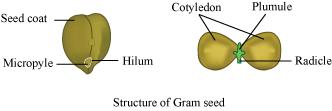
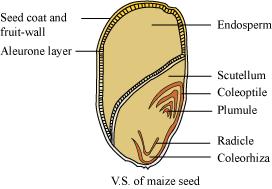
Question 8: Describe modifications of stem with suitable examples
Answer:
Stems of various plants have undergone modifications to perform different functions.
Underground stems or storage stems:
Examples: Rhizomes, Corms, tubers
In ginger and banana, the underground stem is called a rhizome. The underground stem in Colocasia (arvi) is known as corm. Rhizomes and corms are underground stems, modified for the storage of food. Also, these stems help in vegetative reproduction of these plants. The tips of the underground stem in potato plants become swollen due to the accumulation of food. The potato is a tuber that helps in the storage of food and bears eyes on it. Subtended by a leaf scar, these eyes bear buds that give rise to new plants.
Supportive stems
Example: tendril
The stem in some weak plants bear thin, slender, and spirally-coiled structures called tendrils that help the plant get attached to nearby structures for support. Tendrils are found in cucumbers, melons, and other members of the family Cucurbitaceae.
Protective stems
Example: Thorns
The stem in bougainvillea and citrus plants (like lemon and orange) bear sharp, pointed structures called thorns, which provide protection to the plant from herbivores.
Photosynthetic stems
Example: Opuntia
The stem in the Opuntia is green. It carries out the process of photosynthesis in the absence of leaves.
Others stem modifications
In some plants, underground stems such as grasses spread in the soil and help in perenation. These stems are called runners.
The short lateral stem called the offset in some aquatic plants (such as Eichhornia) bears leaves and tufts of roots at the node and gives rise to new plants.
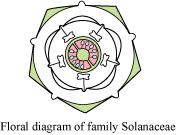
Question 9: Take one flower each of families Fabaceae and Solanaceae and write its semi-technical description. Also draw their floral diagrams after studying them.
Answer
(1) Family Fabaceae/Papilionaceae (pea plant)
Fabaceae/Papilionaceae is a sub-family of the Leguminoseae family.
Vegetative features:
Habit: Pinnately compound, alternately arranged with leaf tendrils with the pulvinus present at the leaf base along folacious stipules.
Root: Tap root system with root nodules.
Floral features:
Inflorescence: Racemose, generally axial than terminal Flower: Zygomorphic and bisexual flowers are found
Calyx: It contains five sepals which are gamosepalous while aestivation is imbricate. Corolla: It contains five petals (polypetalous) with vexillary aestivation. Androecium: It consists of ten anthers that are diadelphous with dithecous anthers. Gynoecium: Monocarpellary superior ovary which is unilocular with marginal placentation.
Fruit: Legume pod with non-endospermic seeds
Floral formula: 
Economic importance: Peas are used as vegetables for making various culinary preparations.

(2) Flowers of Solanum nigrum
Family Solanaceae
Vegetative features:
Habit: Erect, herbaceous plant
Leaves: Simple, exstipulate leaves with reticulate venation Stem: Erect stem with numerous branches.
Floral features:
Inflorescence: Solitary and axillary Flowers: Actinomorphic, bisexual flowers
Calyx: Calyx is composed of five sepals that are united and persistent. Aestivation is valvate.
Corolla: Corolla consists of five united petals with valvate aestivation. Androecium: It consists of five epipetalous stamens.
Gynoecium: It consists of bicarpellary syncarpous superior ovary with axile placentation.
Fruits: Berry
Seeds: Numerous, endospermous
Floral formula: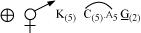
Economic importance: Peas are used as vegetables for making various culinary preparations.
Question 10: Describe the various types of placentations found in flowering plants.
Answer
Placentation refers to the arrangement of ovules inside the ovary. It is of five basic types.
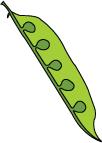
(A) Marginal placentation:
The ovary in which the placenta forms a ridge along the ventral suture of the ovary and the ovules develop on two separate rows is known to have marginal placentation. This type of placentation is found in peas.
(B) Parietal placentation
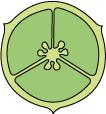
When the ovules develop on the inner walls of the ovary, the ovary is said to have parietal placentation.

C) Axile placentation
In axile placentation, the placenta is axial and ovules are attached to it. Examples include China rose, lemon, and tomato.
(D) Basal placentation
The ovary in which the placenta develops from its base and a single ovule is found attached to the base is said to have basal placentation. It is found in marigold and sunflower.

(E) Free central placentation
In free central placentation, the ovules develop on the central axis while the septa are absent. This type of placentation is found in Dianthus and primrose.

Question 11: What is a flower? Describe the parts of a typical angiosperm flower?
Answer:
A flower can be defined as the reproductive unit of any flowering plant (angiosperms). Flowers carry out sexual reproduction in angiosperms. A typical flower is a modified stem with a condensed axis. A flower has four different parts i.e., the calyx, corolla, androecium, and gynoecium. Androecium and gynoecium represent the male and female reproductive organs of a flower (respectively). Bisexual flowers are those which contain both androecium and gynoecium, while unisexual flowers contain either gynoecium or androecium. The corolla and the calyx are generally distinct, but may sometimes be fused (called perianth). A flower that contains all four floral parts is called a complete flower.
Parts of flowers
(A) The calyx forms the outermost whorl of a flower, which contains sepals. They are green, leaf–like structures that cover and protect the flowers during the bud stage. When the sepals of a flower are free, they are called polysepalous, while fused sepals of a flower are called gamosepalous.
(B) The corolla of a flower is a layer that lies inside the calyx. It contains beautifully coloured petals, which help in attracting insects for pollination. When the petals are free, they are called polypetalous, while fused petals are called gamopetalous.
(C) The androecium or the stamen is the male reproductive part of a flower. It consists of two parts, the filament and the bilobed anther. The bilobed anther is the site for meiosis and the generation of pollen grains.
(D) Gynoecium represents the female reproductive part of a flower. It consists of an ovary. The ovary is connected by a long tube (called style) to the stigma. The ovary bears numerous ovules attached to the placenta.
Question 12: How do the various leaf modifications help plants?
Answer:
The main function of the leaves is to carry out the process of photosynthesis. However, in a few plants, leaves are modified to perform different functions.
(a) Tendrils: The leaves of a pea plant are modified into tendrils that help the plant in climbing.
(b) Spines: The leaves in cactus are modified into sharp spines that act as an organ of defense.
(c) Phyllode: The leaves of some Australian acacia are short-lived and soon replaced by flattened, green structures called phyllodes that arise from the petiole of the leaves. The petioles in these plants synthesize food.
(d) Pitcher: The leaves of the pitcher plant are modified into pitcher-like structures, which contain digestive juices and help in trapping and digesting insects.
Question 13: Define the term inflorescence. Explain the basis for the different types of inflorescence in flowering plants.
Answer:
Inflorescence is the manner in which the flowers are arranged on the flowering axis. During the flowering season, the vegetative apex of the stem gets converted into a floral meristem. Based on whether the floral axis continues to grow or end in a flower, inflorescence is classified into racemose and cymose. In racemose inflorescence, the floral axis continues to grow and produces flowers laterally. On the other hand, in cymose inflorescence, the main axis terminates into a flower. Hence, it is limited in growth.
Question 14: Write the floral formula of an actinomorphic bisexual, hypogynous flower with five united sepals, five free petals. Five free stamens and two united carpals with superior ovary and axile placentation.
Answer:
The floral formula of the described flower is represented as:
Actinomorphic flowers are represented by the symbol ⊕.
A bisexual flower is indicated by  .
.
The calyx contains five united sepals which can be represented as K(5).
The corolla consists of five free petals and it represented as C5.
The androecium consists of five free stamens and is represented by A5.
The gynoecium consists of a superior ovary with two united carpels and axile placentations, which can be represented as G(2)
Question 15: Describe the arrangement of floral members in relation to their insertion on thalamus?
Answer:
Based on the position of the calyx, corolla, and androecium (with respect to the ovary on the thalamus), the flowers are described as hypognous, perigynous, and epigynous.
In hypogynous flowers, the ovary occupies the highest position on the thalamus while other floral parts are situated below it. In such flowers, the ovary is superior e.g., China rose, mustard etc.
In perigynous flowers, the ovary is situated at the centre and other floral parts are arranged on the rim of the thalamus. The ovary here is said to be half inferior e.g., plum, rose, peach
In epigynous flowers, the thalamus grows around the ovary fusing with its wall. The other floral parts are present above the ovary. Hence, the ovary is said to be inferior e.g., flowers of guava and cucumber.