
Answer the followings Questions
Q1. Read the story on page 130. In what ways in the monkey king similar to or different from the kings you read about in Chapters 6 and 11?
Ans: The monkey king in the story on page 130 is similar to the kings mentioned in chapters 6 and 11. The monkey king like the other kings has a huge army.
He himself is wise, diplomatic and brave. He has the virtue of taking right moment. When he observes the situation of the attack on his community by the king’s men, he makes a quick plan to save his army. First, he let all of them cross the river. As he is the last, he gets tired and exhausted, he falls down and is dead. In this way, he sacrifices his life for the safety of his kingdom. This is the supreme virtue of a king. So, he is in no way different from the other human kings.
Q2. Find out more and teU. a story from one of the epics.
Ans: We have a number of stories in our epics which inspire us in many ways. They guide us and teach us the ideals of life. Such epics are the Mahabharata and Ramayana.
In the Mahabharata, we have one such story. The battle was finalised between Kauravas and Pandavas. Both the parties were making efforts’ to win the favour of their relatives and other king. Krishna who was related to both was considered as a super man, possessing the qualities of gods. So, Duryodhana, the eldest of the Kauravas approached him. On the same day Arjuna, one of the five Pandavas, also went to Krishna. Duryodhana was a proud fellow. He sat on the head-side of Krishna who was sleeping at that time. Arjuna, a humble fellow, reached there after Duryodhana. But he sat at the feet side of Krishna and began pressing his feet. As Krishna opened his eyes, he saw Aijuna. Krishna had already promised them that he would be from the side of the man who would reach him first. As krishna saw Arjuna first he said that he would be in favour of Arjuna. Duryodhana opposed it because he had reached there first. Krishna said that those who want to get something from anyone then should be humble and courteous. Here, Duryodhana lost Krishna. We learn from this story that we should not show our arrogance to those from whom we ask for something.
MULTIPLE CHOICE QUESTIONS
Choose the correct option to complete the statements given below:
(i) The iron Pillar is situated at………………
(a) Junagarh (b) Mehrauli
(c) Aihole (d) Ahmedabad.
(ii) The height of the Iron Pillar is ……………. .
(a) 7.2 m (b) 8.2 m
(c) 9.2 m (d) 10.2 m.
(iii)The small box placed at the centre or heart of the stupa is known as a………………………
(a) Relic casket (b) Sacred box
(c) Trunk (d) None of the above.
(iv) The puranas contained stories about …………………
(a) Kings and queens (b) Gautam Buddha
(c) Mahatma Gandhi (d) Gods and goddesses.
(v) Sanskrit Ramayana is written by ………………
(a) Valmiki (b) Vyasa
(c) Tulsidas (d) Vishnu Sharma.
Ans. (i)—(b), (ii)—(a), (iii)—(a), (iv)—(d), (v)—(a).
FILL IN THE BLANKS
Fill in the blanks with appropriate words to complete each sentence.
(i) The ………. at Aihole was built about 1400 years ago
(ii)The small box placed at the centre of the stupa contains bodily remains of the and his followers.
(iii)The……. were recited in temples by priests and people came to listen to them.
(iv) Both the……….. and the…………. are supposed to have been composed by Vyasa.
(v)developed a scientific explanation for eclipses.
Ans: (i) Durga temple (ii) Buddha
(iii) Vedas (iu) Puranas, Mahabharata
(u) Aryabhatta
TRUE/FALSE
State whether these sentences are true (T) or false (F).
(i) Most temples of this period had a hall like structure known as the mandapa.
(ii) Mahabalipuram and Aihole are known for the finest stone temples.
(iii) Merchant and farmers usually decided to build stupas and temples during this period.
(iv) The Tamil epic the Silappadikaram was composed by a poet named Ilango.
(v) Meghaduta is a famous poem compsed by Tulsidas.
(vi) Women and Shudras could hear the stories of the Puranas.
(vii) It was Ravana who abducted Rama’s wife Sita.
(viii) The Jatakas and the Panchatantra are collections of stories told by birds and animals.
(ix) Aryabhatta was a famous story-letter.
(x)The Bhagavad Gita is a part of the Ramayana.
Ans. (i) True, (ii) True, (iii) False, (iv) True, (v) False, (vi) True, (vii) True, (viii) False, (ix) False, (x) False.
MATCHING SKILL
Match the items in column A correctly with those given in column B.
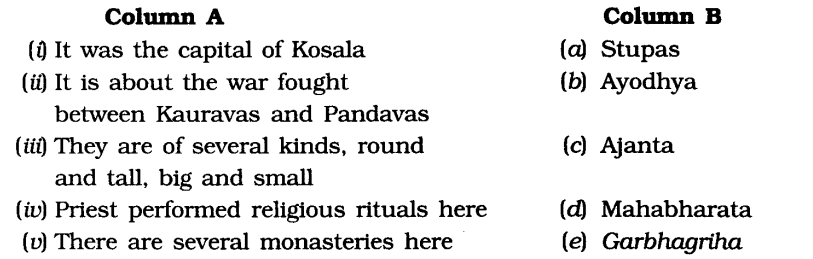
Ans. (i)—(b), (ii)—(d), (iii)—(a), (iv)—(e), (v)—(c).
VERY SHORT ANSWER TYPE QUESTIONS
Q1. When was the Iron Pillar made?
Ans: It was made about 1500 years ago.
Q2. Mention the most striking feature of the Iron Pillar.
Ans: The Pillar has not rusted in all these years.
Q3. What do you mean by the word ‘Stupa’? [V. Imp.]
Ans: The word Stupa means a mound. It is a Buddhist religious building.
Q4. Why did devotees walk around the stupa in a clockwise direction?
Ans: They did so to show their devotion.
Q5. Why was Amaravati famous?
Ans: Amaravati was a place where a magnificent stupa once existed.
Q6. Marne the deities worshipped in the earliest Hindu temples.
Ans: Vishnu, Shiva and Durga.
Q7. What was the garbhagriha?
Ans: It was a room in the temple during this period.
Q8. Why was the garbhagriha so important? [V. Imp.]
Ans: The image of the chief deity was place in the garbhagriha. Also, the priests performed religious rituals here.
Q9. What was the shikhara?
Ans:It was a tower built on the top of the garbhagriha to mark this out as a sacred place.
Q10. What do you know about the monolithic temples at Mahabalipuram?
Ans: Each of these temples was carved out of a huge, single piece of stone.
Q11. Why did only Kings or queens decide to build stupas and temples?
Ans: Building stupas and temples was an expensive affair. Ordinary people could not think about it.
Q12. How were the gifts brought by the devotees used?
Ans: The gifts brought by the devotees were used to decorate stupas and temples.
Q13. How were paintings done in the dark caves?
Ans: The caves were dark. Therefore paintings were done there in the torch light.
Q14. What are epics? Give examples. ‘ [V. Imp.]
Ans: Epics are grand, long compositions about the heroic deeds of men and women, They include stories about gods as well. Example—the Mahabharata, the Ramayana.
Q15. Which gods and goddesses were mentioned in the stories of the Puranas?
Ans: Vishnu, Shiva, Durga or Parvati were mentioned in the stories of the Puranas.
Q16. How were the Puranas different from the Vedas?
Ans: Women and Shudras were not allowed to study the Vedas but these people could read and hear the verses of the Puranas.
Q17. Where are the stories told by ordinary people preserved? [V. Imp.]
Ans: The stories told by ordinary people are preserved in the Jatakas and the Pcmchatantra.
Q18. Name the book written by Aryabhatta In which language is it written?
Ans: This book is Aryabhatiyam. It is written in Sanskrit.
SHORT ANSWER TYPE QUESTIONS
Q1. Write a few lines on the Iron Pillar located at Mehrauli, Delhi
Ans:
The Iron Pillar located at Mehrauli, Delhi was made about 1500 years ago.
It is made of iron. Its height is 7.2 m and its weight is over 3 tones.
It was probably built during the Gupta dynasty.
It is amazing that the pillar has not rusted in all these years.
The pillar is a remarkable example of the skill of Indian crafts people.
The pillar is famous all over the world.
Q2. How were stupas and temples built?[V. Imp.]
Ans: Building stupas and temples was not an ordinary job. It needed huge wealth which only kings or queens could afford.
There were several stages in building a stupa or a temple. Firstly, good quality stone had to be found, quarried and transported to the place that was often carefully selected for the new building. Secondly, these rough blocks of stone had to be shaped and covered into pillars, and panels for walls, floors and ceilings. Thirdly, these had to be placed in precisely the right position.Kings and queens spend money from their treasury to pay the crafts persons.
Q3. What are the main features of Ajantapaintings?[V. Imp.]
Ans:The paintings of Ajanta are world famous. Ajanta is a place where several caves were hollowed out of the hills over centuries.
Most of these were Buddhist monasteries while some of them were decorated with paintings.
The caves are dark inside and therefore most of these paintings were done in the light of torches.
The colours are vivid even after 1500 years.
These colours were made of plants and minerals.
Q4. Write in brief about Kalidasa’s Meghaduta. [Imp.]
Ans: Kalidasa’s Meghaduta is a best-known poem. It is one of his best literary creation. It is in Sanskrit. It was written during the Gupta reign. There is a description of monsoon in this famous book. The monsoon cloud is imagined to be a messenger between lovers who are separated from one another.
The poet beautifully describes the breeze that will carry the cloud northwards. It is a cool breeze. It blows with fragrance of the earth. It is delightful, swollen by the cloud’s showers. Elephants inhale it deeply. It causes the wild figs to ripen. It blows gently with the cloud. This description is veiy sensuous and appealing. It creates a real picture of the cloud and the breeze. Kalidasa was really a poet at par.
Q5. What are Puranas? Mention some of their features.
Ans: The term Purana literary means old. The Puranans are collections of old Hindu religions stories. Here are some of their features:
They contain stories about gods and goddesses such as
Vishnu, Shiva, Durga or Parvati.
.They also contain details on how these deities were to be worshipped.
There are accounts as well about the creation of the world and about kings.
Puranas unlike Vedas could be read and heard by everybody including women and Shudras
Q6. Describe the contribution of Aryabhatta to Science. [V. Imp.]
Ans: The name of Aryabhatta emerged during this period. He became famous as a mathematician and astronomer. He wrote a book in Sanskrit known as the Aryabhatiyam. He stated that day and night were caused by the rotation of the earth on its axis, even though it seems as if the sun is rising and setting everybody. He developed a scientific explanation for eclipses as well. He also found a way of calculating the circumference of a circle, which is nearly as accurate as the formula we use today.
LONG ANSWER TYPE QUESTIONS
Q1. What are stupas? Mention some of their striking features.
Ans: Stupas are Buddhist religious buildings made of brick and stone. There are several kinds of stupas.
Some are round and tall while some are big and small. Here are some striking features of stupas.
There is a small box, known as a relic casket, placed at the centre or heart of the stupa. The box contains bodily remains of the Buddha or his followers, or things they used, as well as precious stones and coins.
This box was covered with earth. Later, a layer of mud brick or baked brick was added on top. And then, the dome like structure was sometimes covered with carved stone slabs. ‘
A path called the pradakshina patha was laid around the stupa. This was surrounded with railings. Entrance to the path was through gateways.
Devotees walked around the stupa in a clockwise direction, as a mark of devotion.
Q2. Describe the earliest Hindu temples.
Ans: Some Hindu temples were also built during this period. The deities worshipped in these shrines were Vishnu, Shiva and Durga. The most important part of the temples was the garbhagriha, which was a room where the image of the chief deity was placed. It was at this place that priests performed religious rituals and devotees offered worship to the deity.
The garbhagriha had a tower known as the shikhara built on its top. This marked the place as a sacred one. Building shikharas require careful planning. Most temples also had a mandapa. This was a hall like structure meant for the common people to assemble.
Mahabalipuram and Aihole in south India were famous for their temples. These were stone temples. The monolithic temples of Mahabalipuram were very beautiful. Each of these temples was carved out of a huge, single piece of stone. It is therefore they are known as monoliths. The Durga temple at Aihole was built about 1400 years ago.
Q3. Describe the two Sanskrit epics the Mahabharata and Ramayana.
Or
Why are the epics like Mahabharata and Ramayana so popular even today?
Ans. The Mahabharata and Ramayana are the most popular of the epics and other religious books of the Hindus. They are also famous among the followers of other religion. The causes for their popularity are almost the same. The story of the Mahabharata tells family drama followed by a great war between the two groups of the same family, the Kauravas and Pandavas. Here, we learn how are fights for the right cause. The Pandavas are dethroned and banished diplomatically by their cousin Duryodhana. They are always subjected to humiliation and injustice. Finally, they are put in a great battle to get their own right. In the Mahabharata we know how much tolerance one should have, how one can fight for a justified cause, how we should respect our elders, etc. There are so many teachings of ideal life in it. The Gita, which constitute a part of the Mahabharata is in itself considered as a great epic. It unfolds all the mysteries of life, the life before and the life after.
In the same way the Ramayana, written in the most popular language of the time, teaches us the high ideals of life. Rama, the most prominent character, shows how man should follow the ideals of life. He possesses all the virtues of a highly idealistic and realistic human being. He follows the system in a humble way. He fights for the justice and his right. This story is told in a very realistic way. It seems to be the story of a common man. So, it has a great appeal in our society till today.