
Exercise 10.1
Q.1 Find the perimeter of each of the following figures
(a)
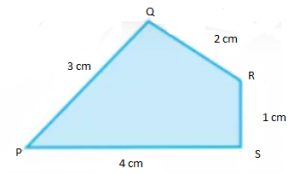
Ans.
Perimeter is the distance covered along the boundary of a closed figure.
Perimeter = Sum of the distances or lengths of all the sides
= PQ + QR + RS + SP.
= 3 cm + 2 cm + 1 cm + 4 cm.
= (3 + 2 + 1 + 4) cm
= 10 cm
The perimeter of the given figure is 10 cm.
(b)
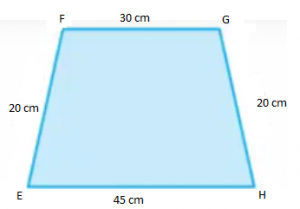
Ans.
Perimeter = Sum of the distances or lengths of all the sides
= EF + FG + GH + HE.
= 20 cm + 30 cm + 20 cm + 45 cm.
= (20 + 30 + 20 + 45) cm
= 105 cm
The perimeter of the given figure is 105 cm
(c)
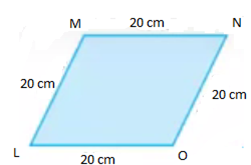
Ans.
Perimeter = Sum of the distances or lengths of all the sides.
= LM + MN + NO + OL
= 20 cm + 20 cm + 20 cm + 20 cm
= (20 + 20 + 20 + 20) cm
= 80 cm
The perimeter of the given figure is 80 cm.
(d)
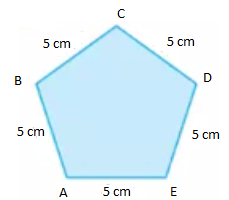
Ans.
Perimeter = Sum of the distances or lengths of all the sides.
= AB + BC + CD + DE + EA
= 5 cm + 5 cm + 5 cm + 5 cm + 5 cm
= (5 + 5 + 5 + 5 + 5) cm
= 25 cm
The perimeter of the given figure is 25 cm.
(e)
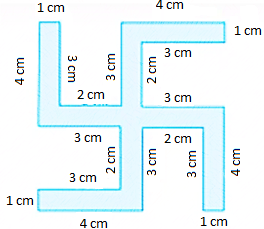
Perimeter = Sum of the distances or lengths of all the sides.
We are simplifying the problem by considering a single ‘L’ shaped section and finding its perimeter. There are four such ‘L’ shaped sections and the total perimeter is four times the perimeter of a single section.
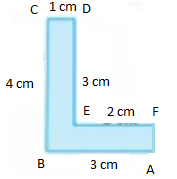
Perimeter of the ‘L’ shaped section = AB + BC + CD + DE + EF
= 3 + 4 + 1 + 3 + 2
= 13 cm
The perimeter of a single ‘L’ section is 13 cm
The perimeter of the entire figure = 4 x perimeter of each ‘L’ section.
= 4 x 13 cm
= 52 cm
The perimeter of the entire figure is 52 cm.
Q2. The lid of a rectangular box of sides 50 cm by 10 cm is sealed all around with a tape. What is the length of the tape required?
Ans.
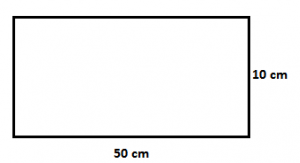
Dimensions of the given box:
Length of the rectangular box (l) = 50 cm
Breadth of the rectangular box (b) = 10 cm
Perimeter of a rectangle = 2 x (l + b)
= 2 x (50 cm + 10 cm)
= 2 x (60 cm)
= 120 cm
The perimeter of the rectangular box = Length of the tape required to measure the box = 120 cm
Q3. A table-top measures 3 m 35 cm by 1 m 40 cm. What is the perimeter of the table-top?
Ans.
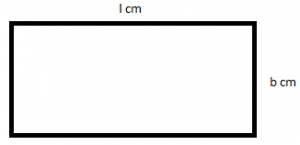
The length of the rectangle should be greater than the breadth (l > b)
Length of the rectangle (l) = 3 m 35 cm
= (300 + 35) cm (∵ 1 m = 100 cm)
= 335 cm
Breadth of the rectangle (b) = 1 m 40 cm
= (100 + 40) cm (∵ 1 m = 100 cm)
= 140 cm
Perimeter of the table top = Perimeter of the rectangle
= 2 x (length + breadth)
= 2 x (l + b)
= 2 x (335 cm + 140 cm)
= 2 x (475 cm)
= 950 cm
The perimeter of the table top = 950 cm = 9.5 m
Q4. A photo of sides 17.8 cm by 12.7 cm is to be framed with wood. What is the length of wooden strip required?
Ans:
Length of photograph (I) = 17.8 cm
Breadth of photograph (b) = 12.7 cm
Length of required wooden strip = Perimeter of Photograph
= 2 x (/ + b)
= 2 x (17.8 + 12.7)
= 2 x 30.5 = 61 cm
Q5. Each side of rectangular piece of land which measures 0.8km by 0.7km is to be fenced with 5 rows of wires. How much length of wire is needed?
Ans:
Length of land (I) = 0.8 km
Breadth of land (b) = 0.7 km
Perimeter = 2 x (I + b) = 2 x (0.8 + 0.7) = 2 x 1.5 = 3.0 km
Length of wire required = 5 x 3 = 15 km
Q6. Find the perimeter of the following shapes:
(a) An equilateral triangle of side 5 cm.
(b) An Isosceles triangle with equal sides 6 cm each and the third side 5 cm.
(c) A triangle of sides 6 cm, 3 cm and 2 cm
Ans:
(a) Perimeter = of an equilateral triangle = 3 x Side of triangle
= (3 x 5) cm = 15 cm
(b) Perimeter = (6 cm + 3 cm + 2 cm) = 11 cm.
(c) Perimeter = (2 x 6) + 5 = 17 cm
Q7. A triangle has sides measuring 15 cm, 12 cm and 13 cm. Find its perimeter.
Ans:
Perimeter of the triangle = Sum of the lengths of all sides of the triangle
Perimeter = 15 + 12 + 13 = 40 cm
Q9. Find the side of the square whose perimeter is 16 m.
Ans:
Perimeter of square = 4 x Side
16 = 4 x Side
Side= 16⁄4=4 cm
Side = 4 cm
Q10. Find the side of a regular pentagon if its perimeter is 150 cm.
Ans: Perimeter of regular pentagon = 5 x Length of side
150 = S x Side
Side= 150⁄5 = 30 cm
Therefore, Side = 30 cm
Q11. A piece of string is 120 cm long. What will be the length of each side if the string is used to form
(a) A regular hexagon?
(b) A square?
(c) An equilateral triangle?
Ans:
(a) Perimeter = 4 x Side
120 = 4 x Side
Side = 120⁄4 = 30 cm
(b) Perimeter = 3 x Side
120 = 3 x Side
Side=120⁄3=40 cm
(c) Perimeter = 6 x Side
120 = 6 x Side
Side=120⁄6=20 cm
Q12: What is the third side of a triangle if two of its sides are 15 cm and 12 cm, whose perimeter is 40 cm?
Ans:
Perimeter of triangle = Sum of all sides of the triangle
40 = 15 + 12 + Side
40 = 27 + Side
Side = 40 – 27 = 13 cm
Hence, the third side of the triangle is 13 cm.
Q13: A square park of side 240m is to be fenced. Find the cost of fencing if the rate of fencing per meter is Rs.10.
Ans: Length of fence required = Perimeter of the square park
= 4 x Side = 4 x 240 = 960 m
Cost for fencing 1 m of square park = Rs 10
Cost for fencing 960 m of square park = 960 x 10 = Rs 9600
Q14: A rectangular park of length 150 and breadth 175 is to be fenced. Find the cost if the fencing rate is Rs.15 per meter.
Ans: Length of rectangular park (I) = 150 m
Breadth of rectangular park (b) = 175 m
Length of wire required for fencing the park = Perimeter of the park
= 2 x (/ + b) = 2 x (150 + 175) = 2 x 325 = 650 m
Cost for fencing 1 m of the park = Rs 15
Cost for fencing 650 m of the square park = 650 x 15 = Rs 9750
Q15. Adam runs around a square park of side 80 m. Eve runs around a rectangular park with length 70 m and breadth 40 m. Who covers a comparatively lesser distance?
Ans:
Distance covered by Adam = 4 x Side of square park
= 4 X 80 = 240 m
Distance covered by Eve = 2 x (70 + 40)
= 2 x 110 = 220 m
Therefore, Eve covers less distance.
Q16: What is the perimeter of each of the following figures? What do you infer from the answers?
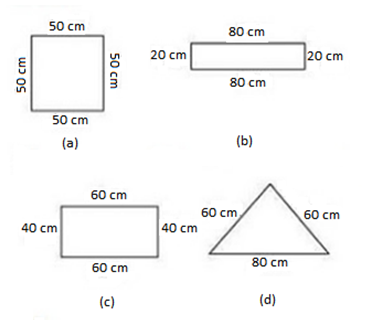
Ans:
(a) Perimeter of square = 4 x 50 = 200 cm
(b) Perimeter of rectangle = 2 x (20 + 80) = 200 cm
(c) Perimeter of rectangle = 2 x (40 + 60) = 200 cm
(d) Perimeter of triangle = 60 + 60 + 80 = 200 cm
It can be inferred that all the figures have the same perimeter.
Q17: Ram buys 9 square slabs, each having a side of 2 m. Initially, he lays them in the form of a square.
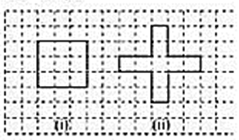
(a) Looking at the figure, find out the perimeter of his arrangement.
(b) His friend Mani looked at the figure and asked him to lay them out in the shape of a cross. Looking at the second figure, find out the perimeter of the cross.
(c) Out of the two shapes, find out which one has a larger perimeter.
(d) Mani suggests that there’s a way to get an even greater perimeter. Can you guess a way of doing it? (The paving slabs must meet along complete edges. That is, they cannot be broken.)
Ans:
(a) Side of the square = (3 x 2) m = 6 m
Perimeter of the square = (4 x 3) m = 12 m
(b) Perimeter of the cross = 2+4+4+2+4+4+2+4+4+2+4+4 = 40m
(c) The cross formation has the greatest perimeter of all arrangement.
(d) Formation with perimeter which is greater than 40 m can’t be determined.
EXERCISE-10.2
Q1. Count the squares and find out the area of the following diagrams:
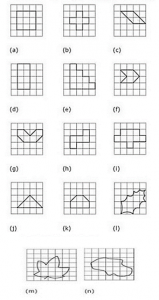
Ans:
(a) The figure contains 9 fully filled squares only. Therefore, the area of this figure will be 9 square units.
(b) The figure contains 5 fully filled squares only. Therefore, the area of this figure will be S square units.
(c) The figure contains 2 fully filled squares and 4 half-filled squares. Therefore, the area of this figure will be 4 square units.
(d) The figure contains 8 fully filled squares only. Therefore, the area of this figure will be 8 square units.
(e) The figure contains 10 fully filled squares only. Therefore, the area of this figure will be 10 square units.
(f) The figure contains 2 fully filled squares and 4 half-filled squares. Therefore, the area of this figure will be 4 square units.
(g) The figure contains 4 fully filled squares and 4 half-filled squares. Therefore, the area of this figure will be 6 square units.
(h) The figure contains 5 fully filled squares only. Therefore, the area of this figure will be S square units.
(I) The figure contains 9 fully filled squares only. Therefore, the area of this figure will be 9 square units.
(j) The figure contains 2 fully filled squares and 4 half-filled squares. Therefore, the area of this figure will be 4 square units.
(k) The figure contains 4 fully filled squares and 2 half-filled squares. Therefore, the area of this figure will be 5 square units.
(l) From the given figure, it can be observed that
| Covered Area | Number | Area estimate ( sq units ) |
| Fully filled squares | 2 | 2 |
| Half filled squares | – | – |
| More than half filled squares | 6 | 6 |
| Less than half filled squares | 6 | 0 |
Total area = 6 + 2 = 8 sq units.
(m) From the above figure, it is observed that,
| Covered Area | Number | Area estimate ( sq units ) |
| Fully filled squares | 5 | 5 |
| Half filled squares | – | – |
| More than half filled squares | 10 | 10 |
| Less than half filled squares | 9 | 0 |
Total area = 9 + 5 = 14 sq units
(n) From the above figure, it is observed that,
| Covered Area | Number | Area estimate ( sq units ) |
| Fully filled squares | 8 | 8 |
| Half filled squares | – | – |
| More than half filled squares | 10 | 10 |
| Less than half filled squares | 9 | 0 |
Total area = 10 + 8 = 18 sq units.
EXERCISE-10.3
Q1. What is the area of the following rectangles whose sides’ measure:
(a) 2 cm and 5 cm
(b) 15 m and 20 m
(c) 4 km and 5 km
(d) 3 m and 60 cm
Ans: It is known that, Area of a rectangle = Length (l) x Breadth (b)
(a) l = 2 cm
b = 5 cm
Area = l x b = 2 x 5 = 12 cm2
(b) l = 15 m
b= 20 m
Area = l x b= 20 x 15 = 300 m2
(c) l = 4 km
b= 5 km
Area = l x b = 4 x 5 = 20 km2
(d) l = 3 m
b = 60 cm = 0.60 m
Area = l x b=2 x 0.60 = 1.20 m2
Q2. Find the areas of the squares whose sides are: (a) 8 cm (b) 11 cm (c) 6 m
Ans:
It is known that, Area of a square = (Side)2
(a) Side = 8 cm Area = (8)2 =64 cm2
(b) Side = 11 cm Area = (11)2 = 121 cm2
(c) Side = 6 m Area = (6)2 = 36 m2
Q3. Which one has the largest and smallest area among the 3 rectangles whose dimensions measure:
(a) 5 m by 6 m
(b) 12m by 4 m
(c) 2 m by 10 m
Ans: We know that, Area of rectangle = Length x Breadth
(a) l = 5m
b = 6m
Area = l x b = 5 x 6 = 30 m2
(b) l = 12m
b = 4m
Area = l x b = 12 x 4 = 48 m2
(c) l = 2m
b = 10m
Area = l x b = 2 x 10 = 20 m2
From the above results, we come to know that (b) has the largest area and rectangle (c) has the smallest area.
Q5: What is the cost of tiling a rectangular plot of land 400 m long and 300 m wide at the rate of Rs 5 per hundred sq in?
Ans:
Area of rectangular plot = 400 x 300 = 120000 m2
Cost of tiling per 100 m2= Rs 5
Cost of tiling per 120000 m2 = 5⁄100 ×120000=Rs.6000
Q6: What is the area of table whose sides measure 1m 20 cm in length and 2m 50 cm in breadth?
Ans:
Length (l) = 1 m 20cm = (1+20⁄100) m=1.2 m
Breadth (b) 2 m 50 cm = (2+50⁄100) m=2.5 m
Area = l x b = 1.2 x 2.5 = 3 m2
Q7: How many sq meters of carpet is needed to cover the floor of a room of sides measuring 3 m in length and 4 m 20cm in breadth?
Ans:
Length (l) = 3 m
Breadth (b) = 4 m 20 cm = (4+20⁄100) m = 4.2 m
Area = l x b = 3 x 4.2 = 12.6 m2
Q8: A square carpet is laid on the floor of sides measuring 4 m in a floor of sides 4 m and 5 m. Find the remaining area of the floor that is not carpeted.
Ans:
Length (I) = 4 m
Breadth (b) = 5 m
Area of floor = l x b = 4 x 5 = 20 m2
Area covered by the carpet = (Side) 2 = (4)2 = 16 m2
Area not covered by the carpet = 20 – 16 = 4 m2
Q9: From a piece of land measuring 4 m long and 6 m wide, 4 sq flower beds of side 2m each are dug out. Find out the remaining area of the land.
Ans:
Area of the land = 4 x 6 = 24 m2
Area occupied by 4 flower beds = 4 x (Side)2 = 4x (2)2 = 16m2
Area of the remaining part = 24 – 16 = 8 m2
Q10: Split the below figures into multiple rectangles and find out their area. All dimensions are given in centimeters.
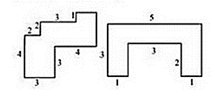
Ans:
(a) The above figures can be split in to multiple rectangles as follows:
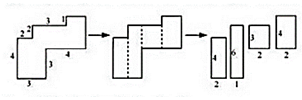
Area of 1st rectangle = 8 x 4 = 32 cm2
Area of 2nd rectangle = 12 x 2 = 24 cm2
Area of 3rd rectangle = 6 x 4 = 24 cm2
Area of 4th rectangle = 8 x 4 = 32 cm2
Total area of the whole figure = 32 + 24 + 24 + 32 = 112 cm2
(b) The above figures can be split in to multiple rectangles as follows:
Area of 1st rectangle = 6 x 2 = 12 cm2
Area of 2nd rectangle = 6 x 2 = 12 cm2
Area of 3rd rectangle = 6 x 2 = 12 cm2
Total area of the whole figure = 12 + 12 + 12 = 36 cm2
Q11. Split the below figures into multiple rectangles and find out their area. All dimensions are given in centimeters.
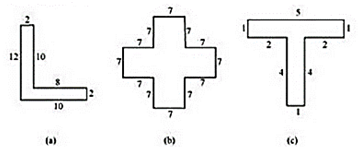
Ans:
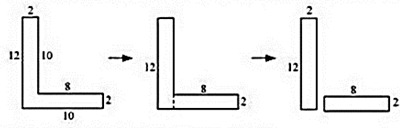
(a) The above figures can be split in to multiple rectangles as follows:
Area of 1st rectangle = 24 x 4 = 96 cm2
Area of 2nd rectangle = 16 x 4 = 64 cm2
Total area of the whole figure = 96 + 64 = 160 cm2
(b) The above figures can be split in to multiple rectangles as follows:
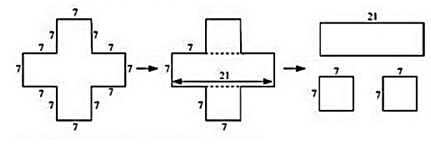
Area of 1st rectangle = 42 x 14 = 588 cm2
Area of 2nd rectangle = 14 x 14 = 196 cm2
Area of 3rd rectangle = 14 x 14 = 196 cm2
Total area of the whole figure = 588 + 196 + 196 = 980 cm2
(c) The above figures can be split in to multiple rectangles as follows:
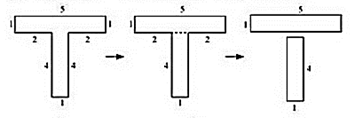
Area of 1st rectangle = 10 x 2 = 20 cm2
Area of 2nd rectangle = 8 x 2 = 16 cm2
Total area of the whole figure = 20 + 16 = 36 cm2
Q12. Tiles of sides measuring 10 cm by 4 cm each are to be fit in a rectangular region whose length and breadth are respectively:
(a) 144 cm and 100 cm
(b) 36 cm and 70 cm
Ans.
(a) Total area of the region = 144 x 100 = 14400 cm2
Area of one tile = 10 x 4 = 40 cm2
Number of tiles required = 14400⁄40 = 360
Therefore, 360 tiles are required.
(b) Total area of the region = 36 x 70 = 2520 cm2
Area of one tile = 40 cm2
Number of tiles required = 2520⁄40 = 63
Therefore, 63 tiles are required.