
Working With the Text (Page 131)
QA .Complete the following sentences.
1.The old banyan tree “did not belong” to the grandfather, but only to the boy, because_____________________________________ .
2.The small gray squirrel became friendly when_____________________________________
3.When the boy started to bring him pieces of cake and biscuit, the squirrel
4.In the spring, the banyan tree_____________________________________________ and
__________________________________________ would come there.
5.The banyan tree served the boy as a____________________________________________ .
6.The young boy spent his afternoons in the tree____________________________________
Ans.
1. the old man was not strong enough to climb it
2.it found that the boy carried no catapult or air/gun in his hand
3.became bold enough to take pieces of food from his hand
4.was full of small red figs, birds of all kinds
5reading room where he had made a rough platform to sit and read books
6.leaning against the tree, reading story books,
B.Answer the following questions.
Q1.“It was to be a battle of champions.” (8)
(i)What qualities did the two champions have? Pick out words and phrases from the paragraph above this line in the text and write them down.
Mongoose Cobm
(a)________________ (a) ______________
(b)_______________ (b) ______________
(c)_______________ (r) ______________
| Ans. | (a) a great fighter | (a) skilled and experienced champion fighter |
| (b) very clever and swift | (b) had a broad hood and poisonous teeth | |
| (c) made calculated move | (c) swift in speed and attack |
ii)What did the cobra and the mongoose do, to show their readiness for the fight?
Ans. The cobra produced a hissing sound to challenge the mongoose to a fight. It raised three feet of its body off the ground. It spread its broad hood. The mongoose bushed its tail. The long hair on its back also stood up.
Q2.Who were the other two spectators? What did they do? (Did they watch, or did they join in the fight?) (10)
Ans. In addition to the narrator, the two other onlookers of the fight were a myna and a wild crow. First of all they sat on the cactus plant to watch the outcome of the fight. In the end they took part in the game. Both tried to pick up the cobra for their meal.
The crow got bitten and died. The mongoose dragged the snake away into the bushes. The myna also flew away.
Q3.Read the descriptions below of what the snake did and what the mongoose did. Arrange their actions in the proper order. (11, 16)
| (i) | ceased to struggle | ‘ • | grabbed the snake by the snout |
| (ii) | tried to mesmerise | • | dragged the snake into |
| the mongoose | the bushes | ||
| (iii) | coiled itself around | • | darted away and bit the |
| the mongoose | cobra on the back | ||
| (iv) | stnick the crow | • | pretended to attack the cobra on one side |
| struck again and | • | refused to look into the | |
| missed | snake’s eyes | ||
| (v) | struck on ihe side | • | sprang aside, jumped in |
| that the mongoose | and bit | ||
| pretended to attack |
Q4.(i) What happened to the crow in the end? (16)
(ii) What did the myna do finally? (17)
Ans.
(i) In the end the crow got bitten by the cobra and it fell dead.
(ii) The myna flew to the ground, looked into the bushes, gave a shrill cry and flew away.
Working With Language
Q1.The word ‘round’ usually means a kind of shape. What is its meaning in the story?
2.Find five words in the following paragraph, which are generally associated with trees. But here, they have been used differently. Underline the words. Hari leavesfor work at nine every morning. He works in the local branchof the firm of which his uncle is the owner. Hari’s success is really the fruit of his own labour. He is happy, but he has a small problem. The rootcause of his problem is a stray dog near his office. The dog welcomes Hari with a loud barkevery day.
Ans.
1. The word ‘round’ in the story means ‘the second course of fight’.
2.leaves, branch, fruit, root, bark.
B.The words in the box are all words that describe movement. Use them to fill in the blanks in the sentences below.
dived gliding sprang darting
whipped…back delving
1.When he began to trust me, the squirrel began_______________________ into my pockets for morsels of cake.
2. saw a cobra______________ out of a clump of cactus.
3.The snake hissed, his forked tongue______________________ in and out.
4.When the cobra tried to bite it, the mongoose________________________ aside.
5.The snake _________________ his head ________________ to strike at the crow.
6.The birds __________________ at the snake.
Ans.
1.delving / to delve
2.gliding
3.darting / darted /
4.sprang
5.whipped, back
6.dived
C.Find words in the story, which show things striking violently against each other.
1.The cobra struck the crow, his snout th___________ ing against its body. (15)
2.The crow and the myna c _ ll_________ in mid-air. (13) ‘
3.The birds dived at the snake, but b____________ d into each other instead (14)
Ans.
1. thudding
2.collided
3.bumped
D.Look at these sentences.
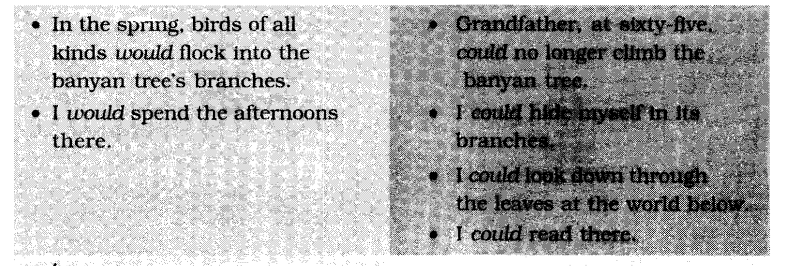
‘Would’ tells us what the author used to do. Could’ tells us what the author was usually able to do. or or what used to happen. grandfather is now not able to do.
Choose would and could to replace the italicised words in the following sentences.
Grandfather says, in the old days,
1.elephants were able to fly in the sky, like clouds. They were also able to change their shapes. They used to fly behind clouds and frighten them. People used to look up at the sky in wonder.
2.because there was no electricity, he used to get up with the sun, and he used to go to bed with the sun, like the birds.
3.like the owl, he was able to see quite well in the dark. He was able to tell who was coming by listening to their footsteps.
Ans.
1. elephants could fly in the sky, like clouds. They could also change their shapes. They would fly behind clouds and frighten them. People would look up at the sky in wonder.
2.because there was no electricity, he would get up with sun and he would go to bed with the sun, like the birds.
3.like the owl, he could see quite well in the dark. He could tell who was coming by listening to their footsteps.
Speaking (Page 135)
Look at these sentences.
The tree was older than Grandfather.
Grandfather was sixty-five years old. ‘
How old was the tree? Can you guess?
The tree was as old as Dehradun itself?
Suppose Dehra Dun is 300 years old. How old is the tree?
When two things are the same in some way, we use as…as.
Here is another set of examples.
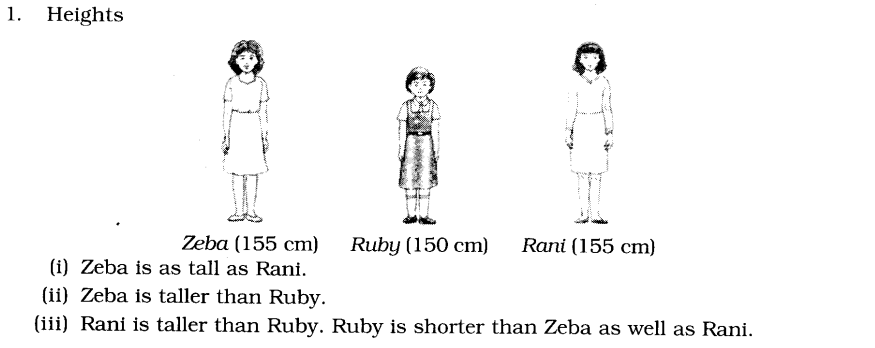
Mr Sinha is 160 centimetres tall. .Mr Gupta is 180 centimetres tall.
Mrs Gupta is 160 centimetres tall.
Mrs Gupta is as tall as Mr Sinha.
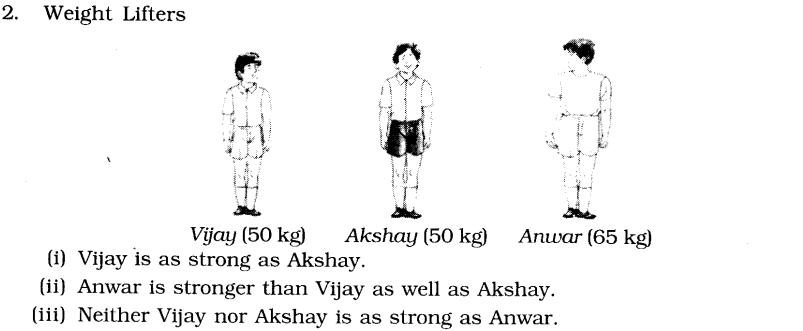
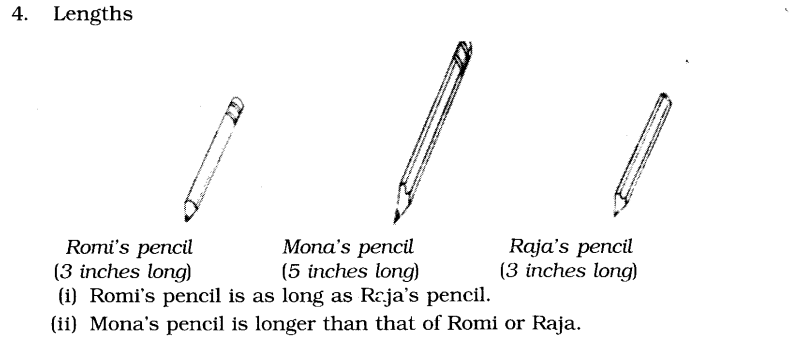
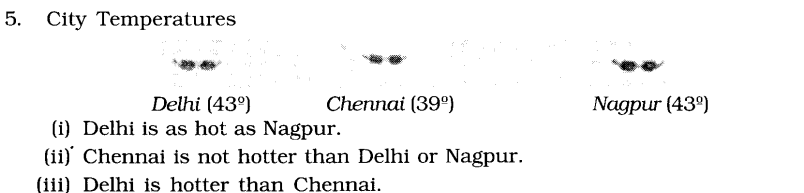
Use the words in the box to speak about the people and the things below, using as., .as or -erthan
tall – taller cold – colder hot – hotter strong – stronger short – shorter
(Notice that in the word ‘hot’, the letter ‘t’ is doubled when -er is added.)

(i) Shimla is as cold as Gangtok.
(ii) Shimla or Gangtok are not so cold as Srinagar,
(iii)Shimla is not colder than Srinagar.
Writing
Q1.Read again the paragraphs of the story in which the author describes the banyan tree, and what he used to do there. Is there a place in your house, or in your grandparents’ or uncles’ or aunts’ houses, that you specially like? Write a short paragraph about it saying.
where it is • what you do there • why you like it
You may instead write about a place you dislike, or are afraid of.
Ans. My Favourite Place
My favourite place in the house is either the balcony or the cemented platform built round the stem of the peepal tree. I use to sit in the balcony to enjoy the sunshine on winter days and the cool breeze on summer mornings. I learn my lessons and even do my homework there. I like it because it is an isolated, quiet and open place.
SHORT ANSWER TYPE QUESTIONS
Q1.Why did the speaker find the old banyan tree exclusively his own?
Ans. The old banyan tree became the narrator’s own property because his grandfather was too old to climb it. ‘
Q2.What did the speaker do while hiding himself in the banyan tree branches?
Ans. The author used to read story books and watch the world below.
Q3.When did the banyan tree become a noisy place?
Ans. The banyan tree became the noisiest place in the garden during the fig season.
Q4.Where did the author usually spend his afternoons?
Ans. The author usually spent his afternoons on the platform he had built half way up the tree.
Q5.What exciting scene did the author enjoy from his platform in the banyan tree?
Ans. The author enjoyed the fight between a mongoose and a cobra, a battle of two champions.
Q6.What trick did the mongoose apply to overpower and kill the cobra?
Ans. He first bit the snake twice on the back. When the cobra was tired, the mongoose caught it by the snout. He finally dragged the dead snake into the bushes.
Q7.creatures lost their lives in the classic struggle between the cobra and the mongoose. Who were those victims?
Ans. The cobra and the crow.
LONG ANSWER TYPE QUESTIONS
Q1.What is the story The Banyan Tree about? Narrate the incident in brief.
Ans. The Banyan Tree is about a deadly fight between a mongoose and a snake. The outcome of such a fight is the death of the cobra. The mongoose is faster in movement than his opponent. The writer witnessed such a fight, sitting on a branch of a banyan tree. He enjoyed the fight. Both the mongoose and the cobra were experienced fighters. They could strike with speed. A myna and a crow also arrived to feed on the dead crew. The crow had hard luck. He was bitten and he fell dead. The cobra got tired in the fight and the mongoose dragged it into the bushes.
Q2.Bring out the relevance/significance of the banyan tree in the title of Ruskin Bond’s story.
Ans. The banyan tree served as a platform for the writer to sit and watch the thrilling fight between a cobra and a wild mongoose. The tree was almost the speaker’s property because his grandfather could not climb it. The fight started undqr that tree in sunshine. Two other spectators, a myna and a crow, also arrived to feed on the dead cobra. But they sat on a cactus plant not the tree.