Close Menu
    Facebook X (Twitter) Instagram
    CBSE Learning
    • Home
    • NCERT Solutions
    • Class 12
      • Class 12 Physics
      • Class 12 Chemistry
      • Class 12 Maths
      • Class 12th Biology
      • Class 12 English
      • Class 12 Accountancy
      • Class 12 Economics
      • Class 12 Business Studies
      • Class 12 Political Science
      • Class 12 Sociology
      • Class 12 Psychology
    • Class 11
      • Class 11 Maths
      • Class 11 Physics
      • Class 11 Chemistry
      • Class 11 Biology
      • Class 11 Accountancy
      • Class 11 English
      • Class 11 Economics
      • Class 11 Business Studies
      • Class 11 Political Science
      • Class 11 Psychology
      • Class 11 Sociology
    • Class 10
      • Class 10 English
      • Class 10 Maths
      • Class 10 Science
      • Class 10 Social Science
    • Class 9
      • Class 9 Maths
      • Class 9 English
      • Class 9 Science
      • Class 9 Social Science
    • Class 8
      • Class 8 Maths
      • Class 8 Science
      • Class 8 English
      • Class 8 Social Science
    • Class 7
      • Class 7 Maths
      • Class 7 Science
      • Class 7 English
      • Class 7 Social Science
    • Class 6
      • Class 6 Maths
      • Class 6 Science
      • Class 6 English
      • Class 6 Social Science
    CBSE Learning
    Home » NCERT Solution Class 8 Science Chapter 5 – Coal and Petroleum
    class 8 science

    NCERT Solution Class 8 Science Chapter 5 – Coal and Petroleum

    AdminBy AdminUpdated:March 9, 20244 Mins Read
    Facebook Twitter Pinterest LinkedIn Tumblr Email
    Share
    Facebook Twitter LinkedIn Pinterest Email

    NCERT Solutions for Class 8 Science Chapter 5 – Coal and Petroleum provide a comprehensive guide for students studying under the Central Board of Secondary Education (CBSE) curriculum. This chapter explores the formation, composition, and uses of coal and petroleum, which are two of the most important sources of energy in the world today. NCERT Solutions for Class 8 Science Chapter 5 have been developed by the National Council of Educational Research and Training (NCERT) to help students understand and master the concepts covered in this chapter.

    NCERT Solution Class 8 Science Chapter 5 – Coal and Petroleum

    Exercise : Solutions of Questions on Page Number : 62


    Q1 : What are the advantages of using CNG and LPG as fuels?
    Answer :
    The advantages of using compressed natural gas (CNG) and liquified petroleum gas (LPG) as fuels are:
    (i) They can be burnt directly.
    (ii) They can be transported easily through pipe lines.
    (iii) They are clean fuels and do not give smoke when burnt.
    (iv) They give a lot of heat energy when burnt.


    Q2 : Name the petroleum product used for surfacing of roads.
    Answer :
    Bitumen, a petroleum product, is used for surfacing roads.


    Q3 : Describe how coal is formed from dead vegetation. What is this process called?
    Answer :
    Millions of years ago, dense forests got buried under the soil due to natural processes like storms, floods, and earthquakes. These got compressed as more and more soil got deposited over them. When they got buried deep in the soil, they were exposed to very high pressure and temperature. Under these conditions, these slowly got converted into coal. This process of formation of coal from dead vegetation is called carbonization.


    Q4 :  Fill in the banks.
    (a) Fossil fuels are ________, ________and _________.
    (b) Process of separation of different constituents from petroleum is called _________.
    (c) Least polluting fuel for vehicles is __________.

    Answer :

    (a) Fossil fuels are __coal__, __petroleum__and __natural gas__.
    (b) Process of separation of different constituents from petroleum is called __refining__.
    (c) Least polluting fuel for vehicles is __compressed natural gas (CNG)__.


    Q5 : Tick True/False against the following statements.
    (a) Fossil fuels can be made in the laboratory. (T / F)
    (b) CNG is more polluting fuel than petrol. (T / F)
    (c) Coke is almost pure form of carbon. (T / F)
    (d) Coal tar is a mixture of various substances. (T / F)
    (e) Kerosene is not a fossil fuel. (T / F)
    Answer :
    (a) Fossil fuels can be made in the laboratory. (F)
    (b) CNG is more polluting fuel than petrol. (F)
    (c) Coke is almost pure form of carbon. (T)
    (d) Coal tar is a mixture of various substances. (T)
    (e) Kerosene is not a fossil fuel. (F)


    Q6 : Explain why fossil fuels are exhaustible natural resources.
    Answer :
    Fossil fuels require millions of years to form from the dead vegetation and animals that get buried deep inside the Earth. They require high temperature and pressure for their formation, which cannot be provided in the laboratory. Thus, fossils are limited. Therefore, the use of fossil fuels at this rate will lead to their exhaustion.


    Q7 : Describe characteristics and uses of coke.
    Answer :
    Characteristics of coke are:
    (i) Tough
    (ii) Porous
    (iii) Black in colour
    Uses of coke:
    (i) In manufacture of steel.
    (ii) In the extraction of metals (as a reducing agent).


    Q8 : Explain the process of formation of petroleum.
    Answer :
    Petroleum was formed from dead organisms that got buried in the sea millions of years ago. These dead bodies got covered with layers of sand and clay. Lack of air, high temperature, and high pressure transformed these dead organisms into petroleum and natural gas.


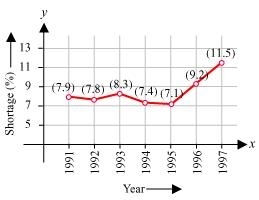
    Q9 : The following Table shows the total power shortage in India from 1991 – 1997. Show the data in the form of a graph. Plot shortage percentage for the years on the Y-axis and the year on the X-axis.

    S. No.    Year Shortage (%)
    1
    2
    3
    4
    5
    6
    7
    1991
    1992
    1993
    1994
    1995
    1996
    1997
    7.9
    7.8
    8.3
    7.4
    7.1
    9.2
    11.5

    Answer :


    Share. Facebook Twitter Pinterest LinkedIn Tumblr Email
    Previous ArticleNCERT Solutions for Class 8 Science – Chapter 4 Materials : Metals and Non-Metals
    Next Article CERT Solutions for Class 8 Science Science – Chapter 6 – Combustion and Flame
    Recent Posts
    • Birds Name in English
    NCERT Book Solutions
    • NCERT Solutions for Class 12 Maths
    • NCERT Solutions for Class 12 Physics
    • NCERT Solutions for Class 12 Chemistry
    • NCERT Solutions for Class 12 Accountancy
    • NCERT Solutions for Class 12 English
    • NCERT Solutions for Class 12 Economics
    • NCERT Solutions for Class 12 Business Studies
    • NCERT Solutions for Class 12 Political Science
    • NCERT Solutions for Class 12 Psychology
    • NCERT Solutions for Class 12 Sociology
    • NCERT Solutions for Class 12 Biology
    • NCERT Solution for Class 11 Physics
    • NCERT Solutions for Class 11 Chemistry
    • NCERT Solutions for Class 11 Maths
    • NCERT Solutions for Class 11 Biology
    • NCERT Solutions for Class 11 Accountancy
    • NCERT Solutions for Class 11 English
    • NCERT Solutions for Class 11 Business Studies
    • NCERT Solutions for Class 11 Economics
    • NCERT Solutions for Class 11 Political Science
    • NCERT Solutions for Class 11 Psychology
    • NCERT Solutions for Class 11 Sociology
    NCERT Solutions
    • NCERT Solutions for Class 10 Maths
    • NCERT Solutions for Class 10 Science
    • NCERT Solutions for Class 10 English
    • NCERT Solutions for Class 10 Social Science
    • NCERT Solutions for Class 9 Maths
    • NCERT Solutions for Class 9 Science
    • NCERT Solutions for Class 9 English
    • NCERT Solutions for Class 9 Social Science
    • NCERT Solutions for Class 8 Maths
    • NCERT Solutions for Class 8 Science
    • NCERT Solutions for Class 8 English
    • NCERT Solutions for Class 8 Sanskrit
    • NCERT Solutions for Class 8 Social Science
    • NCERT Solutions for Class 7 Maths
    • NCERT Solutions for Class 7 English
    • NCERT Solutions for Class 7 Social Science
    • NCERT Solutions for Class 7 Science
    Exams
    • Privacy Policy
    • NEET 2024
    • NCERT Solutions for Class 8 Sanskrit
    • Current Affairs
    Links
    Latest News
    Contact Us
    Privacy Policy
    Ask a Doubt
    © 2025 CBSE Learning

    Type above and press Enter to search. Press Esc to cancel.