
Answer the following Questions
Q1. Why did the children go to Yasmin Khala’s house?
Ans: The children broke the street-light while playing cricket. As its replacement was beyond their reach, they were very much upset. They didn’t know whom did the street light belong to. They went to Rehana’s mother who gave them the knowledge that it is the Municipal Corporation of the city that takes care of replacing lights. She also told them that Yasmin Khala would be the best person because she has just retired from the Municipal Corporation. She advised the children to go to Yasmin Khala to get their problem solved.
Q2. List four ways in which the work of the Municipal Corporation affects the life of a city-dweller.
Ans: The Municipal Corporation affects the life of a city-dweller in several ways:
It takes care of street lights.
It ensures that diseases do not break out in the city.
It runs schools, hospitals and dispensaries.
It takes care of garbage collection, water supply, keeping the streets and the market clean.
Q3. Who is a Municipal Councillor?
Ans: A Municipal Councillor is an elected representative of a ward. He is also known as Ward Councillor.
4. What did Gangabai do and why?
Ans: Gangabai and other women of her locality were very much unhappy to find garbage lying all over the street and spreading foul smell. One day she said that it is the Ward Councillor who they should go to and protest since they are the ones who elected him. She gathered a small group of women and went to his house to get their problems solved.
Q5. How does the Municipal Corporation earn the money to do its work?
Ans: The Municipal Corporation is one of the most important organs of the three-tier government system. It is responsible for all round development of its designated area. It undertakes all the public facilities and welfare works like sanitation, water, road, education, health, etc. As these works require fund, so it collects revenue from the residents living in its corporation area. It levies taxes on property, water and other services. Taxes are fixed on the measurement and consumption of the services. Taxes are levied on education and other amenities like owning a hotel, entertainment etc.
Q6. Discuss
In the two photographs you see different ways of collecting and disposing garbage.
(i) Which way do you think provides safety to the person disposing garbage?
(ii)What are the dangers of collecting garbage in the manner shown in the first photograph?
(iii)Why do you think that proper ways of disposing garbage are not available to those who work in municipalities?
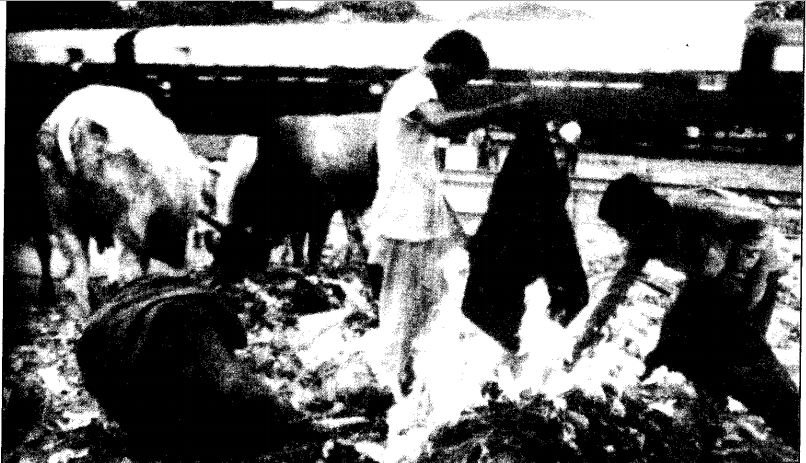
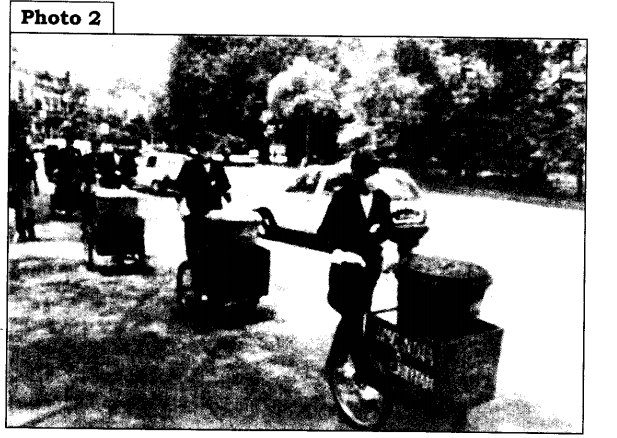
Ans: (i)The way shown in photo 2 provides safety to the person disposing garbage,
(ii) Collecting garbage in the manner shown in photo 1 is full of dangers. Children are so close to open garbage that they may fall sick or they may develop symptoms of some deadly disease in the long run. There may be pieces of broken glasses. While collecting garbage in,this manner, their fingers may
get injured. We see two stray cows around the garbage searching some eatables. These cows may attack these boys which may take their lives. Thus, there is no safety at all in this way.
(iii) The proper ways of disposing garbage are not available to those who work in municipalities because firstly, the government has not done proper arrangement for this as yet. It has provided trucks no doubt but their number is not sufficient. Secondly, the workers working in the municipalities are generally less aware of health and hygeine. They do not bother whether garbage is being disposed properly or not. Thirdly, the economic condition of the municipalities is not good.
Q7. Several poor people in the city work as domestic servants as well as work for the Corporation, keeping the city clean. Yet the slums in which they live are quite filthy. This is because these slums seldom have any water and sanitation facilities. The reason often given by the Municipal Corporation is that the land in which the poor have set up their homes does not belong to them and that slum-dwellers do not pay taxes. However, people living in middle class neighbourhoods pay very little in taxes compared to the amount of money the corporation spends on them in setting up parks, street lighting facilities, regular garbage collection etc. Also as you read in this chapter, the property taxes collected by the Municipality makes up only 25-30 percent of its money. Why do you not think it is important that the Corporation should spend more money on slum localities? Why is it important that the Municipal Corporation provide the poor in the city with the same facilities that the rich get?
Ans. I think it is important that the corporation should spend more money on slum localities because slum-dwellers are also a part of our society. They need education, sanitation, rehabilitation and other facilities as the common people avail. They are also human beings. They lack even basic amenities of life which cause spread of many diseases among them. They are the citizens of our country. So in order to achieve our constitutional ideals the Municipal Corporation should provide the poor in the city with the same facilities that the rich get.
MULTIPLE CHOICE QUESTIONS
Choose the correct option to complete the statement given below.
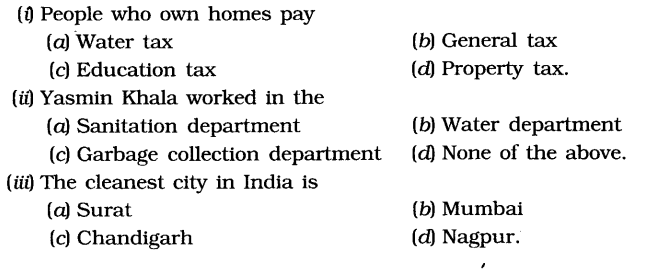
(iv) Which one is not the job of the Municipal Corporation?
(a)It keeps the streets and markets clean.
(b)It makes gardens and maintains them.
(c)It builds hotels for the tourists
(d)It runs schools, hospitals and dispensaries.
(v) The Municipal Council is found in
(a)Big cities (b) Small towns
(c) villages (d) Metropolitan cities.
Ans: (i)—(d), (ii)—(a), (iii)—(c), (iv)—(c), (v)—(b).
FILL IN THE BLANKS
Fill in the blanks with appropriate words to complete each sentence:
(i)Property taxes form only ……………. percent of the money that a Municipal Corporation earns.
(ii) Collecting garbage is quite a………… job.
(iii) The kabadi wallah plays a major role in ………………. household plastic and paper.
(iv) The Ward Councillor is elected by the people of his ………………
(v) Gangabai rushed to the house of………………
Ans: (i) 25-30 (£i) dangerous
(iii) recycling (iv) Ward/area (v) Ward Councillor.
TRUE/FALSE
State whether these sentences are true (T) or false (F).
(i) Gangabai was a timid lady.
(ii) Yasmin Khala was a retired judge.
(iii) Pune, being a big city, has a Municipal Corporation.
(iv) Larger houses have to pay less taxes.
(v) The Commissioner and the administrative staff implement the decisions taken by the Councillor’s Committees and the councillors.
Ans. (i)—F, (ii)—F, (iii)—T, (iv)—F, (v)—T.
MATCHING SKILL
Ans: (i)-c (ii)-e (iii)-a (iv)-b (v)-d
VERY SHORT ANSWER TYPE QUESTIONS
Q1: Who was Yasmin Khala?
Ans: Yasmin Khala was a Municipal Corporation employee.
Q2. What had children done to the street light?
Ans: They had broken the streetlight while playing.
Q3. What did children want to know?
Ans: They wanted to know whom did the lights on the streets belong to.
Q4. Whose duty is it to replace the streetlights?
Ans: It is the duty of the Municipal Corporation of the city to replace the streetlights.
Q5. Who takes decisions like where a park or a new hospital should go?
Ans: The Ward Councillors usually takes such decisions.
Q6. What is the difference between the ward Commissioner and the ward Councillors?[V. Imp.]
Ans: The Commissioner is the body elected by the councillors while the Councillors are elected by the general voters of the world,
Q7. What is a tax? [V. Imp.]
Ans: A tax is a sum of money that people pay to the government for the services the government provides.
Q8. What types of taxes people have to pay?
Ans: People have to pay property tax on their homes as well as taxes for water and other services.
Q9. Name two departments of the Municipal Corporation. [Imp.]
Ans: Water department and garbage collection department,
Q10. What did the Commissioner advise Gangabai?
Ans:The Commissioner advised Gangabai to get a petition signed by all the adults in the locality saying that garbage was not being collected.
Q11. How can common people keep their streets clean?
Ans: They can do this by keeping dustbin/dustbins at home.
SHORT ANSWER TYPE QUESTIONS
Q1. How are complicated decisions taken? Explain with examples. [V. Imp.]
Ans: (Complicated decisions usually affect the entire city and therefore these decisions are taken by groups of Councillors who form committees to decide and debate issue. For example, if bus stands need to be improved or a crowded market place needs to have its garbage cleared more regularly, etc.
Q2. Write a short note on the topic ‘Sub-contracting’. [Imp.]
Ans: In recent times, in order to save money the Commissioners of several municipalities across the country had hired private contractors to collect and process garbage. This is known as Sub-Contracting. This means that the work that was earlier being done by government workers is now being done by a private company or agency. These contract workers get low salary and their jobs are temporary.
LONG ANSWER TYPE QUESTIONS
Q1. Explain the Junctions of the Ward Councillor and the Administrative staff.
Ans: The Ward Councillors are elected members. They are responsible for the welfare of the people of their wards. They listen their problems and get them solved. Sometimes, they have to take complicated decisions that affect the entire city. At such moments, groups of councillors who form committees gather together to decide and debate issues.
While the Councillor’s Committees and the councillors decide on issues, the Commissioner and the administrative staff implement these decisions.
All of the Ward Councillors meet and they make a budget and the money is spent according to this. The Ward Councillors try and ensure that the particular demands of their wards are placed before the entire council. These decisions are then implemented by the administrative staff.