
EXERCISE-12.1
Question 1:The number of girls and boys studying in a class are 25 and 20 respectively.
Calculate the ratio of number of girls to that of boys?
Calculate the ratio of number of girls to that of the total students in the class?
Solution:
Given;
No. of girls = 25
No. of boys = 20
Total number of students studying the class = 25 + 20 = 45
Ratio of no. of girls to boys = 25⁄20 = 5⁄4
Ratio of girls to total students in the class = 25⁄45 = 5⁄9
Question 2: The strength of a class is 40, in which 8 students play football, while 14 others play cricket and all those left over play tennis.
What is the ratio of the students playing football to the students playing tennis?
What is the ratio of the students playing cricket to the strength of the class?
Solution:
Students playing football = 8 students
Students playing cricket = 14 students
Students playing tennis = 40 – (14 + 8) = 18
ratio of the students playing football to the students playing tennis = 8⁄18 = 4⁄9
ratio of the students playing cricket to the strength of the class = 14⁄40 = 7⁄20
Question 3:Observe the following figure and answer the below questions
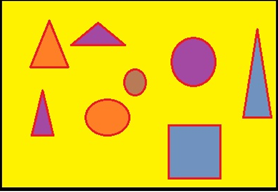
i) Calculate the ratio of triangles to the circles within the rectangle?
ii) Calculate the ratio of squares to the figures of all shapes within the rectangle?
iii) Calculate the ratio of circles to the figures of all shapes within the rectangle?
Solution:
No. of triangles within the rectangle = 4
No. of circles within the rectangle = 3
No. of squares within the rectangle = 1
Total figures = 8
i) Ratio of triangles to the circles = 4⁄3
ii) Ratio of squares to all figures = 1⁄8
iii) Ratio of circles to all figures = 3⁄8
Question 4: Kedhar and Rishab cover a distance of 10 km and 15 km respectively. What is the ratio of Kedhar’s speed to that of Rishab?
Solution:
Distance covered by kedhar in one hour = 10 km
Distance covered by Rishab in one hour = 15 km
Speed of Kedhar = 10 km/h
Speed of Rishab = 15km/h
Ratio of Kedhar’s speed to that of Rishab’s = 10⁄15 = 2⁄3
Questsion 5: Fill in the following boxes
1821 = ⊓⁄7 = 12⁄⊓ = ⊓⁄35
And tell if these ratios are equivalent.
Solution:
18⁄21 = 18÷3⁄21÷3 = 6⁄7
6⁄7 = 6×2⁄7×2 = 12⁄14
6⁄7 = 6×5⁄7×5 = 30⁄35
Thus, 6, 14, 30 are the numbers that are to be filled in three boxes respectively.
Yes, these ratios are equivalent.
Questsion 6: Reduce the following ratios to their lowest terms;
(i) 81 to 108 (ii) 98 to 63
(iii) 33 to 121 (iv) 30 to 45
Solution:
(i) 81⁄108 = 3×3×3×3⁄2×2×3×3×3 = 3⁄4
(ii) 98⁄63 = 14×7⁄9×7 = 14⁄9
(iii) 33⁄121 = 3×11⁄11×11 =3⁄11
(iv) 40⁄35 = 2×3×5⁄3×3×5 =2⁄3
Questsion 7: Fathima’s salary is Rs. 2,00,000 per annum and out of which she saves 75,000.
i) Calculate the ratio of Seema’s earnings to her savings
ii) Calculate the ratio of Seema’s savings to her expenditure
Solution:
Income = Rs 2,00,000
Savings = Rs 75,000
Expenditure = Rs 1,25,000
i) Ratio of Seema’s earnings to her savings = 2,00,000⁄75,000 = 8⁄3
ii) ratio of Seema’s savings to her expenditure = 75,0001⁄25,000 = 3⁄5
Questsion 8: 3852 pupil studies in a school which has 154 teachers. Calculate the ratio of teachers to the students?
Solution:
Ratio of teachers to students = 154⁄3850 = 2×11×7⁄2×11×175 = 7⁄175
Questsion 9: There are 5852 students in a school, out of which 3800 are girls. Calculate the ratio of
i) Girls to total students in school
ii) Boys to girls in school
iii) Boys to total students in school
Solution:
Number of students in school = 5852
Girls in school = 3800
Boys in school = 5852 – 3800 = 2052
i) Required ratio = 3800⁄5852 = 1900⁄2926 = 100⁄154 = 50⁄77
ii) Required ratio = 2052⁄3800 = 1026⁄1900 = 513⁄950 = 27⁄50
iii) Required ratio = 2052⁄5852 = 27⁄77
Questsion 10: Calculate the ratio for the given
i) 30 seconds to 1.5 minutes ii) 40 cg to 1.5 g
iii) 55 paise to 1 rupee iv) 500 mm to 2 m
Solution:
i) 1.5 minutes = 90 seconds
∴ Required ratio = 30⁄90 = 1⁄3
ii) 1.5 gram = 150 gram
∴ Required ratio = 40⁄150 = 4⁄15
iii) 1 rupee = 100 paise
∴ Required ratio = 55⁄100 = 11⁄20
iv) 2 m = 2000 mm
∴ Required ratio = 500⁄2000 = 1⁄4
Questsion 11: A college comprises of 1800 pupil. Among those 750 prefer hockey , 800 prefer football and remaining students prefer basketball. If only one game can be preferred by a student, what is the ratio of
i) Students who prefer hockey to students who prefer basketball
ii) Students who prefer football to students who prefer hockey
iii) Students who prefer hockey to the total number of students
Solution:
i) The ratio required is 750⁄250 = 3⁄1
ii) The ratio required is 800⁄750 = 16⁄15
iii) The ratio required is 750⁄1800 = 5⁄12
Questsion 12:The price of a dozen pens is 216 and the price of 8 pencils is 64. Calculate the ratio of the price of a pen to the price of a pencil?
Solution:
Dozen pens cost 216. Therefore, cost of one pen = 216⁄12 = 18
8 pencils cost 64. Therefore, cost of one pencil = 64⁄8 = 8
Ratio of the price of a pen to the price of a pencil = 18⁄8 = 9⁄4
∴ Required ratio =9⁄4
Questsion 13: The length and breadth of a box are in a ratio of 6:3. Fill in the emply blanks and find the possible lengths and breadths of the box?
| Length of the box | 30 | 60 | |
| Breadth of the box | 15 | 60 |
Solution:
Ratio of length to breadth = 6:3 = 6⁄3
Therefore, their equivalent ratios are = 6⁄3 × 10⁄10 = 60⁄30 = 6⁄3 × 20⁄20 = 120⁄60
| Length of the box | 30 | 60 | 120 |
| Breadth of the box | 15 | 30 | 60 |
Questsion 14:How can 20 pens be divided between Sujay and Ram the ratio of 4:1?
Solution:
Ratio between Sujay and ram = 4:1
Total value = 4+1 = 5
Therefore, Sujay’s part of total pencils = 4⁄5
Ram’s part of total pencils = 1⁄5
Thus, Pencils with Sujay = 4⁄5 × 20 = 16 pencils
Pencils with Ram = 1⁄5 × 20 = 4 pencils
Questsion 15: Sneha and Radhika decide to divide 35 candies between them in the ratio of their ages. If Sneha and Radhika are 16 and 12 years old respectively, find how many candies Sneha and Radhika get.
Solution:
Ratio of Sneha’s age to Radhika’s age = 16⁄12 = 4⁄3
Total value = 4+3 = 7
Candies received by Sneha = 4⁄7 * 35 = 20
Candies received by Radhika = 3⁄7 * 35 = 15
Questsion 16: The present age of a son and his father is 15 and 60 years respectively. Calculate the ratio of
i) Current age of father to that of his son
ii) Age of father to that of his son, when son was 9 years old
iii) Age of father to that of his son 10 years later
iv) Age of father to that of his son, when the father was 50 years old.
Solution:
i) Required ratio = 60⁄15 =4⁄1
ii) Required ratio = 54⁄9 = 6⁄1
iii) Required ratio =70⁄25 = 14⁄5
iv) Required ratio =50⁄5 = 10⁄1
Exercise 12.2
Questsion 1: Find whether the following set of numbers are in proportion.
i) 15, 45, 40, 120 ii) 33, 121, 9, 96
iii) 4, 6, 8, 12 iv) 33, 44, 75, 100
Solution:
i) 15, 45, 40, 120
15⁄45= 1⁄3 40⁄120= 1⁄3
∴ 15, 45, 40, 120 are in proportion.
ii) 33, 121, 9, 96
33⁄121 =3⁄11 9⁄96 =3⁄32
∴ 33, 121, 9, 96 are not in proportion.
iii) 4, 6, 8, 12
4⁄6 =2⁄3 8⁄12 =2⁄3
∴ 4, 6, 8, 12 are in proportion.
iv) 33, 44, 75, 100
33⁄44 = 3⁄4 75⁄100 =3⁄4
∴ 33, 44, 75, 100 are in proportion.
Questsion 2: State whether the following statements are true or false.
i) 16:24::20:30 ii) 21:6::35:10
iii)12:18::28:12 iv) 8:9::24:27
v) 5.2:3.9::3:4 vi) 0.9:0.36::10:4
Solution:
i) 16⁄24 = 2⁄3
20⁄30 = 2⁄3
∴ 16⁄24 = 20⁄30
∴ True
ii) 21⁄6 = 7⁄2
35⁄10 = 7⁄2
∴ 21⁄6 = 35⁄10
∴ True
iii) 12⁄18 = 2⁄3
28⁄12 = 7⁄3
∴ 12⁄18 ≠ 28⁄12
∴ False
iv) 24⁄27 = 8⁄9
∴ True
v) 5.2⁄3.9 = 4⁄3
∴ 4⁄3 ≠ 3⁄4
∴ False
vi) 0.9⁄0.36 = 90⁄36 = 10⁄4
∴ True
b) 90 litres: 15 litres = 30kg: 5kg
Solution:
⇒90⁄15 = 6⁄1
Similarly
⇒30⁄5 = 6⁄1
Both are equal so the statement is true
c) 99 persons: 66 persons = 33 kg: 22kg
Solution:
⇒99⁄66 = 3⁄2
Similarly
⇒ 33⁄22 = 3⁄2
Both are equal so the statement is true
d) 8 m: 24m = 11kg: 33kg
Solution:
⇒ 8⁄24 = 1⁄3
Similarly
⇒11⁄33 = 1⁄3
Both are equal so the statement is true
e) 32 kg: 64kg = 44m: 20m
Solution:
⇒32⁄64 = 1⁄2
Similarly
⇒44⁄20 = 11⁄5
Both are not equal so the statement is false
Questsion 4: Check whether the given ratios form a proportion. Also, write the middle terms and extreme terms where the ratios form a proportion
a) 50cm: 2m and Rs.60: Rs.240
Solution:
1m = 100cm
So, 2m = 200cm
⇒ 50⁄200 = 1⁄4
Similarly
⇒ 60⁄240 = 1⁄4
The ratios are equal and therefore these are in proportion
Middle terms = 200cm, Rs.60
Extreme terms = 50cm, Rs.240
b) 26litres: 39litres and 8bottles: 12bottles
Solution:
⇒ 26⁄39 = 2⁄3
Similarly
⇒8⁄12 = 2⁄3
The ratios are equal and therefore these are in proportion
Middle terms = 39litres, 8bottles
Extreme terms = 26litres, 12bottles
c) 4kg: 40kg and 15g: 225g
Solution:
⇒ 4⁄40 = 1⁄10
Similarly
⇒ 15⁄225 = 1⁄15
The ratios are not equal and therefore these are not in proportion
d) 4 persons: 42 persons and Rs.8: Rs.84
Solution:
⇒ 4⁄42 = 2⁄21
Similarly
⇒8⁄84 = 2⁄21
The ratios are equal and therefore these are in proportion
Middle terms = 42 persons , Rs.8
Extreme terms = 4 persons, Rs.84
EXERCISE-12.3
Questsion 1:The price of a 8 m long cloth is Rs.288. Determine the price of 5 m long cloth.
Solution:
Price of 8 m long cloth = Rs.288
Price of 1 m long cloth =288⁄8 = Rs.36
Therefore, the price of 5 m long cloth = 36 x 5 = Rs.180
Questsion 2:How much does Laura earn in 30 days if her earnings for 10 days is Rs.2500?
Solution:
Her earning for 10 days = Rs. 2500
Her earning for 1 day = 2500⁄10 = Rs.250
Therefore, her earning in 30 days = 250 x 30 = Rs.7500
Questsion 4: The price of 6 kg of rice is Rs.36. Determine
(a) the cost of 9 kg of rice.
(b) the quantity of rice that can be purchased for Rs.51.
Solution:
(a) Price of 6 kg rice = Rs.36
Cost of 1kg rice = 36⁄6 = Rs.6
Therefore, the cost of 9 kg rice = 6 x 9 = Rs.54
(b) Rice bought for Rs.36 = 6 kg
Rice bought for Re.1 =6⁄36 kg
Therefore, rice purchased for Rs.51 = 6⁄36 ×51 = 8.5 kg
Questsion 5: Over last 30 days, the temperature dropped 45 degree Celsius. If the temperature drops at the same rate in the next 10 days, how much is the cumulative temperature drop?
Solution:
Temperature drop in 30 days = 450C
Temperature drop in one day = 4530 = 1.50C
Therefore, the temperature drop in next 10 days = 1.5 x 10 = 150C
So, there will be 15oC drop in the temperature in next 10 days.
Questsion 6: How much does Deepak have to pay rent for a whole year, if he pays Rs.6000 for 3 months?
Solution:
Rent for 3 months = Rs.6000
Rent for 1 month = 6000⁄3 = Rs.2000
Therefore, rent for 12 months = 2000 x 12 = 24000
She has to pay Rs.24000 for a whole year.
Questsion 7: 5 dozens of apple cost Rs.60. How many apples do you think can you buy with Rs.15?
Solution:
Number of apples bought with Rs.60 = 5 dozens = 12 x 5 dozens = 60
Number of apples bought with Re.1 = 60⁄60 = 1
So, the number of apples that can be bought with Rs.15 = 15 x 1 = 15
5 apples can be bought with Rs.15
Questsion 8: 72 books weigh 9 kg. What would be the weight of 40 books?
Solution:
Weight of 72 books = 9 kg
So, 1 book weight =9⁄72 = 1⁄8 kg
So, 40 books would weight = 1⁄8 × 40 = 5kg
Thus, 40 books weight 5 kg.
Questsion 9: To cover a distance of 594 km, a truck requires 108 liters of diesel. How many liters of fuel is required to cover a distance of 1650 km?
Solution:
Diesel needed for 594 km = 108 litres
Diesel needed for 1 km = 108⁄594= 2⁄11 litre
So, the diesel needed for 1650 km = 2⁄11 ×1650=300 liters
Thus, to cover a distance of 1650 km, 300 liters of fuel is required.
Question 10: Ramu buys 15 pens for Rs.150 and Manush buys 8 pens for Rs.64. Among both, who bought the pen for cheaper price?
Solution:
Ramu bought 15 pens for Rs.150
Therefore, Cost of 1 pen = 150⁄15 = Rs.15
Manush bought 8 pens for Rs.64
Therefore, price of 1 pen = 64⁄8 = Rs.8
So, Manush got the pens cheaper.
Question 11:Rahul scored 42 runs in 6 overs and Anuj scored 63 runs in 7 overs. Who scored maximum runs per over?
Solution:
Runs scored by Rahul in 6 overs = 42
Therefore, Rahul’s runs per over = 42⁄6 =7
Runs scored by Anuj in 7 overs = 63
Therefore, Anuj’s runs per over = 63⁄7 = 9
Obviously, Anuj scored more runs per over than Rahul.