
Exercise 4.1 : Solutions of Questions on Page Number : 60
Q1 : Construct the following quadrilaterals.
(i) Quadrilateral ABCD
AB = 4.5 cm
BC = 5.5 cm
CD = 4 cm
AD = 6 cm
AC = 7 cm
(ii) Quadrilateral JUMP
JU = 3.5 cm
UM = 4 cm
MP = 5 cm
PJ = 4.5 cm
PU = 6.5 cm
(iii) Parallelogram MORE
OR = 6 cm
RE = 4.5 cm
EO = 7.5 cm
(iv) Rhombus BEST
BE = 4.5 cm
ET = 6 cm
Answer :
(i) Firstly, a rough sketch of this quadrilateral can be drawn as follows.
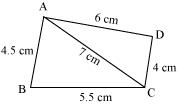
(1) ΔABC can be constructed by using the given measurements as follows.

(2) Vertex D is 6 cm away from vertex A. Therefore, while taking A as centre, draw an arc of radius 6 cm.

(3) Taking C as centre, draw an arc of radius 4 cm, cutting the previous arc at point D. Join D to A and C.
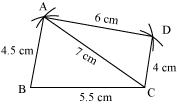
ABCD is the required quadrilateral.
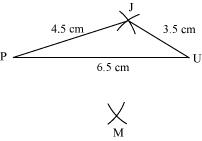
(ii)Firstly, a rough sketch of this quadrilateral can be drawn as follows.
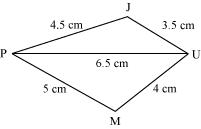
(1) Δ JUP can be constructed by using the given measurements as follows.
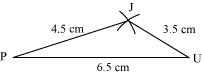
(2) Vertex M is 5 cm away from vertex P and 4 cm away from vertex U. Taking P and U as centres, draw arcs of radii 5 cm and 4 cm respectively. Let the point of intersection be M.
(3) Join M to P and U.
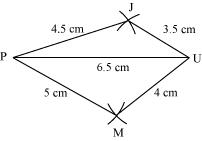
JUMP is the required quadrilateral.
(iii)We know that opposite sides of a parallelogram are equal in length and also these are parallel to each other.
Hence, ME = OR, MO = ER
A rough sketchof this parallelogram can be drawn as follows.
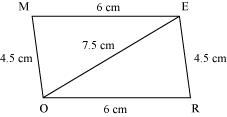
(1) Δ EOR can beconstructed by using the given measurements as follows.

(2) Vertex M is 4.5 cm away from vertex O and 6 cm away from vertex E. Therefore, while taking O and E as centres, draw arcs of 4.5 cm radius and 6 cm radius respectively. These will intersect each other at point M.

(3) Join M to O and E.

MORE is the required parallelogram.
(iv)We know that all sides of a rhombus are of the same measure.
Hence, BE = ES = ST = TB
A rough sketch of this rhombus can be drawn as follows.
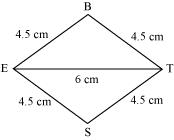
(1) Δ BET can be constructed by using the given measurements as follows.

(2) Vertex S is 4.5 cm away from vertex E and also from vertex T. Therefore, while taking E and T as centres, draw arcs of 4.5 cm radius, which will be intersecting each other at point S.
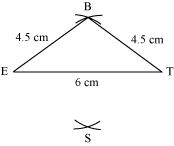 (3)Join S to E and T
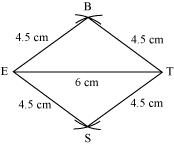 BEST is the require rhombus
Exercise 4.2 : Solutions of Questions on Page Number : 62
Q1 : Construct the following quadrilaterals.
(i) Quadrilateral LIFT
LI = 4 cm
IF = 3 cm
TL = 2.5 cm
LF = 4.5 cm
IT = 4 cm
(ii) Quadrilateral GOLD
OL = 7.5 cm
GL = 6 cm
GD = 6 cm
LD = 5 cm
OD = 10 cm
(iii) Rhombus BEND
BN = 5.6 cm
DE = 6.5 cm
Answer :
(i) A rough sketch of this quadrilateral can be drawn as follows.
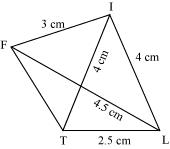
(1) Δ ITL can be constructed by using the given measurements as follows.
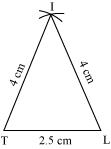
(2) Vertex F is 4.5 cm away from vertex L and 3 cm away from vertex I. Therefore, while taking L and I as centres, draw arcs of 4.5 cm radius and 3 cm radius respectively, which will be intersecting each other at point F.
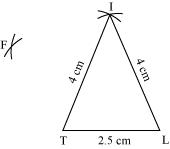
(3) Join F to T and F to I.
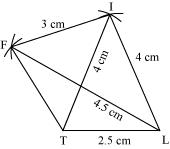
LIFT is the required quadrilateral.
(ii)A rough sketch of this quadrilateral can be drawn as follows.
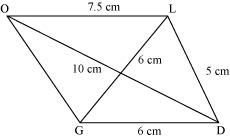
(1) Δ GDL can be constructed by using the given measurements as follows.
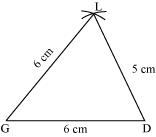
(2) Vertex O is 10 cm away from vertex D and 7.5 cm away from vertex L. Therefore, while taking D and L as centres, draw arcs of 10 cm radius and 7.5 cm radius respectively. These will intersect each other at point O.

(3) Join O to G and L.

GOLD is the required quadrilateral.
(iii) We know that the diagonals of a rhombus always bisect each other at 90º. Let us assume that these are intersecting each other at point O in this rhombus.
Hence, EO = OD = 3.25 cm
A rough sketch of this rhombus can be drawn as follows.

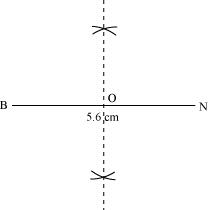
(1) Draw a line segment BN of 5.6 cm and also draw its perpendicular bisector. Let it intersect the line segment BN at point O.
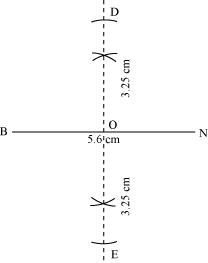
(2) Taking O as centre, draw arcs of 3.25 cm radius to intersect the perpendicular bisector at point D and E.
(3) Join points D and E to points B and N.
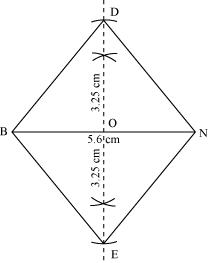
BEND is the required quadrilateral.
Exercise 4.3 : Solutions of Questions on Page Number : 64
Q1 : Construct the following quadrilaterals.
(i) Quadrilateral MORE
MO = 6 cm
OR = 4.5 cm
∠ M = 60°
∠ O = 105°
∠ R = 105°
(ii) Quadrilateral PLAN
PL = 4 cm
LA = 6.5 cm
∠ P = 90°
∠ A = 110°
∠ N = 85°
(iii) Parallelogram HEAR
HE = 5 cm
EA = 6 cm
∠ R = 85°
(iv) Rectangle OKAY
OK = 7 cm
KA = 5 cm
Answer :
(i)
(1)A rough sketch of this quadrilateral can be drawn as follows.
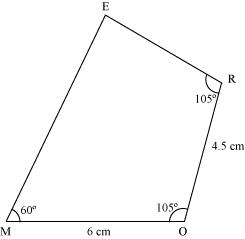
(2) Draw a line segment MO of 6 cm and an angle of 105º at point O. As vertex R is 4.5 cm away from the vertex O, cut a line segment OR of 4.5 cm from this ray.

(3) Again, draw an angle of 105º at point R.
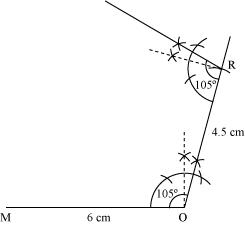
(4) Draw an angle of 60º at point M. Let this ray meet the previously drawn ray from R at point E.

MORE is the required quadrilateral.
(ii)
(1)The sum of the angles of a quadrilateral is 360°.
In quadrilateral PLAN, ∠ P + ∠ L + ∠ A + ∠ N = 360°
90° + ∠ L + 110° + 85° = 360°
285° + ∠ L = 360°
∠ L = 360° – 285° = 75°
(2)A rough sketch of this quadrilateral is as follows.

(3) Draw a line segment PL of 4 cm and draw an angle of 75º at point L. As vertex A is 6.5 cm away from vertex L, cut a line segment LA of 6.5 cm from this ray.

(4) Again draw an angle of 110º at point A.
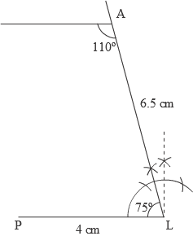
(5) Draw an angle of 90º at point P. This ray will meet the previously drawn ray from A at point N.
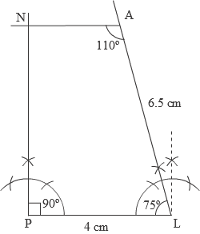
PLAN is the required quadrilateral.
(iii)
(1)Firstly, a rough sketch of this quadrilateral is as follows.
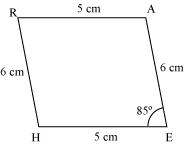
(2) Draw a line segment HE of 5 cm and an angle of 85º at point E. As vertex A is 6 cm away from vertex E, cut a line segment EA of 6 cm from this ray.

(3) Vertex R is 6 cm and 5 cm away from vertex H and A respectively. By taking radius as 6 cm and 5 cm, draw arcs from point H and A respectively. These will be intersecting each other at point R.

Join R to H and A.
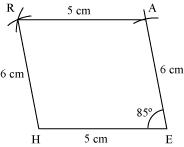
HEAR is the required quadrilateral.
(iv)
(1)A rough sketch of this quadrilateral is drawn as follows.

(2) Draw a line segment OK of 7 cm and an angle of 90º at point K. As vertex A is 5 cm away from vertex K, cut a line segment KA of 5 cm from this ray.
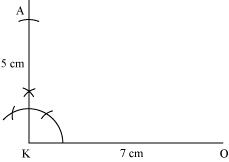
(3) Vertex Y is 5 cm and 7 cm away from vertex O a
 (4) Join Y to A and O.
 OKAY is the require quardrilateral.
Exercise 4.4 : Solutions of Questions on Page Number : 67
Q1 : Construct the following quadrilaterals,
(i) Quadrilateral DEAR
DE = 4 cm
EA = 5 cm
AR = 4.5 cm
∠ E = 60°
∠ A = 90°
(ii) Quadrilateral TRUE
TR = 3.5 cm
RU = 3 cm
UE = 4 cm
∠ R = 75°
∠ U = 120°
Answer :
(i)
(1)A rough sketch of this quadrilateral can be drawn as follows.
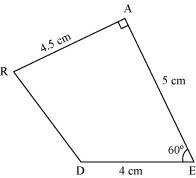
(2) Draw a line segment DE of 4 cm and an angle of 60º at point E. As vertex A is 5 cm away from vertex E, cut a line segment EA of 5 cm from this ray.

(3) Again draw an angle of 90º at point A. As vertex R is 4.5 cm away
from vertex A, cut a line segment RA of 4.5 cm from this ray.

(4) Join D to R.
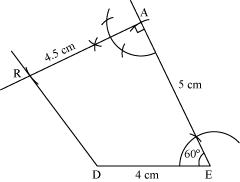
DEAR is the required quadrilateral.
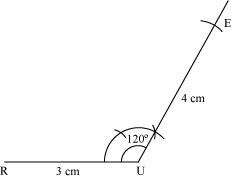
(ii)
(1)A rough sketch of this quadrilateral can be drawn as follows.

(2) Draw a line segment RU of 3 cm and an angle of 120º at point U. As vertex E is 4 cm away from vertex U, cut a line segment UE of 4 cm
from this ray.
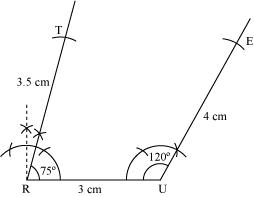
(3) Next, draw an angle of 75º at point R. As vertex T is 3.5 cm away from vertex R, cut a line segment RT of 3.5 cm from this ray.
(4) Join T to E.
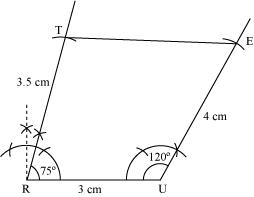
TRUE is the required quadrilateral.
Exercise 4.5 : Solutions of Questions on Page Number : 68
Q1 : Draw the following:
The square READ with RE = 5.1 cm
Answer :
All the sides of a square are of the same measure and also all the interior angles of a square are of 90º measure. Therefore, the given square READ can be drawn as follows.
(1)A rough sketch of this square READ can be drawn as follows.
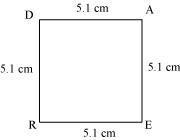
(2) Draw a line segment RE of 5.1 cm and an angle of 90º at point R and E.

(3) As vertex A and D are 5.1 cm away from vertex E and R respectively, cut line segments EA and RD, each of 5.1 cm from these rays.

(4) Join D to A.
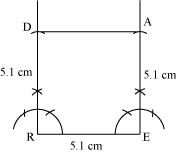
READ is the required square.
Q2 : Draw the following:
A rhombus whose diagonals are 5.2 cm and 6.4 cm long.
Answer :
In a rhombus, diagonals bisect each other at 90 º. Therefore, the given rhombus ABCD can be drawn as follows.
(1)A rough sketch of this rhombus ABCD is as follows.
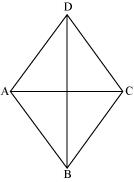
(2) Draw a line segment AC of 5.2 cm and draw its perpendicular bisector. Let it intersect the line segment AC at point O.
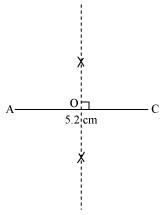
(3) Draw arcs of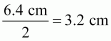 on both sides of this perpendicular bisector. Let the arcs intersect the perpendicular bisector at point B and D.
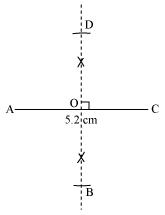
(4) Join points B and D with points A and C.
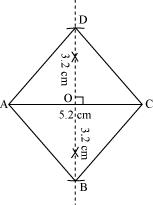
ABCD is the required rhombus.
Q3 : Draw the following:
A rectangle with adjacent sides of length 5 cm and 4 cm.
Answer :
Opposite sides of a rectangle have their lengths of same measure and also, all the interior angles of a rectangle are of 90º measure. The given rectangle ABCD may be drawn as follows.
(1)A rough sketch of this rectangle ABCD can be drawn as follows.
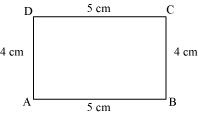
(2) Draw a line segment AB of 5 cm and an angle of 90º at point A and B.

(3) As vertex C and D are 4 cm away from vertex B and A respectively, cut line segments AD and BC, each of 4 cm, from these rays.

(4) Join D to C.

ABCD is the required rectangle.
Q4 : Draw the following:
A parallelogram OKAY where OK = 5.5 cm and KA = 4.2 cm.
Answer :
Opposite sides of a parallelogram are equal and parallel to each other. The given parallelogram OKAY can be drawn as follows.
(1)A rough sketch of this parallelogram OKAY is drawn as follows.
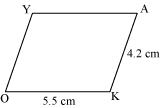
(2) Draw a line segment OK of 5.5 cm and a ray at point K at a convenient angle.

(3) Draw a ray at point O parallel to the ray at K. As the vertices, A and Y, are 4.2 cm away from the vertices K and O respectively, cut line segments KA and OY, each of 4.2 cm, from these rays.

(4) Join Y to A.

OKAY is the required parallelogram.