Exercise 11.1 : Solutions of Questions on Page Number : 191
Q1 : Construct an angle of 90° at the initial point of a given ray and justify the construction.
Answer :
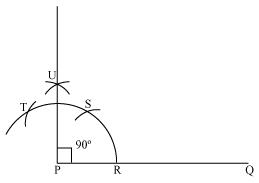
The below given steps will be followed to construct an angle of 90°.
(i) Take the given ray PQ. Draw an arc of some radius taking point P as its centre, which intersects PQ at R.
(ii) Taking R as centre and with the same radius as before, draw an arc intersecting the previously drawn arc at S.
(iii) Taking S as centre and with the same radius as before, draw an arc intersecting the arc at T (see figure).
(iv) Taking S and T as centre, draw an arc of same radius to intersect each other at U.
(v) Join PU, which is the required ray making 90° with the given ray PQ.
Justification of Construction:
We can justify the construction, if we can prove ∠UPQ = 90°.
For this, join PS and PT.
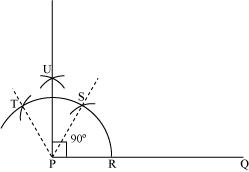
We have, ∠SPQ = ∠TPS = 60°. In (iii) and (iv) steps of this construction, PU was drawn as the bisector of ∠TPS.
∴ ∠UPS = ∠TPS
∠TPS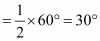
Also, ∠UPQ = ∠SPQ + ∠UPS
= 60° + 30°
= 90°
Q2 : Construct an angle of 45° at the initial point of a given ray and justify the construction.
Answer :
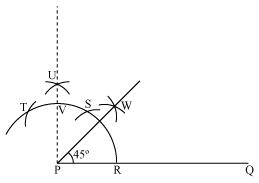
The below given steps will be followed to construct an angle of 45°.
(i) Take the given ray PQ. Draw an arc of some radius taking point P as its centre, which intersects PQ at R.
(ii) Taking R as centre and with the same radius as before, draw an arc intersecting the previously drawn arc at S.
(iii) Taking S as centre and with the same radius as before, draw an arc intersecting the arc at T (see figure).
(iv) Taking S and T as centre, draw an arc of same radius to intersect each other at U.
(v) Join PU. Let it intersect the arc at point V.
(vi) From R and V, draw arcs with radius more than RV to intersect each other at W. Join PW.
PW is the required ray making 45° with PQ.
Justification of Construction:
We can justify the construction, if we can prove ∠WPQ = 45°.
For this, join PS and PT.
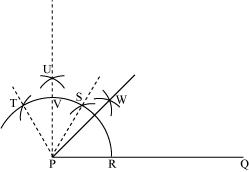
We have, ∠SPQ = ∠TPS = 60°. In (iii) and (iv) steps of this construction, PU was drawn as the bisector of ∠TPS.
∴ ∠UPS = ∠TPS
Also, ∠UPQ = ∠SPQ + ∠UPS
= 60° + 30°
= 90°
In step (vi) of this construction, PW was constructed as the bisector of ∠UPQ.
∴ ∠WPQ = ∠UPQ
Q3 : Construct the angles of the following measurements:
(i) 30° (ii) (iii) 15°
Answer :
(i)30°
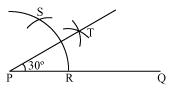
The below given steps will be followed to construct an angle of 30°.
Step I: Draw the given ray PQ. Taking P as centre and with some radius, draw an arc of a circle which intersects PQ at R.
Step II: Taking R as centre and with the same radius as before, draw an arc intersecting the previously drawn arc at point S.
Step III: Taking R and S as centre and with radius more than RS, draw arcs to intersect each other at T. Join PT which is the required ray making 30° with the given ray PQ.
(ii)
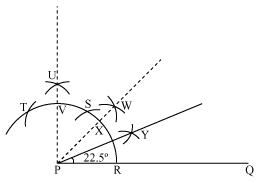
The below given steps will be followed to construct an angle of.
(1) Take the given ray PQ. Draw an arc of some radius, taking point P as its centre, which intersects PQ at R.
(2) Taking R as centre and with the same radius as before, draw an arc intersecting the previously drawn arc at S.
(3) Taking S as centre and with the same radius as before, draw an arc intersecting the arc at T (see figure).
(4) Taking S and T as centre, draw an arc of same radius to intersect each other at U.
(5) Join PU. Let it intersect the arc at point V.
(6) From R and V, draw arcs with radius more than RV to intersect each other at W. Join PW.
(7) Let it intersect the arc at X. Taking X and R as centre and radius more than RX, draw arcs to intersect each other at Y.
Joint PY which is the required ray making with the given ray PQ.
(iii) 15°
The below given steps will be followed to construct an angle of 15°.
Step I: Draw the given ray PQ. Taking P as centre and with some radius, draw an arc of a circle which intersects PQ at R.
Step II: Taking R as centre and with the same radius as before, draw an arc intersecting the previously drawn arc at point S.
Step III: Taking R and S as centre and with radius more than RS, draw arcs to intersect each other at T. Join PT.
Step IV: Let it intersect the arc at U. Taking U and R as centre and with radius more than RU, draw an arc to intersect each other at V. Join PV which is the required ray making 15° with the given ray PQ.
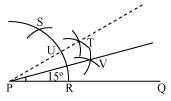
Q4 : Construct the following angles and verify by measuring them by a protractor:
(i) 75° (ii) 105° (iii) 135°
Answer :
(i) 75°
The below given steps will be followed to construct an angle of 75°.
(1) Take the given ray PQ. Draw an arc of some radius taking point P as its centre, which intersects PQ at R.
(2) Taking R as centre and with the same radius as before, draw an arc intersecting the previously drawn arc at S.
(3) Taking S as centre and with the same radius as before, draw an arc intersecting the arc at T (see figure).
(4) Taking S and T as centre, draw an arc of same radius to intersect each other at U.
(5) Join PU. Let it intersect the arc at V. Taking S and V as centre, draw arcs with radius more than SV. Let those intersect each other at W. Join PW which is the required ray making 75° with the given ray PQ.
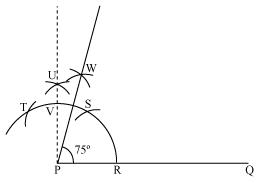
The angle so formed can be measured with the help of a protractor. It comes to be 75 º.
(ii) 105°
The below given steps will be followed to construct an angle of 105°.
(1) Take the given ray PQ. Draw an arc of some radius taking point P as its centre, which intersects PQ at R.
(2) Taking R as centre and with the same radius as before, draw an arc intersecting the previously drawn arc at S.
(3) Taking S as centre and with the same radius as before, draw an arc intersecting the arc at T (see figure).
(4) Taking S and T as centre, draw an arc of same radius to intersect each other at U.
(5) Join PU. Let it intersect the arc at V. Taking T and V as centre, draw arcs with radius more than TV. Let these arcs intersect each other at W. Join PW which is the required ray making 105° with the given ray PQ.
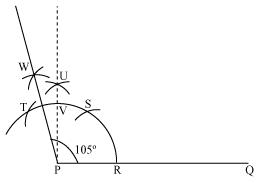
The angle so formed can be measured with the help of a protractor. It comes to be 105 º.
(iii) 135°
The below given steps will be followed to construct an angle of 135°.
(1) Take the given ray PQ. Extend PQ on the opposite side of Q. Draw a semi-circle of some radius taking point P as its centre, which intersects PQ at R and W.
(2) Taking R as centre and with the same radius as before, draw an arc intersecting the previously drawn arc at S.
(3) Taking S as centre and with the same radius as before, draw an arc intersecting the arc at T (see figure).
(4) Taking S and T as centre, draw an arc of same radius to intersect each other at U.
(5) Join PU. Let it intersect the arc at V. Taking V and W as centre and with radius more than VW, draw arcs to intersect each other at X. Join PX, which is the required ray making 135°with the given line PQ.
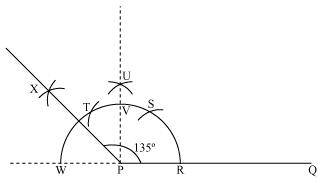
The angle so formed can be measured with the help of a protractor. It comes to be 135 º.
Q5 : Construct an equilateral triangle, given its side and justify the construction
Answer :
Let us draw an equilateral triangle of side 5 cm. We know that all sides of an equilateral triangle are equal. Therefore, all sides of the equilateral triangle will be 5 cm. We also know that each angle of an equilateral triangle is 60º.
The below given steps will be followed to draw an equilateral triangle of 5 cm side.
Step I: Draw a line segment AB of 5 cm length. Draw an arc of some radius, while taking A as its centre. Let it intersect AB at P.
Step II: Taking P as centre, draw an arc to intersect the previous arc at E. Join AE.
Step III: Taking A as centre, draw an arc of 5 cm radius, which intersects extended line segment AE at C. Join AC and BC. ΔABC is the required equilateral triangle of side 5 cm.
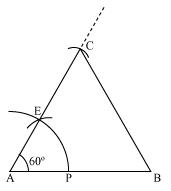
Justification of Construction:
We can justify the construction by showing ABC as an equilateral triangle i.e., AB = BC = AC = 5 cm and ∠ A = ∠ B = ∠ C = 60°.
In ΔABC, we have AC = AB = 5 cm and ∠ A = 60°.
Since AC = AB,
∠ B = ∠ C (Angles opposite to equal sides of a triangle)
In ΔABC,
∠ A + ∠ B + ∠ C = 180° (Angle sum property of a triangle)
⇒ 60° + ∠ C + ∠ C = 180°
⇒ 60° + 2 ∠ C = 180°
⇒ 2 ∠ C = 180° – 60° = 120°
⇒ ∠ C = 60°
∴ ∠ B = ∠ C = 60°
We have, ∠ A = ∠ B = ∠ C = 60° … (1)
⇒ ∠ A = ∠ B and ∠ A = ∠ C
⇒ BC = AC and BC = AB (Sides opposite to equal angles of a triangle)
⇒ AB = BC = AC = 5 cm … (2)
From equations (1) and (2), ΔABC is an equilateral triangle.
Exercise 11.2 : Solutions of Questions on Page Number : 195
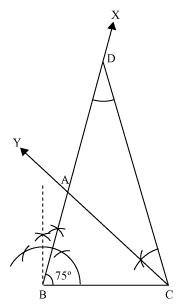
Q1 : Construct a triangle ABC in which BC = 7 cm, ∠ B = 75° and AB + AC = 13 cm.
Answer :
The below given steps will be followed to construct the required triangle.
Step I: Draw a line segment BC of 7 cm. At point B, draw an angle of 75°, say ∠ XBC.
Step II: Cut a line segment BD = 13 cm (that is equal to AB + AC) from the ray BX.
Step III: Join DC and make an angle DCY equal to ∠ BDC.
Step IV: Let CY intersect BX at A. ΔABC is the required triangle.
Q2 : Construct a triangle ABC in which BC = 8 cm, ∠ B = 45° and AB – AC = 3.5 cm.
Answer :
The below given steps will be followed to draw the required triangle.
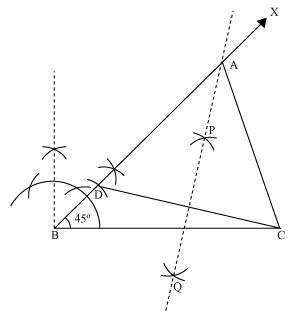
Step I: Draw the line segment BC = 8 cm and at point B, make an angle of 45°, say ∠ XBC.
Step II: Cut the line segment BD = 3.5 cm (equal to AB – AC) on ray BX.
Step III: Join DC and draw the perpendicular bisector PQ of DC.
Step IV: Let it intersect BX at point A. Join AC. ΔABC is the required triangle.
Q3 : Construct a triangle PQR in which QR = 6 cm, ∠ Q = 60° and PR – PQ = 2 cm
Answer :
The below given steps will be followed to construct the required triangle.
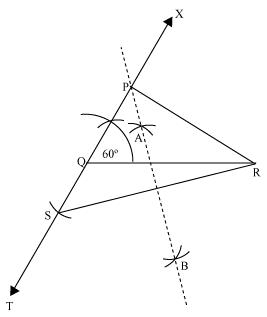
Step I: Draw line segment QR of 6 cm. At point Q, draw an angle of 60°, say ∠ XQR.
Step II: Cut a line segment QS of 2 cm from the line segment QT extended in the opposite side of line segment XQ. (As PR > PQ and PR – PQ = 2 cm). Join SR.
Step III: Draw perpendicular bisector AB of line segment SR. Let it intersect QX at point P. Join PQ, PR.
ΔPQR is the required triangle.
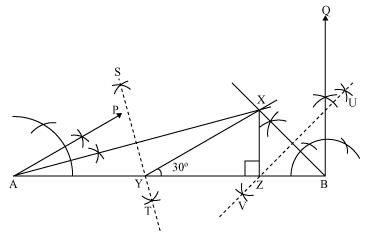
Q4 : Construct a triangle XYZ in which ∠ Y = 30°, ∠ Z = 90° and XY + YZ + ZX = 11 cm.
Answer :
The below given steps will be followed to construct the required triangle.
Step I: Draw a line segment AB of 11 cm.
(As XY + YZ + ZX = 11 cm)
Step II: Construct an angle, ∠ PAB, of 30° at point A and an angle, ∠ QBA, of 90° at point B.
Step III: Bisect ∠ PAB and ∠ QBA. Let these bisectors intersect each other at point X.
Step IV: Draw perpendicular bisector ST of AX and UV of BX.
Step V: Let ST intersect AB at Y and UV intersect AB at Z.
Join XY, XZ.
ΔXYZ is the required triangle.
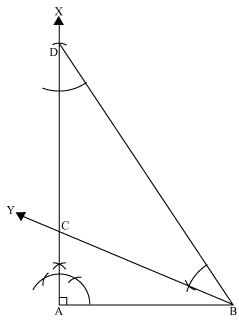
Q5 : Construct a right triangle whose base is 12 cm and sum of its hypotenuse and other side is 18 cm.
Answer :
The below given steps will be followed to construct the required triangle.
Step I: Draw line segment AB of 12 cm. Draw a ray AX making 90° with AB.
Step II: Cut a line segment AD of 18 cm (as the sum of the other two sides is 18) from ray AX.
Step III: Join DB and make an angle DBY equal to ADB.
Step IV: Let BY intersect AX at C. Join AC, BC.
ΔABC is the required triangle.